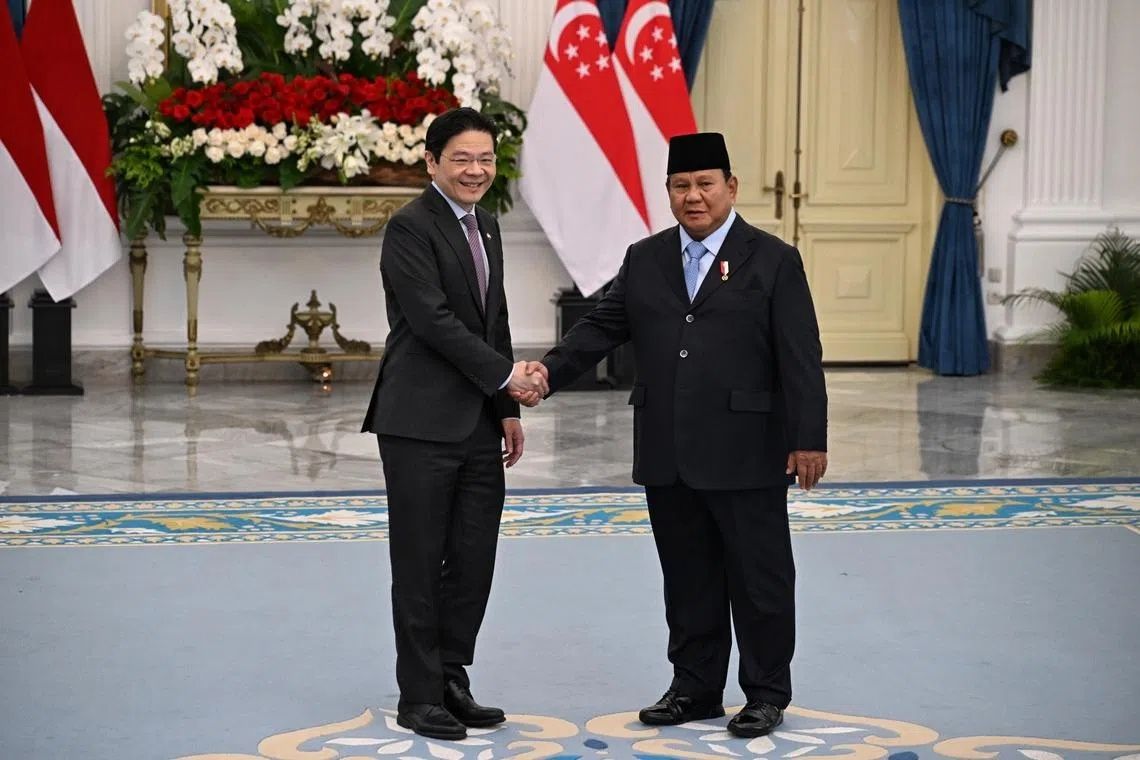
Singapore and Indonesia have reaffirmed their resolve to maintain the Strait of Malacca as an unrestricted maritime passage, placing bilateral security cooperation at the heart of their relationship as both nations grapple with widening geopolitical tensions across the region. The declaration followed high-level talks on July 6 between Prime Minister Lawrence Wong and President Prabowo Subianto during their annual leaders' summit, where safeguarding one of the globe's most critical shipping arteries emerged as a shared priority amid mounting uncertainty in international affairs.
The Strait of Malacca serves as the artery through which a substantial proportion of international commerce and energy resources flow daily, connecting the Indian Ocean to the South China Sea and supporting trade networks that extend far beyond Southeast Asia. Its continued accessibility underpins not only regional prosperity but also the stability of global supply chains that touch virtually every economy worldwide. President Prabowo underscored Indonesia's commitment to this principle during the joint press conference, emphasizing that as countries directly flanking the waterway, Singapore and Indonesia bear particular responsibility for its stewardship. He pledged that Indonesia would maintain its coordination with Malaysia and Thailand to uphold the United Nations Convention on the Law of the Sea, ensuring the passage remains available to all vessels regardless of origin or destination.
The Indonesian president's remarks extended beyond simple freedom of navigation to encompass the fuller spectrum of maritime security challenges confronting the region. He identified protection against pollution, accidental collisions, robbery and piracy as integral components of maintaining a properly functioning strait. This comprehensive approach reflects evolving threats that extend well beyond traditional interstate conflict, acknowledging that environmental damage and criminal activity pose equally serious risks to the corridor's viability. PM Wong similarly framed maritime security within the broader context of global supply chain disruptions, drawing a direct parallel to recent events in the Middle East where tensions have constricted traffic through the Strait of Hormuz and rippled outward to destabilize energy markets and commerce worldwide.
The two leaders' emphasis on strategic alignment carries particular significance for Malaysia and the broader Southeast Asian region, which derive substantial economic benefits from the strait's unrestricted operation. Malaysia, as a co-littoral state, maintains a vested interest in the diplomatic consensus now solidifying between Singapore and Indonesia. The coordinated messaging suggests that major regional players are moving toward greater institutional cooperation on maritime governance, potentially offering a stabilizing counterweight to external pressures that might otherwise introduce friction into the equation. This coordination also demonstrates mutual recognition that unilateral approaches to strait security would prove counterproductive and that collective frameworks serve all parties more effectively than individual assertions of control.
Beyond maritime matters, the retreat showcased an expanding bilateral agenda that increasingly ventures into sectors critical to both economies' long-term trajectories. Progress on cross-border electricity trade represents perhaps the most substantial development, positioning renewable energy cooperation as a cornerstone of future economic integration between the two neighbours. Indonesia's sovereign investment fund Danantara has assumed lead responsibility for implementing these arrangements, marking a significant institutional commitment to translating aspirational goals into concrete infrastructure. The involvement of major Singapore-based energy firms including Keppel Electric, Sembcorp Industries and Singapore Energy Interconnections signals that the private sector stands ready to mobilize capital and expertise toward realizing this vision.
PM Wong characterized the cross-border electricity initiative as a "win-win" arrangement that transcends bilateral benefit to contribute meaningfully to the proposed ASEAN Power Grid, a regional infrastructure project designed to enhance energy security across Southeast Asia. The grid concept addresses a fundamental vulnerability in the region's energy architecture: the uneven distribution of renewable resources and generating capacity across member states. By enabling electricity trade across borders, nations rich in hydroelectric potential or equipped with abundant solar infrastructure can supply neighbouring countries facing energy constraints, thereby reducing dependence on fossil fuel imports and accelerating the region's transition toward cleaner energy systems. For Malaysia, such developments carry particular relevance given the nation's own energy security imperatives and its role as a potential transit hub for regional power flows.
The two sides additionally prioritized cooperation in digital infrastructure, cybersecurity and supply chain resilience—domains that increasingly determine competitive advantage in the modern economy. President Prabowo indicated that discussions on digital ecosystem development and cybersecurity coordination had yielded substantive outcomes, though the statement lacked specificity regarding implementation mechanisms or timelines. Nonetheless, the emphasis on these sectors reflects recognition that traditional manufacturing and foreign direct investment frameworks alone no longer suffice to ensure shared prosperity. Instead, both nations are pivoting toward collaboration on emerging technologies and resilient logistics networks that will shape their economies across the coming decades.
The bilateral relationship itself assumes particular strategic significance as Singapore and Indonesia prepare to commemorate six decades of diplomatic relations in 2027. Rather than treating this milestone as an occasion for ceremonial reflection alone, both governments are actively strengthening the substantive foundations upon which their partnership rests. PM Wong's repeated affirmations of Singapore's confidence in Indonesia's economic future—coupled with specific references to ongoing investment initiatives—carry importance beyond mere diplomatic courtesy. They signal to regional investors and international observers that Singapore views Indonesia as a stable, attractive investment destination worthy of long-term capital commitment.
Singapore's investment footprint across Indonesia demonstrates this confidence in tangible form. The industrial zones in the Batam, Bintan and Karimun region, long established as manufacturing hubs benefiting from proximity to Singapore, continue to attract capital flows. More notably, the Kendal Industrial Park in central Java, which approaches its tenth anniversary in 2026 amid full-capacity operations, stands poised for substantial expansion that will add 1,000 hectares of developed industrial space. Such growth projections suggest that Singapore-based companies perceive genuine economic opportunities within Indonesia's domestic market and view the country as a viable manufacturing base for regional and global supply chains. This confidence translates directly into job creation and technology transfer that benefit Indonesia's development trajectory.
The retreat outcomes reveal a relationship increasingly characterized by strategic depth rather than mere diplomatic courtesy or traditional trade ties. Both nations recognize that their individual prosperity depends substantially on maintaining regional stability and fostering the infrastructure—physical, digital and institutional—that underpins modern economic integration. The convergence of maritime security commitments with energy cooperation, supply chain resilience initiatives and digital infrastructure development suggests that Singapore-Indonesia relations are evolving into a comprehensive partnership spanning security, energy, economics and technology.
For regional observers including Malaysian policymakers, the Singapore-Indonesia consensus on maritime security and expanding cooperation offers both reassurance and impetus. Reassurance emerges from the clear commitment by two major regional powers to maintain the Strait of Malacca as a common good accessible to all nations. Impetus arises from the practical demonstration that Southeast Asian countries can coordinate effectively on shared challenges without external intermediation, suggesting that regional mechanisms possess sufficient legitimacy and capability to address emerging issues. As geopolitical complexities intensify and competition for resources and influence grows more pronounced, the model of cooperation embedded in these Singapore-Indonesia initiatives may offer valuable lessons for broader ASEAN cohesion and stability across the Indo-Pacific region.

