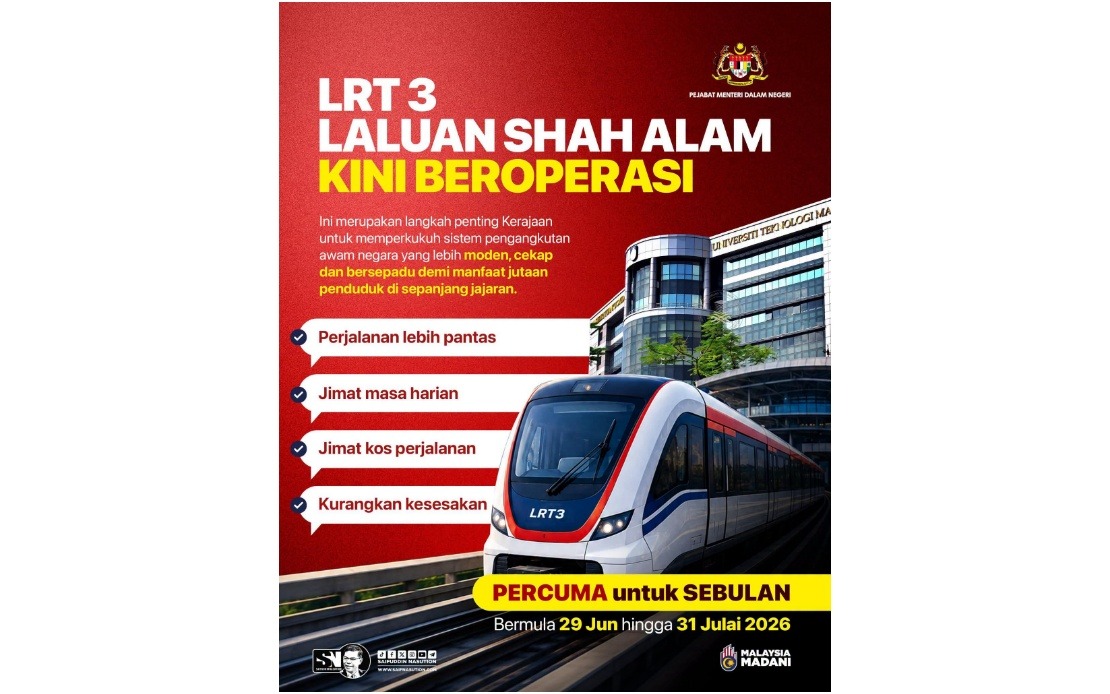
The Shah Alam Line LRT3, which began operations on June 29, represents a cornerstone of the MADANI Government's strategic approach to addressing transport challenges in one of Malaysia's most congested metropolitan areas. Home Minister Datuk Seri Saifuddin Nasution Ismail framed the new rail corridor as a transformative investment aimed at reshaping how residents and workers navigate the Klang Valley, a region that has long struggled with traffic congestion and inefficient transit connections.
In his commentary on the project, Saifuddin emphasised that the infrastructure extends beyond merely adding another transport option to the existing network. Rather, he positioned the LRT3 as an integrated solution that tackles multiple interconnected problems facing daily commuters. By providing an alternative to private vehicles, the line directly addresses traffic congestion on major routes while simultaneously reducing the time individuals spend travelling and lowering the financial burden of commuting for workers, students, and those conducting personal business.
The strategic timing of the line's launch reflects government awareness of demographic and economic pressures in the Klang Valley. The corridor serves Shah Alam, Klang, Subang and intermediate areas that collectively form one of Malaysia's primary economic and residential zones. For many residents in these municipalities, the introduction of efficient public rail transport offers relief from a situation that has grown increasingly untenable, with rising fuel costs and deteriorating traffic conditions making daily commutes progressively more expensive and time-consuming.
To catalyse adoption among potentially sceptical commuters, Prime Minister Datuk Seri Anwar Ibrahim announced a promotional period of free fares extending from June 29 through July 31. This concession applies not only to the main LRT3 line itself but also encompasses Prasarana Malaysia Bhd feeder bus services operating along the corridor. The complementary bus network represents a crucial component, as many potential users live or work at distances from the main rail stations and depend on connecting services to access the system effectively.
Saifuddin's public messaging focused on converting this free-trial period into sustained behavioural change. By inviting residents to experience the service without financial commitment, the government hopes that positive first experiences will translate into regular ridership once normal fares commence. The minister's rhetorical appeal—explicitly encouraging commuters to "leave your car behind" and experience the convenience firsthand—represents a shift in tone from previous government communications about public transport, moving from technical infrastructure announcements toward aspirational lifestyle messaging.
The timing of this infrastructure investment carries significance beyond immediate transport logistics. In Malaysia's current political context, delivering tangible improvements to urban quality of life serves as a demonstration of governmental efficacy and commitment to addressing citizen concerns. For residents of the Klang Valley, who have endured decades of traffic problems that previous administrations promised but failed to adequately resolve, the actual completion and operation of the LRT3 represents substantive rather than rhetorical action.
The project's emphasis on integration between the main line and feeder services reflects lessons learned from earlier Malaysian rail developments. Previous LRT and monorail systems sometimes functioned as isolated network segments, with limited connectivity to surrounding areas, thereby restricting their utility for the broader population. The deliberate inclusion of coordinated bus services suggests a more sophisticated understanding of the complete journey experience that commuters require, recognising that convenient access to and from rail stations fundamentally determines whether individuals will adopt public transport.
For Malaysia's broader regional context within Southeast Asia, the Shah Alam LRT3 development occurs amid increasing competition between major metropolitan areas to attract talent and investment through improved liveability. Singapore's comprehensive transit system and Thailand's expanding Bangkok Metro have raised regional expectations regarding urban infrastructure quality. Malaysia's commitment to expanding the Klang Valley's rail network signals ambition to maintain competitiveness as a destination for skilled workers and commercial investment.
The economic implications of the project extend beyond immediate commuter benefits. Reduced traffic congestion theoretically increases productivity by allowing workers and goods to move more efficiently throughout the region. Lower commuting costs improve household financial capacity for consumption and investment. Additionally, the project represents substantial employment during construction and ongoing operational employment, contributing to economic activity in the broader economy.
The government's decision to maintain the free-fare promotional period through July presents a structured opportunity to gather usage data and assess demand patterns. This information will prove valuable for future planning, fare-setting decisions, and potential expansion of the network. Understanding which route segments experience peak utilisation and which demographic groups most readily adopt the service could inform subsequent policy decisions regarding public transport investment.
Looking forward, the sustainability of the LRT3's success depends on factors beyond the promotional free-fare period. Reliability, frequency, cleanliness, and safety will ultimately determine whether trial users convert to regular commuters. Government credibility regarding public transport improvements will hinge on maintaining consistent service quality and avoiding the operational difficulties that have occasionally plagued earlier Malaysian rail systems. For residents of Shah Alam, Klang, and surrounding areas, the LRT3 represents both genuine infrastructure progress and a test case for whether their government can deliver on sustained promises of urban improvement.

