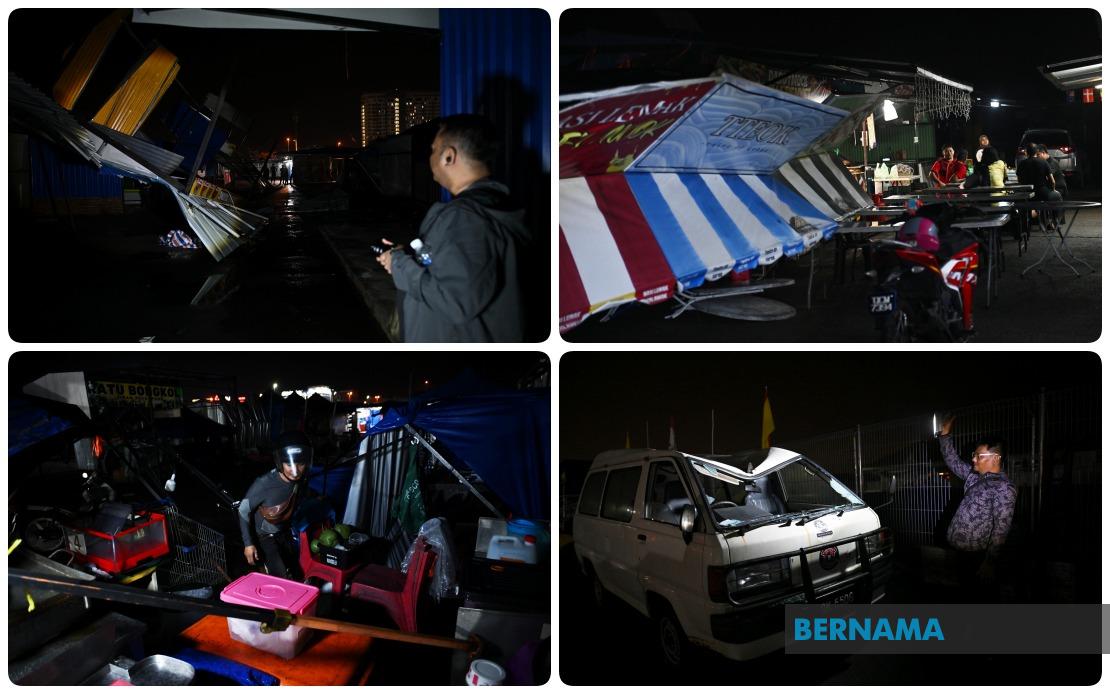
A powerful storm that swept through Kuching on the weekend has left the N6 Metrocity 2 Youth Night Market in disarray, with authorities forced to shut down the popular trading hub following widespread structural damage and vendor losses. The meteorological event, accompanied by heavy downpour and fierce winds, struck during peak business hours when the market typically draws its largest crowds, transforming what should have been a lucrative evening into a scene of chaos and financial ruin for hundreds of small traders.
The incident unfolded with startling speed as traders and shoppers scrambled to evacuate when violent gusts began dismantling the market infrastructure. Mohamad Faisal, a 42-year-old vendor, described the harrowing experience as canopy structures became airborne projectiles, forcing merchants to flee for their safety. The unpredictability of the disaster meant that vendors had little time to secure their merchandise or equipment, leaving businesses exposed to the elements and further damage as rain poured down on exposed goods and electrical systems.
According to market management, the scale of destruction represents the most severe incident the trading site has experienced in its operational history. Out of approximately 300 trader lots operating at the venue, more than 40 have suffered serious damage, with casualties ranging across food vendors, retailers, and service providers who depend on this weekly market for their primary income. The financial toll has been staggering, with individual traders estimating losses between RM2,000 and RM5,000 solely from canopy replacement costs, not accounting for damaged cooking equipment, merchandise losses, or revenue forgone during closure periods.
Hamzah Hassan, deputy chairman of the N6 Metrocity 2 Youth Night Market, emphasized that the incident had inflicted unprecedented damage to both private vendor assets and public infrastructure. The market's main stage, management office, and electrical distribution network all sustained significant damage, undermining the operational foundation upon which the entire market depends. The management has estimated that comprehensive restoration will require substantial investment, placing immediate pressure on both the association and affected traders who lack emergency reserves to absorb such losses.
For vendors who have built their livelihoods around this market over the past decade, the storm represents an existential threat to their economic stability. Many operate on thin margins, with weekly takings barely exceeding operational costs. The sudden loss of RM2,000 to RM5,000 in capital equipment cannot simply be written off, and for traders dependent on quick turnover of perishable goods, the closure means total revenue loss for the affected period with no corresponding reduction in their fixed costs or loan obligations.
The Malaysian Meteorological Department had issued thunderstorm warnings for the Kuching region and surrounding areas between 5 pm and 9 pm on the day of the incident, though the intensity of the storm appears to have exceeded forecasts. The warning covered a broad geographic area including Serian, Siburan, Samarahan, Simunjan, Kapit, and Song, indicating that the severe weather system affected multiple communities across Sarawak. However, specific wind speed data or damage assessments from other locations have not been detailed, raising questions about whether the market suffered disproportionate impact due to its open-air design or other vulnerabilities.
The market's vulnerability to weather events reflects a broader challenge facing informal and semi-formal trading sectors across Southeast Asia. Night markets and hawker centres, while economically vital to communities, often operate with minimal structural resilience and inadequate insurance coverage. Many traders lack the resources to obtain comprehensive business interruption insurance, leaving them entirely exposed when natural disasters strike. The lack of permanent infrastructure also means that recovery requires rebuilding from scratch rather than repairs.
Market management has initiated outreach to government ministries, local elected representatives, and cooperative organizations seeking financial assistance and support for affected traders. This appeal reflects the recognition that individual vendor resources are insufficient to address the scale of damage, and that public sector intervention may be necessary to prevent economic collapse among the merchant community. In Malaysia's context, such disasters often trigger compassion-based relief initiatives from state governments or Members of Parliament, though systematic disaster recovery programs for informal traders remain underdeveloped.
The closure of the N6 Metrocity 2 Youth Night Market also represents a loss to Kuching's broader consumer community, as residents lose access to a convenient shopping and dining venue. Night markets serve important cultural and economic functions beyond simple commerce, providing affordable meals, entertainment, and social gathering spaces for middle and lower-income families. The disruption thus affects multiple constituencies beyond just the trading community, potentially generating political pressure for rapid resolution.
Looking forward, the incident raises critical questions about disaster preparedness and resilience planning for temporary trading venues. Few Malaysian municipalities have developed comprehensive protocols for rapid structural assessment and recovery support for night markets and similar informal commercial spaces. The damaged market will require engineering assessment before reopening, and traders face uncertainty about whether they should invest in replacement canopies without clarity on timeline or continued operational viability at the location.
The storm damage in Kuching exemplifies vulnerabilities within Malaysia's informal economy that become apparent only when disaster strikes. While the nation's meteorological services provide adequate warning capability, the downstream institutional capacity to support rapid recovery for small traders remains fragmented and reactive rather than proactive. Building resilience into informal trading infrastructure requires systematic investment and policy coordination that extends beyond emergency response into structural design standards and accessible insurance mechanisms.

