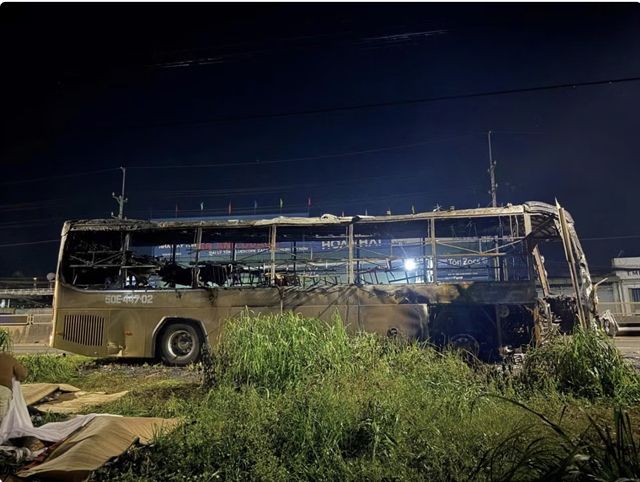
A devastating fire claimed seven lives early Sunday morning when a sleeper bus traveling south from Dong Nai to Ho Chi Minh City struck a roadside embankment on National Highway 1, sparking what authorities say was a rapidly spreading blaze that consumed the vehicle within minutes. The incident occurred at approximately 2:30am in Hung Thinh Commune, underscoring persistent safety concerns on Vietnam's highways where long-distance buses remain a common yet high-risk mode of transport for thousands of commuters and travelers daily.
The bus, operated by 41-year-old driver Tran Thanh Hai from Khanh Hoa Province, was carrying 33 passengers and crew when it first made contact with an embankment alongside the highway. Initial contact with the roadside barrier apparently did not immediately disable the vehicle, as Tran Thanh Hai managed to steer the bus before it struck a second embankment, bringing the transport to a halt. The timing and sequence of these collisions remain part of an ongoing investigation into whether mechanical failure, driver error, fatigue, or road conditions contributed to the accidents that preceded the fire.
Within moments of the vehicle coming to rest, flames erupted from the front compartment and propagated with alarming speed through the enclosed passenger cabin where most occupants remained seated or in sleeping berths. The rapid spread of fire in sleeper buses presents a particular danger because passengers are often in recumbent positions or in confined bunk spaces, limiting their ability to detect danger quickly or escape. Some travelers managed to exit the burning bus through emergency exits or windows, but others found themselves trapped as smoke filled the compartment and flames advanced faster than they could navigate through the disoriented panic of evacuation.
Local residents living in proximity to the accident scene became first responders in the critical minutes before professional emergency services arrived. These civilians deployed portable fire extinguishers and whatever equipment they could locate nearby in desperate attempts to control the blaze before it consumed the entire vehicle. Their efforts, though ultimately insufficient against the intensity of the fire, likely saved additional lives by preventing complete entrapment of remaining occupants. Such community interventions highlight both the heroism of ordinary citizens and the dangerous reality that remote highway accidents may occur far from rapid professional response capabilities.
Emergency authorities, dispatched following urgent distress calls, arrived with specialized firefighting equipment and trained rescue teams who worked to extinguish the flames, extract any survivors still trapped within the wreckage, and manage traffic diversions along the critical National Highway 1 corridor. By the time firefighters brought the conflagration under control, the bus had been reduced to a charred skeleton, making identification of victims and forensic analysis considerably more challenging. The Hung Thinh Commune People's Committee officially confirmed that seven people had perished in the disaster.
Emerged survivors and the injured were transported to Thong Nhat General Hospital where medical teams began treatment for burns, smoke inhalation, and trauma-related injuries. Among the casualties and injured passengers, at least one person suffered only minor injuries and was subsequently discharged, indicating a spectrum of harm depending on proximity to the fire's origin and individual circumstances. The remaining injured continued receiving hospital care as their conditions were evaluated and monitored.
Investigators cordoned off the accident site to conduct forensic examination of the burned bus remains, focusing on identifying the specific origin point of the fire and determining whether the blaze resulted from mechanical malfunction, fuel system failure, or an external ignition source. The examination process is necessarily meticulous because charring and thermal damage obscure evidence that would normally be visible. Authorities continue formal identification of victims and verification of precise circumstances surrounding both the collisions and the subsequent fire.
The tragedy represents the second major sleeper bus disaster to strike Vietnam within a single week, intensifying concerns about safety protocols and driver regulations on the nation's highways. Just seven days earlier, on July 17, another sleeper bus carrying passengers from Thien Cam beach in Ha Tinh Province en route to Thai Nguyen in the north veered off an expressway near Ha Noi and overturned catastrophically, killing five people and injuring numerous others. The rapid recurrence of two significant bus accidents within such a compressed timeframe has prompted questions about whether systematic safety issues require urgent regulatory intervention or enforcement enhancement.
These consecutive tragedies underscore challenges facing Southeast Asia's transportation sector, where long-distance sleeper buses serve as economical transport for millions but operate under varying safety standards and driver welfare conditions. The pattern of accidents raises questions about driver fatigue regulations, vehicle maintenance standards, road infrastructure safety features, and whether enforcement mechanisms sufficiently deter risky operating practices. For Malaysian travelers and transport operators, the incidents provide sobering comparative context regarding road safety protocols across regional markets and highlight why standardized safety practices and consistent enforcement remain essential for protecting passengers on long-distance routes throughout Southeast Asia.

