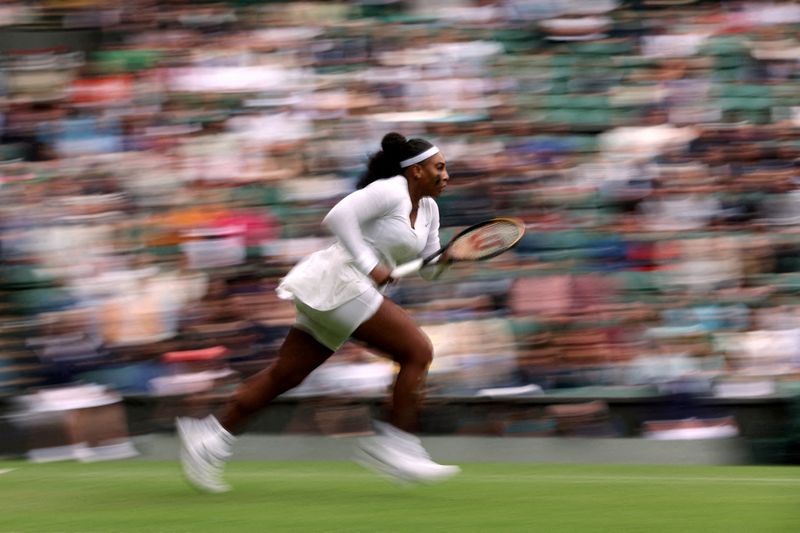
When Serena Williams takes to Centre Court next week at Wimbledon, the narrative surrounding the entire tournament will instantly crystallise around one figure. The 44-year-old American icon, a 23-time Grand Slam singles champion, returns to competitive tennis after a four-year hiatus at a venue where she won her seventh singles title a decade ago. Her comeback transforms what organisers had positioned as an extraordinarily competitive women's draw into something far more captivating—a stage where multiple storylines collide around the presence of a legend who appeared, until recently, to have closed the door on her playing career forever.
The depth of women's tennis in 2024 remains undeniable. Aryna Sabalenka, the world number one, arrives as the tournament favourite despite recent fragility in crucial moments. The Belarusian powerhouse collapsed spectacularly during the French Open quarter-finals, losing ten consecutive games after being within touching distance of the semi-finals. Her emotional intensity, while a source of strength, has also become a liability when pressure intensifies. More concerning for Sabalenka's prospects came during her pre-Wimbledon preparation in Berlin, where she surrendered a deciding set 6-0 to Jessica Pegula, a performance that suggests her confidence remains brittle heading into the grasscourt championship.
Poland's Iga Swiatek presents perhaps the most straightforward threat to potential challengers. She aims to become the first woman since Williams herself in 2016 to win consecutive Wimbledon titles, a feat that underscores both the difficulty of back-to-back grass-court victories and the exceptional consistency she has demonstrated. Simultaneously, the Russian teenage sensation Mirra Andreeva, who at 19 became the youngest French Open champion in 34 years, brings an audacious and inventive approach to the traditionally orthodox demands of Wimbledon's surface. Her fearless ball-striking and tactical creativity represent a generational shift in how younger players approach the sport.
Coco Gauff continues her pursuit of a breakthrough Wimbledon title, a grass-court fortress that has eluded the American despite her success elsewhere. Elena Rybakina, the 2022 champion, wields an understated but devastatingly effective power game that suits the fast grass surface perfectly. Meanwhile, British hope Emma Raducanu carries the weight of national expectation, seeking what would be the first Grand Slam title won by a British woman since Virginia Ruffin in 1977. For Malaysian and Southeast Asian tennis enthusiasts, this array of competing narratives represents the modern landscape of women's professional tennis—diverse, increasingly unpredictable, and distributed across multiple rising stars rather than concentrated in a single dominant figure.
Yet Williams' presence fundamentally alters this competitive ecosystem. The eighth and final wildcard granted to Williams guarantees unprecedented television ratings and will dominate social media discourse throughout the championship. Her first competitive singles match since the U.S. Open in 2022 represents a seismic cultural moment in sports, extending far beyond tennis purists. The logistics of her comeback reveal meticulous preparation: she rejoined the anti-doping pool in December of the previous year, has shed approximately 20 pounds through weight-loss medication, and has maintained a rigorous training regimen alongside coach Rennae Stubbs. Her recent doubles appearance at Queen's Club alongside Victoria Mboko showcased flashes of the explosive power that characterised her prime—her 120-mile-per-hour serve, historically among the most dominant weapons in women's tennis, remains formidable.
The decision to debut her comeback at Wimbledon rather than scheduling a gradual series of warm-up tournaments reflects a confidence bordering on audacious. Former world number one Andy Roddick expressed astonishment at the psychological fortitude required for such a choice, noting that few athletes possess the self-belief to thrust themselves into competition at tennis's most prestigious stage after such an extended absence. Fellow American and Grand Slam champion Lindsay Davenport acknowledged the extraordinary difficulty of grass-court tennis—where the ball skids low, moves quickly, and demands explosive athleticism—while conceding that if anyone possessed the capacity to transcend these physical challenges, Williams represented that rare exception.
Historically, Williams' dominance created a monoculture in women's tennis during her peak years. However, since her 2016 triumph at Wimbledon, the championship has produced eight different first-time winners, a statistical illustration of how thoroughly the sport's power dynamics have redistributed. Players including Naomi Osaka, Swiatek, Sabalenka, Gauff, and Barty have accumulated multiple Grand Slam titles without approaching Williams' historical dominance. The most recent six Grand Slam tournaments have been claimed by six different women, establishing parity at the sport's highest echelon. For Malaysian readers following international tennis, this diffusion of championship opportunities reflects broader democratisation within professional sports, where training science, mental conditioning, and equipment technology have narrowed the performance gaps that once separated exceptional athletes from their peers.
The psychological dimension of a potential Williams encounter looms particularly over Sabalenka's campaign. As sports analysts have observed, should the world number one face Williams early in the draw, the matchup presents zero upside for the Belarusian. If Williams, competing in her first singles match in years, manages to hold serve three or four times, the psychological victory against a legend would dwarf any competitive advantage Sabalenka might claim. This dynamic reveals how Williams' presence functions beyond mere competitive tennis—her narrative possesses sufficient gravitational force to reshape how opponents approach matches against her, introducing psychological variables that have little to do with current form or rankings.
For the broader sporting landscape and Malaysian tennis enthusiasts, Williams' comeback underscores the evolving relationship between athletic careers and longevity. Her four-year absence, rather than representing definitive retirement, emerged as a strategic pause that allowed physical recovery and mental reset. The medical interventions enabling her return—including pharmaceutical weight management—reflect contemporary sports science capabilities that extend athletic careers beyond traditional boundaries. Her potential to become the oldest woman to win a singles match at Wimbledon since Martina Navratilova at 47 in 2004 would further challenge conventional assumptions about athletic aging.
The convergence of storylines at this year's Wimbledon creates an unusually compelling championship framework. Sabalenka's fragility under pressure, Swiatek's quest for consecutive titles, Andreeva's youthful innovation, Gauff's grass-court struggles, Rybakina's cold efficiency, and Raducanu's home-nation narrative would ordinarily dominate tournament coverage. Instead, Williams' return has become the prism through which all other narratives will be filtered and understood. Her presence transforms a tournament already distinguished by competitive depth into something approaching cultural phenomenon, commanding attention across demographics and geographies far beyond traditional tennis audiences. For Malaysian readers, her comeback represents not merely a sporting story but a broader meditation on resilience, excellence, and the possibility of meaningful reinvention across the lifespan.

