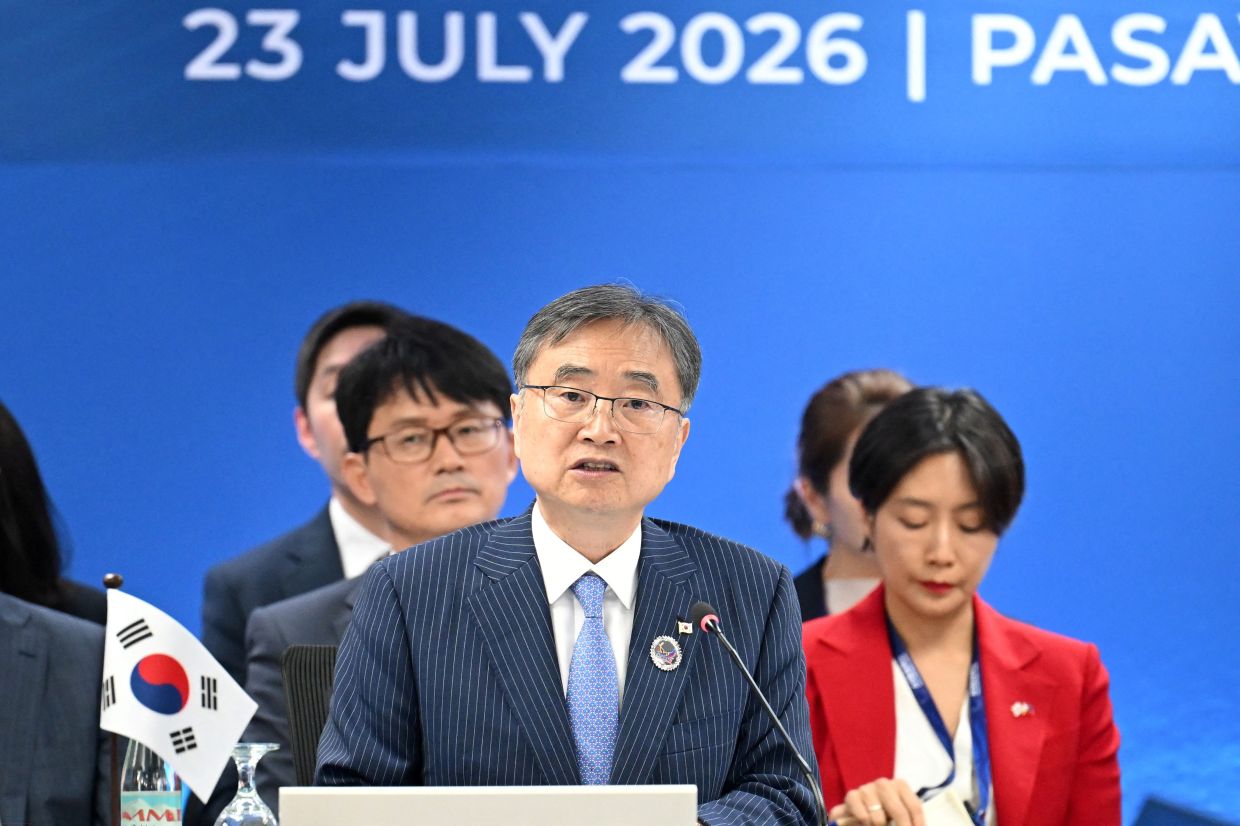
President Lee Jae Myung's administration faces a credibility test in its push to restart dialogue with North Korea after two senior ministers delivered sharply contrasting assessments of engagement strategy this week, signalling unresolved tensions within the government's approach to one of Asia's most consequential security challenges. The public disagreement between Foreign Minister Cho Hyun and Unification Minister Chung Dong-young, aired before reporters and policy observers, underscores the difficulty Seoul faces in maintaining a coherent negotiating position with a recalcitrant adversary that closely monitors any signs of internal discord.
The immediate trigger came when Chung unveiled an ambitious four-party diplomatic framework during a Wednesday policy meeting with President Lee, proposing formal talks involving both Korean states alongside the United States and China. Rather than endorsing this vision, Cho responded dismissively to journalists, characterising Chung's proposals as "idealistic" and cautioning that they lacked endorsement from other government agencies. The rebuke was uncomfortably public—Cho essentially told media audiences to disregard his cabinet colleague's statements as insufficiently vetted. Chung did not remain silent, firing back the following day with a philosophical observation that ideals were precisely what was needed "to change reality," a pointed retort that exposed genuine strategic differences rather than mere bureaucratic posturing.
The divide reflects deeper disagreement over Seoul's fundamental approach to North Korea after years of stalled contact. Lee's administration has signalled a marked departure from his conservative predecessors' "denuclearisation-first" framework, instead adopting a "peace-first" methodology that de-emphasises demands for nuclear abandonment as a precondition for engagement. The administration has also lobbied the United States to encourage President Donald Trump to meet directly with North Korean leader Kim Jong Un, hoping that restored bilateral dialogue might create pathways for Seoul to re-enter negotiations that have been frozen since the Covid-19 pandemic disrupted already tenuous communication channels.
The practical consequences of this internal disagreement extend well beyond Seoul's bureaucratic structures. Analysts studying North Korea's behaviour patterns warn that Pyongyang will interpret ministerial discord as evidence of policy instability and potential vulnerability. Lim Eul-chul, a professor specialising in Korean peninsula affairs at Kyungnam University, characterised the dispute as having "exposed internal differences and weakening policy momentum surrounding North Korea policy." More significantly, Lim cautioned that visible disunity reinforces Kim Jong Un's calculation that even successfully negotiated agreements could face reversal through domestic South Korean political shifts, fundamentally undermining any negotiating partner's credibility.
Southern efforts to soften Pyongyang's stance through unilateral conciliation have achieved minimal traction so far. Seoul has terminated anti-North Korean loudspeaker broadcasts that Pyongyang considered provocative and suspended various measures deemed potentially hostile, yet North Korea has responded largely with silence. The deterioration of inter-Korean relations accelerated markedly during the pandemic years, culminating in Kim Jong Un's 2024 announcement that Pyongyang would abandon reunification aspirations—a dramatic rhetorical break from decades of propaganda—while simultaneously demolishing joint economic projects constructed during previous periods of cooperation. These actions signalled not merely tactical shifts but fundamental repositioning of North Korea's strategic orientation.
The cost of estrangement manifests most starkly in human terms. Defections from North Korea have collapsed to negligible levels, with just 63 individuals successfully crossing into South Korea during the first half of 2026, compared to 1,047 in 2019. This seven-fold decline reflects both tighter North Korean border enforcement and reduced willingness of potential defectors to attempt dangerous escape routes when they perceive diminished South Korean support. The defection statistics serve as an often-overlooked barometer of inter-Korean relations and the broader human rights situation within the North.
Lee's engagement-focused strategy has generated criticism from human rights advocates who view it as sacrificing moral imperatives for diplomatic expediency. The administration has noticeably downgraded priority given to North Korean human rights issues, including suspending certain reporting and broadcasting initiatives that document regime abuses. While South Korea co-sponsored a United Nations resolution addressing North Korean human rights last year, observers note this reflected institutional commitments rather than enthusiastic government advocacy. Kim Tae-Hoon, former president of the human rights organisation PSCORE, disclosed to international media that the apparent cooling of Seoul's rights advocacy has produced concrete operational consequences, with funding donations drying up substantially and forcing the organisation into financial difficulty as international backers interpret the shift as signalling reduced diplomatic space for rights work.
The friction between Seoul's two lead diplomats occurred precisely when the administration needs maximum policy coherence. The government's strategy depends on convincing North Korea that engagement offers genuine benefits while simultaneously reassuring Washington and Tokyo that diplomatic openness does not entail compromising alliance security commitments. This delicate balancing act becomes exponentially more difficult when cabinet-level officials appear to contradict one another in public forums. The Foreign and Unification ministries subsequently declined to elaborate further, issuing only vague commitments to future coordination, while the presidential Blue House maintained silence, suggesting discomfort with the episode rather than resolution of underlying disagreements.
For regional observers including Malaysian policymakers monitoring Korean peninsula dynamics, the minister-level discord carries implications extending beyond peninsula-specific concerns. Seoul's approach to North Korean engagement reflects broader questions about how middle-power governments negotiate with authoritarian adversaries—balancing engagement opportunities against human rights principles, managing alliance relationships while pursuing independent diplomatic initiatives, and maintaining policy coherence when domestic political divisions emerge. The current visible tension suggests these reconciliations remain incomplete within Lee's administration.
The trajectory of Korean peninsula diplomacy now depends significantly on whether these revealed differences prove reconcilable or symptomatic of deeper cabinet-level fractures that could metastasize into broader policy incoherence. Pyongyang will certainly interpret the dispute as revealing exploitable leverage points, potentially using Seoul's apparent internal division as justification for further intransigence. Whether the Foreign and Unification ministries can genuinely coordinate moving forward, or whether this week's clash signals deeper strategic irreconciliation, remains an open question with consequences that extend throughout Northeast Asia's security architecture.

