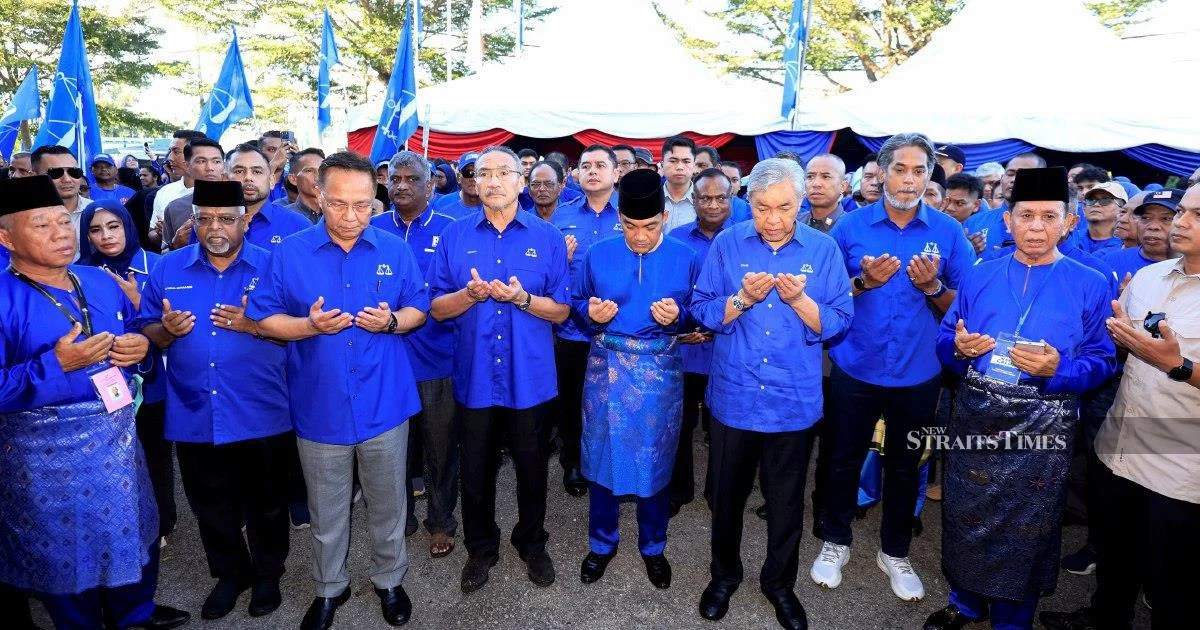
Datuk Onn Hafiz Ghazi has secured a visible show of strength from Barisan Nasional's most prominent figures, who converged on the Simpang Renggam District Council on Wednesday morning to demonstrate their collective backing ahead of the Johor election. The gathering underscores the coalition's determination to project unity and organisational cohesion in the state, which has been a traditional BN stronghold but faces mounting political pressures.
The presence of multiple high-ranking BN personalities at the same venue sends a carefully orchestrated signal about the coalition's confidence in Onn Hafiz as a leading candidate. Such coordinated appearances serve both practical and symbolic functions in Malaysian electoral campaigns—they energise grassroots supporters, attract media coverage, and provide reassurance to party members that the leadership is fully invested in the chosen direction. The Simpang Renggam location is strategically significant, placing the event in a district where BN's organisational machinery has traditionally operated effectively.
Onn Hafiz, who holds considerable influence within Johor's political structure, has emerged as a focal point for BN's electoral strategy. His candidacy represents continuity within the coalition's established hierarchy while also attempting to respond to broader shifts in voter sentiment. The endorsement from senior party figures suggests confidence that his profile and track record can mobilise the party's base and appeal to swing voters who remain undecided about their electoral preferences.
Barisan Nasional's approach in Johor reflects wider calculations about the political landscape heading into the state election. The coalition recognises that visible unity among its top echelon can counteract narratives of internal fragmentation that have plagued Malaysian politics in recent years. By presenting a unified front behind specific candidates, BN aims to communicate that its constituent parties have resolved their differences and are operating under a coherent strategic framework. This becomes particularly important in Johor, where Chinese and Indian voters represent significant demographic blocs whose support can determine electoral outcomes.
The gathering also demonstrates how traditional BN strongholds like Johor remain operationally sophisticated in their campaign mechanics. The coalition maintains extensive ground networks and the capacity to mobilise senior personnel for coordinated campaign events. These capabilities, honed over decades of electoral competition, still represent a considerable asset compared to newer political coalitions that lack comparable organisational infrastructure across all districts.
For Onn Hafiz personally, the backing from BN luminaries reinforces his standing within the party hierarchy and projects an image of inevitability around his candidacy. This can influence how lower-level party members allocate their personal resources and effort during the campaign period. When grassroots activists perceive that national leadership has committed itself to a particular candidate, they tend to mobilise more energetically in support of that person's electoral prospects.
The timing of the Simpang Renggam event, occurring in the lead-up to formal campaign periods, serves to shape the narrative landscape before official proceedings begin. By securing prominent media coverage of BN heavyweights' attendance, the coalition establishes its preferred framing for the electoral contest: that this is an election where BN presents a clear, united alternative to the opposition. This contrasts sharply with opposition narratives that attempt to paint BN as internally divided or lacking coherent policy direction.
Johor's electoral significance extends beyond the state itself. As Malaysia's second-largest state by population and a key economic contributor to the federation, voting patterns in Johor often correlate with broader national trends. A strong BN performance in Johor would provide momentum for federal-level politics, while an opposition breakthrough would signal shifting voter preferences at the national level. This explains why BN's national leadership invests personal time and credibility in supporting state-level candidates in Johor.
The coalition's investment in visible campaign support also reflects anxieties about voter turnout and the danger of complacency. In recent electoral cycles, traditional BN supporters have sometimes absented themselves from voting booths, assuming that the coalition's organisational dominance guaranteed victory regardless of individual participation. By securing prominent leadership attendance at campaign events, BN attempts to convey that the election remains competitive and that every vote matters, thereby encouraging supporters to participate actively.
Opposition parties will likely seek to counter this narrative by emphasising their own momentum and pointing to issues where they claim BN has underperformed. The political contest in Johor will increasingly turn on which coalition can more effectively mobilise voters on issues that resonate most acutely—economic concerns, service delivery, corruption perceptions, and demographic-specific priorities. BN's show of unity behind Onn Hafiz represents one tactical element within this broader strategic competition.
The Simpang Renggam gathering also carries implications for internal BN dynamics beyond Johor. It demonstrates where the coalition's hierarchy has consolidated power and which personalities enjoy backing from the broadest coalition consensus. For other aspiring BN politicians outside Johor, observing who appears at such events provides intelligence about factional alignments and the current distribution of resources within the larger coalition framework.

