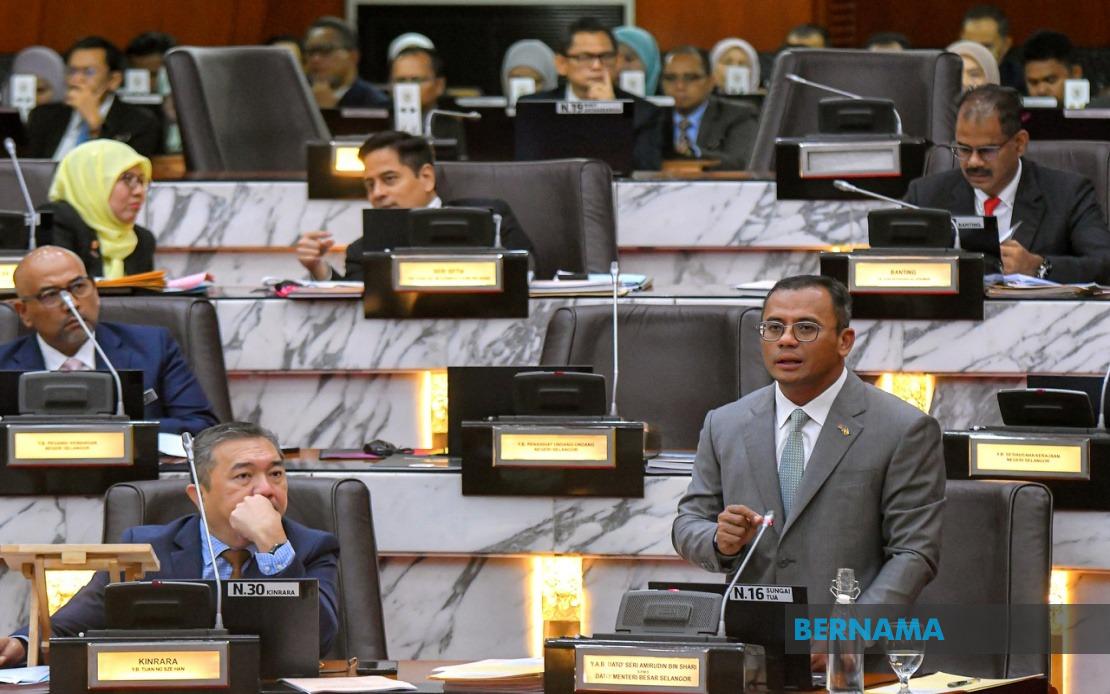
The Selangor state government is moving to substantially expand its Higher Education Institution Study Incentive (HPIPT) programme, with Menteri Besar Datuk Seri Amirudin Shari announcing plans to increase beneficiaries to 5,000 in the 2027 budget cycle, a significant jump from the current 3,000 recipients. The decision comes amid consistently robust interest in the scheme, which has seen applications exceed 5,000 annually for the past two years, signalling strong appetite among Selangor students for financial support as they pursue tertiary education.
The RM1,000 financial assistance programme has become a cornerstone of the state's education support infrastructure, functioning as a critical safety net for young Malaysians navigating the escalating costs of university and polytechnic fees. Available to Selangor residents enrolled at both public and private higher education institutions, the HPIPT extends eligibility to students pursuing diverse pathways including Level 4 Skills Certificates, diplomas, and bachelor's degree programmes. This broad scope reflects recognition that tertiary education encompasses multiple entry points and progression routes beyond traditional university degrees.
The impetus for expansion reflects institutional responsiveness to demonstrated need. With applications consistently exceeding available places by a considerable margin—the 5,000-plus annual submissions dwarfing the 3,000-recipient cap—the state government faces mounting pressure to better match supply with demand. Amirudin's acknowledgement that the government previously supported 5,000 recipients suggests the current contraction to 3,000 was a cost-management measure, making the proposed restoration essentially a recovery of historical capacity rather than entirely new provision. The qualifier that the state is assessing its revenue position before finalising numbers between 5,000 and 6,000 indicates fiscally prudent deliberation, though the thrust toward expansion appears committed.
For Malaysian students and families, particularly those in middle and lower-income brackets, this expansion carries tangible implications. The RM1,000 disbursement, whilst modest, can defray initial semester costs, accommodation deposits, or essential materials, thereby reducing financial stress at a critical juncture when many students juggle part-time employment alongside studies. The ripple effects of expanded support extend beyond individual beneficiaries to reducing systemic barriers that might otherwise compel capable students to abandon tertiary aspirations due to economic constraints. In a competitive regional landscape where human capital development determines economic trajectory, such initiatives represent incremental but meaningful state investment in workforce capability.
Beyond simple expansion of recipient numbers, the Selangor government is simultaneously pursuing operational refinements designed to enhance programme accessibility and effectiveness. A pressing concern is the application timeline, which currently operates after students receive tertiary institution admission confirmations. This compressed window creates administrative bottlenecks and risks excluding students who miss application deadlines through no fault of their own. By reviewing and extending this period, the state aims to better accommodate the sequential processes students navigate—sitting examinations, receiving results, securing admissions, then applying for financial assistance—thereby reducing exclusions based on procedural timing rather than merit or genuine need.
Further innovation involves doubling the application cycle from annual to bi-annual intake, a pragmatic response to the heterogeneous timing of tertiary enrolment across Malaysia's education system. Public universities typically commence intake once yearly, creating concentrated demand at specific periods. However, private institutions and various skills programmes operate on rolling or alternative calendars, meaning some students begin courses outside traditional academic cycles. Semi-annual applications would ensure no student cohort faces unnecessarily delayed access to support merely because their institution's intake cycle misaligned with the previous application window. This disaggregated approach democratises access and acknowledges educational pathways' diversity.
The political dimension merits consideration within Selangor's broader governance context. The query from Datuk Noorazley Yahya, representing Perikatan Nasional at Bukit Melawati, prompted the announcement during legislative assembly proceedings, suggesting bipartisan concern for education funding traverses factional lines. Amirudin's response—substantive rather than dismissive—reflects how education financing has transcended partisan positioning to become accepted state responsibility. Whether PN's questioning represented genuine advocacy or political positioning, the MB's commitment to budget reassessment signals education remains a politically salient portfolio where government performance attracts scrutiny and promises carry electoral weight.
Contextually, Selangor's initiative occurs within Malaysia's broader tertiary education landscape, where rising fees—particularly at private institutions—have intensified student financial burden. Federal government support mechanisms remain critical, yet state-level initiatives like HPIPT fill gaps, particularly for lower-income families ineligible for maximum federal assistance or facing thresholds that exclude borderline cases. Selangor, as Malaysia's economic engine and most populous state, bears outsized demographic responsibility; its expansion signals willingness to deploy fiscal capacity toward human development, differentiating it from states with more constrained revenue bases.
Implementation challenges warrant anticipation. Expanding from 3,000 to 5,000 recipients—a 67 percent increase—while simultaneously doubling application cycles requires proportional administrative scaling. The Selangor government must ensure assessment capacity, fund disbursement mechanisms, and verification systems expand commensurately to prevent quality degradation or processing delays. Criteria for recipient selection also merit scrutiny; whether expansion maintains needs-based prioritisation or dilutes selection rigour determines whether additional places genuinely reach most-deserving cases or slip toward marginal applicants.
Looking forward, the proposed expansion aligns with Malaysia's longer-term education and workforce development imperatives. As industries shift toward high-value-add sectors demanding tertiary credentials, removing financial barriers to completion becomes strategically important. State initiatives like expanded HPIPT contribute incrementally toward this objective, though systemic challenges—inadequate federal funding, rising private institution costs, qualification-employment misalignment—extend beyond state capacity to resolve unilaterally. Nevertheless, Selangor's commitment to doubling support represents meaningful incremental progress toward more inclusive tertiary access.
The timeline for implementation through the 2027 budget provides a defined horizon within which fiscal planning and legislative processes can accommodate the expansion. Whether final numbers settle at 5,000 or stretch toward 6,000 will depend on revenue assessments and competing budget priorities. Regardless of precise final figures, the directional commitment to restoration and expansion represents tangible state acknowledgement that current provision falls short of demonstrated demand, and that education financing investment yields returns spanning individual mobility, systemic capacity, and broader economic competitiveness.

