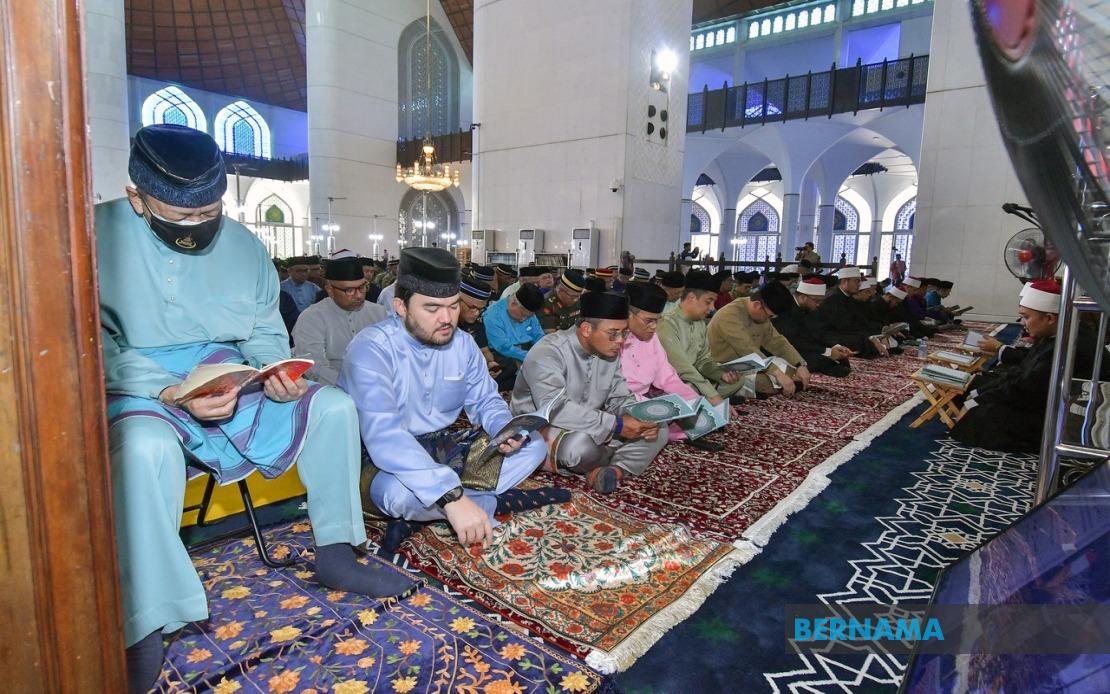
The Sultan of Selangor, Sultan Sharafuddin Idris Shah, participated in special religious observances on Wednesday in preparation for Malaysia's National Day celebrations, underscoring the state's commitment to honouring the occasion through spiritual reflection alongside official festivities. The event brought together members of the security forces stationed across Selangor with members of the public for a morning of Surah Yassin recitation at Masjid Sultan Salahuddin Abdul Aziz Shah in Shah Alam, creating a moment of communal prayer that bridged civilian and uniformed personnel around a shared religious tradition.
Accompanying the Sultan was the Raja Muda of Selangor, Tengku Amir Shah Sultan Sharafuddin Idris Shah, whose presence reflected the royal family's active engagement with state religious and national observances. Upon his arrival at the mosque, the monarch received a formal welcome from Selangor Menteri Besar Datuk Seri Amirudin Shari and Dr Mohammad Fahmi Ngah, chairman of the State Islamic Affairs and Innovation Culture Committee, signalling the coordinated nature of the occasion between palace and government structures.
The gathering drew approximately 1,000 participants, predominantly security force personnel deployed throughout Selangor alongside civilian worshippers. This inclusive approach reflected a deliberate effort to recognise the contributions of military and enforcement agencies while creating an integrated spiritual atmosphere transcending usual hierarchical divisions. The participation of security forces suggested an intentional messaging about national unity and shared values in the lead-up to Independence Day commemorations.
Following the recitation, Sultan Sharafuddin proceeded to lead Friday prayers, where he heard a sermon centred on spiritual and moral dimensions of freedom. The Grand Imam of the mosque, Muhammad Farhan Wijaya, delivered a khutbah titled "Merdeka Daripada Belenggu Kerakusan"—literally "Freedom from the Shackles of Greed"—which contextualised the national celebrations within broader Islamic teachings about restraint, ethical conduct, and liberation from material excess. The sermon's emphasis on freedom from avarice represented a deliberate counterpoint to contemporary consumer culture, framing Merdeka not merely as political independence but as spiritual and moral emancipation.
The choice of sermon topic carries particular resonance for Malaysian audiences navigating questions about corruption, inequality, and ethical governance. By anchoring National Day observances to Islamic principles opposing greed, the state's religious leadership connected patriotic sentiment to values-based governance. This approach aligns with broader regional conversations about how post-colonial nations reconcile development aspirations with ethical frameworks, a conversation particularly relevant as Malaysia confronts questions of institutional integrity and resource distribution.
The event's positioning as a preparatory observance ahead of official National Day celebrations reflects Selangor's practice of layering religious, civic, and nationalist dimensions around Independence Day. Rather than treating Merdeka as a singular civic occasion, the state created a multi-day observance integrating spiritual practice with formal commemoration, suggesting that independence celebrations gain deeper resonance when connected to religious and moral reflection.
Central authorities present at the mosque included Datuk Mohd Shahzihan Ahmad, director of the Selangor Islamic Religious Department (JAIS), and Datuk Salehuddin Saidin, chairman of the Selangor Islamic Religious Council (MAIS). Their attendance represented institutional endorsement of the occasion and demonstrated coordination between palace, government, and religious administration in orchestrating the event.
Selangor's scheduled National Day celebrations will proceed at Kajang Stadium at 8 pm on Sunday, August 30, operating under the theme "Malaysia MADANI: Kesejahteraan Dinikmati" (Malaysia MADANI: Prosperity Shared), aligning with the federal government's overarching narrative for the year's commemorations. This thematic framework emphasises inclusive development and shared well-being, concepts the religious observance had already begun to elaborate through its focus on moral foundations of freedom.
For Malaysian readers, Selangor's approach of embedding pre-National Day prayers highlights how states continue experimenting with ceremonial formats that honour both religious identity and patriotic sentiment. The sermon's emphasis on freedom from materialism offers implicit commentary on governance priorities, suggesting that effective nationhood requires not merely political independence but ethical foundations limiting corruption and excessive self-interest. This framing resonates particularly for Selangor, Malaysia's economically dynamic state, where rapid development creates visible inequalities prompting periodic recalibrations of the relationship between material progress and spiritual values.
The security force participation carries additional significance in a region where civil-military relations remain carefully negotiated. By inviting uniformed personnel into a religious observance led by the Sultan, Selangor reinforced narratives of institutional harmony and shared commitment to national values, countering perceptions of distance between security establishments and civilian authority.
For Southeast Asian observers, Selangor's ceremonial approach reflects broader patterns within Muslim-majority democracies attempting to preserve religious significance in nationalist observances without privileging any single theological interpretation. The inclusive framework—security forces and civilians, elite reception and public participation—demonstrated an approach to religious nationalism that emphasises shared citizenship over sectarian divisions.
The event ultimately illustrated how National Day observances extend beyond political and civic dimensions, incorporating spiritual and moral registers that connect independence to ethical frameworks. By positioning Merdeka within teachings about freedom from greed, Selangor's leadership offered a vision of nationhood rooted not merely in anti-colonial history but in ongoing commitments to justice, restraint, and shared prosperity.

