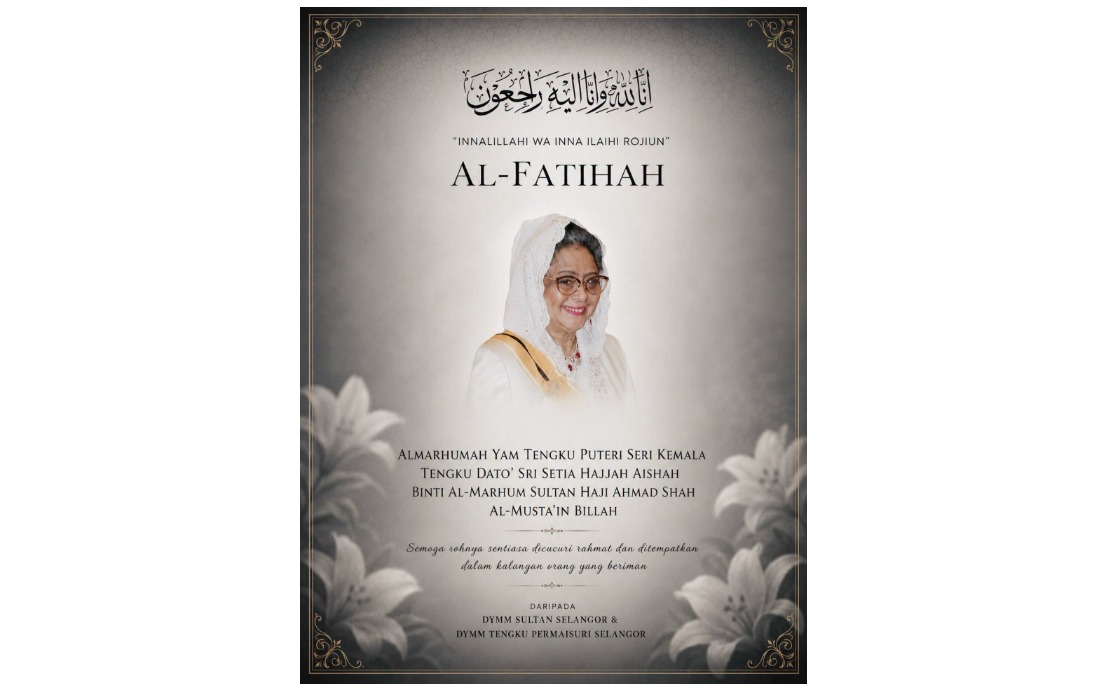
The palace of Selangor has officially conveyed expressions of grief to the Pahang royal household following the death of Tengku Datuk Seri Aishah, the elder sister of Sultan Abdullah Ri'ayatuddin Al-Mustafa Billah Shah. Sultan Sharafuddin Idris Shah and Tengku Permaisuri Selangor Tengku Permaisuri Norashikin extended their sympathies to the reigning Sultan of Pahang in a statement released through the Selangor Royal Office on August 27.
Tengku Puteri Seri Kemala Tengku Datuk Seri Aishah Almarhum Sultan Ahmad Shah, who was the sister of the current Pahang monarch, passed away at a medical facility in Kuala Lumpur on the evening of August 26, with her death occurring at 9:15 pm. The announcement of her passing was made public through official channels the following day, prompting expressions of sympathy from various quarters of the Malaysian royal establishment.
The Selangor sovereign and his consort emphasised their deep sorrow at the loss, with their official message highlighting prayers for divine mercy upon the departed. The statement released by the palace underscored traditional Islamic sentiments, invoking blessings for the deceased and expressing hope that her soul would find peace in accordance with Islamic teachings and royal customs observed within Malaysia's monarchical system.
In accordance with established royal protocols and the wishes of the Pahang palace, the deceased's remains were transported to the Pahang Royal Mausoleum situated in Pekan for the final rites. The funeral arrangements were conducted following the ceremonial standards reserved for members of the royal family, ensuring that appropriate honours were observed throughout the proceedings.
The death of prominent members of Malaysia's royal families typically triggers waves of condolences from across the political and institutional establishment, reflecting the deep respect accorded to the institution of constitutional monarchy in the country. Such expressions serve to reinforce bonds between the various state palaces and demonstrate the unified nature of Malaysia's royal network, despite the federal structure that grants significant autonomy to individual sultans within their respective territories.
Tengku Datuk Seri Aishah's passing represents another significant moment in the Pahang royal lineage, connecting her to the broader history of the state's monarchical traditions. As a member of the immediate family of the reigning Sultan, her death naturally drew formal acknowledgement from her sovereign's counterparts across Malaysia's thirteen sultanates, with the Selangor palace being among the first to issue official condolences.
The exchange of formal sympathies between different state palaces serves an important ceremonial function within Malaysia's constitutional framework, reinforcing the collegiate nature of the nation's royal institution. Each sultan, while maintaining supreme authority within their own state, participates in a broader network of mutual respect and recognition that extends across state boundaries and reflects shared values rooted in Islam, Malay cultural traditions, and the historical evolution of the Malaysian monarchy.
The passing of members of royal families, particularly those of the older generation such as the deceased, often prompts reflection on succession and the continuity of royal institutions within Malaysia's political system. These moments of collective mourning underscore the stability that the monarchy provides within the constitutional framework, even as individual members of royal families experience the same losses and transitions that affect all families within society.
The funeral proceedings in Pekan followed customary practices that balance Islamic religious requirements with the ceremonial expectations befitting a royal personage. The decision to conduct the burial with full honours reflected both the family's wishes and the institutional recognition of her position within the Pahang royal household, ensuring that appropriate respect was extended to her memory and legacy.
As Malaysia's royal families continue to navigate contemporary challenges while maintaining historical traditions, such occasions serve to demonstrate the enduring relevance of the institution to the nation's identity. The coordinated expressions of sympathy from different state palaces, including the formal condolences from Selangor's leadership, exemplify the mutual recognition and support that characterises relationships among Malaysia's sultans, providing continuity and stability within the broader constitutional structure.

