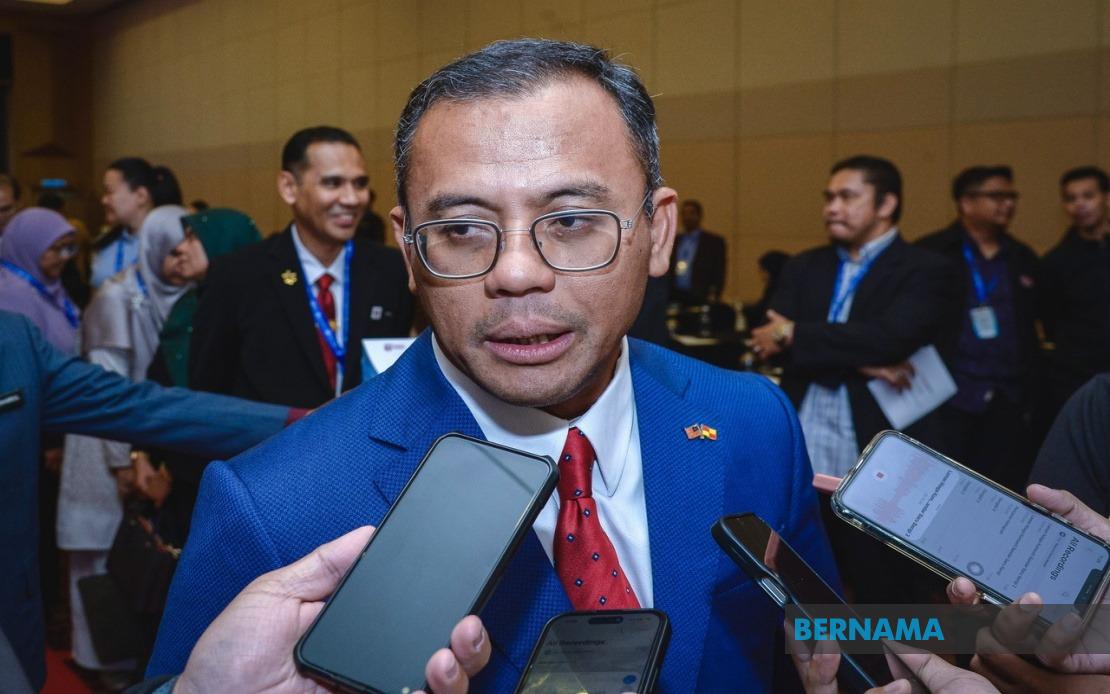
Selangor Menteri Besar Datuk Seri Amirudin Shari has called for a fundamental reimagining of how governments approach policymaking, urging a move away from siloed interventions toward comprehensive frameworks that reflect the lived experiences of citizens. Speaking at the Human Ecology International Conference II 2026 in Bangi, Amirudin articulated a vision where policy design acknowledges the deeply intertwined nature of contemporary challenges, placing human wellbeing at the centre of governance rather than treating disparate social issues as separate administrative concerns.
The core of Amirudin's argument rests on a simple yet profound observation: individuals and families do not experience their lives as a series of unrelated policy domains. When a parent struggles to balance work commitments with childcare responsibilities whilst managing transport costs and housing expenses, these are not abstract problems for different government agencies to solve independently. Instead, they form a complex web of pressures that mutually reinforce one another, creating systemic strain that no single targeted intervention can adequately address. This reality demands what Amirudin termed a transition from "isolated interventions" to "connected environments" and from institutional metrics of success to measurable improvements in how people actually live.
Amirudin's remarks come at a particularly relevant moment for Malaysia's policy landscape. Selangor, as the nation's most economically developed state and home to nearly half the country's urban population, faces acute pressures across multiple fronts simultaneously: rapid urbanisation creating housing affordability crises, transportation bottlenecks that extend family commute times, childcare infrastructure gaps, and wage stagnation relative to cost-of-living increases. These are not problems that respond well to fragmented solutions. A family in Subang Jaya cannot be adequately served by improved public transport alone if childcare facilities remain inaccessible, nor by housing subsidies if transport costs consume any savings achieved. The menteri besar's framing reflects an understanding that contemporary governance requires systems thinking.
The structural pressures Amirudin identified resonate across Southeast Asia broadly, particularly in rapidly developing economies. Rising living costs, extended commute times due to sprawling metropolitan areas, mounting caregiving demands as traditional family structures evolve, employment precarity stemming from technological disruption, housing supply shortages, and the accelerating pace of digital change create conditions where individual resilience alone cannot ensure family stability. These are not failures of personal responsibility or household financial management but symptoms of policy architectures designed for different demographic and economic realities. The menteri besar's assertion that government must ask not merely whether families are coping but whether their environment enables them to thrive represents a significant philosophical shift toward preventative, dignity-focused governance.
Crucially, Amirudin emphasised the role of universities as active partners throughout the entire policy development cycle rather than external commentators or retrospective evaluators. This reflects growing recognition that policymaking benefits from embedding academic rigour, evidence-gathering, and independent evaluation at every stage—from problem definition through intervention design to impact assessment. Malaysian universities, particularly research-intensive institutions, possess expertise in understanding human ecology, social systems, and community dynamics that remains underutilised in formal policy processes. Building institutional partnerships between academic institutions and government can create feedback loops where research findings directly inform iterative policy refinement.
The establishment of the ASEAN Human Ecology Consortium, announced during the conference, represents a regional approach to these challenges. By creating platforms for joint research, student and faculty exchange programmes, collaborative publications, and policy dialogue among human ecology institutions across Southeast Asia, the consortium acknowledges that many of the pressures families face are transnational in character and respond better to shared learning frameworks. Urban congestion, affordable housing shortages, childcare accessibility, healthcare provision, and wage-productivity gaps are challenges facing counterparts across Indonesia, the Philippines, Thailand, and Vietnam. A regional consortium allows smaller nations and researchers to collectively interrogate policy solutions, pilot innovative approaches, and share evidence about what actually works rather than each country reinventing solutions in isolation.
The conference's overarching theme—"Sustaining Human Well-being"—places this discussion within a broader sustainability framework. Often sustainability conversations focus exclusively on environmental dimensions, yet human wellbeing sustainability requires that families can maintain their living standards and life quality across generations without perpetual precarity. A mother working multiple informal jobs to cover household costs whilst managing childcare is not living sustainably regardless of her carbon footprint. Amirudin's framing integrates social sustainability within the broader sustainability agenda, recognising that policy coherence across healthcare, childcare, transport, employment, and cost-of-living dimensions represents essential infrastructure for sustainable human futures.
For Malaysian policymakers, the implications are significant. Current policy development often occurs within ministerial silos where the Health Ministry designs healthcare policy independently, the Transport Ministry develops urban mobility frameworks, and the Housing Ministry manages residential development—with limited formal coordination mechanisms. Amirudin's call for connected environments suggests the need for structured integration at the policy design stage, potentially through cross-agency working groups with executive authority to resolve conflicts between competing departmental objectives. This might involve establishing human ecology taskforces that examine how different policy domains intersect and create compound effects on household wellbeing.
The practical challenge lies in implementation. Integrated policymaking requires different skill sets from traditional sectoral expertise—systems thinking, stakeholder engagement across bureaucratic boundaries, tolerance for complexity and ambiguity, and commitment to evidence-based iteration rather than static five-year plans. It demands that success metrics shift from output-focused measures (how many subsidised houses were built, how many bus routes operate) toward outcome measures (did housing accessibility improve, did transport costs as a percentage of household income decline, did families report improved wellbeing). Such shifts encounter institutional resistance, budget allocation complexities, and the inherent risk that integrated approaches may take longer to show results than concentrated investments in single sectors.
Yet the status quo proves increasingly untenable. When policies operate in isolation, unintended consequences proliferate: public housing programmes without corresponding transport investment trap residents in locations with limited employment access; childcare policies that assume traditional working hours fail families with irregular schedules; transport improvements that increase commute capacity but not affordability; employment policies that boost job creation without addressing wage stagnation. These failures accumulate, creating policy landscapes where official success indicators mask persistent human struggle. Amirudin's message challenges governments to break these cycles through fundamental redesign of how they conceive problems and construct solutions.
The international participation in HEIC II 2026, drawing academics, researchers, practitioners, policymakers, and community representatives from Malaysia, Indonesia, the Philippines and beyond, creates space for honest examination of what works and what fails. Malaysia's relative institutional sophistication and Selangor's position as a development laboratory offer opportunity to pioneer connected policy environments that could become models for the region. Whether such aspirations translate into concrete policy redesign remains to be seen, but Amirudin's articulation of the need reflects growing conviction across Southeast Asian leadership that fragmented approaches to interconnected human challenges represent both ethical failure and policy inefficiency.

