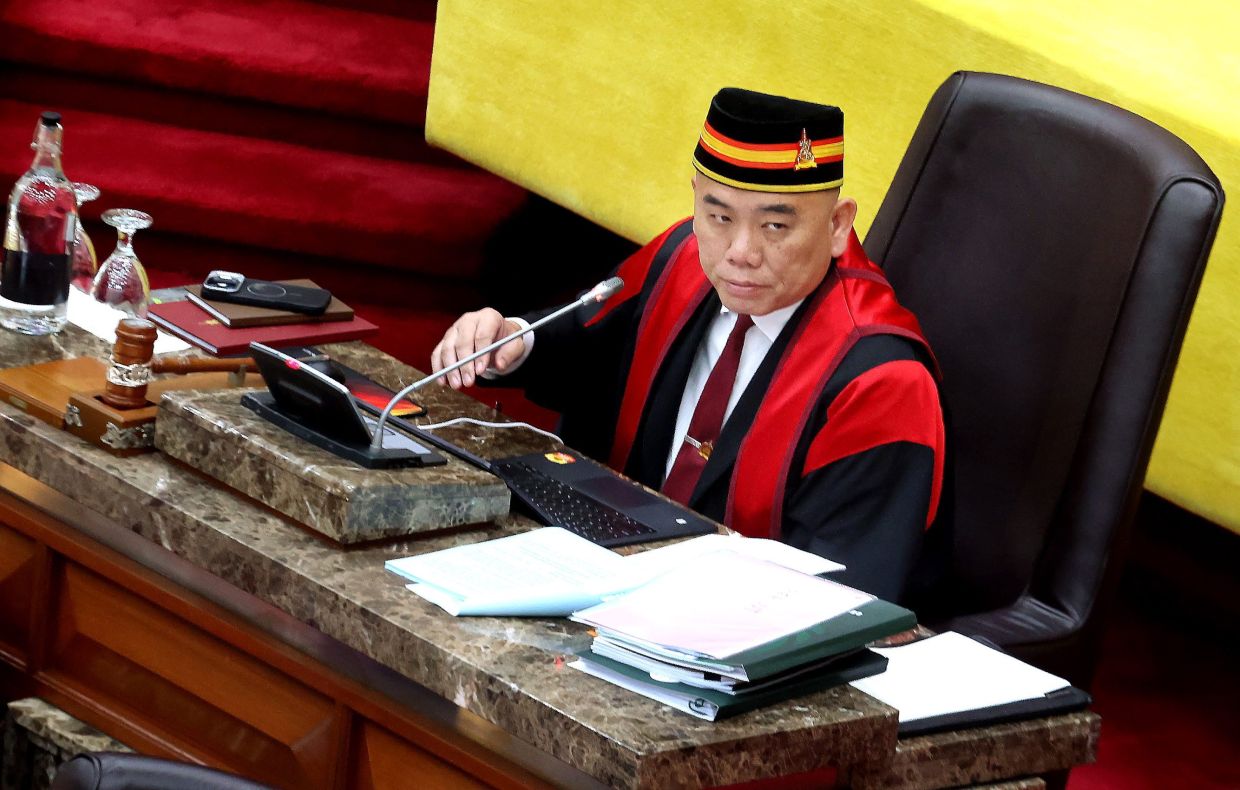
A cloud of uncertainty hangs over Selangor's legislative assembly following revelations that one of its members faces allegations of bankruptcy, prompting a formal investigation that Speaker Lau Weng San says is still in its preliminary stages. The probe, which commenced after the allegations surfaced, encompasses multiple dimensions including the circumstances surrounding the lawmaker's financial status, the verification of claims through relevant institutions, and potential consequences under state electoral law. Lau, speaking after proceedings at Bangunan Dewan Negeri Selangor on Monday, has declined to disclose which assemblyman is at the centre of the inquiry, maintaining that premature identification could prejudice the investigation.
The Speaker's cautious approach reflects the gravity of the matter, given that bankruptcy carries significant implications for legislative eligibility in Malaysia. Under constitutional provisions governing state assemblies, an individual declared insolvent may face questions about their ability to hold elected office, though the precise circumstances and applicable regulations can vary. Lau's statement that investigators will examine "all parties, all constituencies and all other relevant aspects" suggests a comprehensive approach intended to establish whether the allegations hold substance and to identify any procedural irregularities.
Central to the unfolding situation is the jurisdictional division between the state legislature and national electoral machinery. Lau made explicit that any determination regarding whether a by-election becomes necessary will rest with the Election Commission rather than the Selangor Speaker's office. This delineation is crucial because if an assemblyman's seat must be vacated due to bankruptcy, the electoral body would need to trigger a by-election to fill the vacancy, potentially reshaping the political composition of the state assembly at a critical juncture.
The Speaker resisted pressure to provide a timeline for concluding the investigation, emphasizing that thoroughness cannot be sacrificed for speed. His statement that "we have to be sure of everything first. We cannot make any assumptions" underscores the institutional responsibility to proceed methodically, avoiding conclusions based on incomplete evidence. This measured stance also guards against potential legal challenges should the investigation eventually lead to action against the assemblyman in question.
One of the more intriguing dimensions of Lau's comments concerns the relationship between the bankruptcy allegations and an assemblyman's absence from Monday's sitting. When pressed on whether the individual under investigation had been noticeably absent that day, Lau deflected by noting that lawmakers frequently miss proceedings for legitimate reasons including medical leave and other approved absences. This response suggests that absence alone cannot be used as circumstantial evidence, and that the investigation is proceeding on firmer evidentiary grounds than mere non-attendance patterns.
Under the Selangor State Constitution, an assemblyman's seat can only be formally declared vacant by the Speaker if the representative accumulates six consecutive months of absence from assembly sittings without submitting formal notice or authorization for their non-attendance. This procedural safeguard exists to prevent arbitrary removal of elected representatives and to ensure that temporary absences—whether due to illness, family emergencies, or official duties—do not trigger cascading constitutional consequences. The six-month threshold is deliberately stringent, reflecting the principle that legislators should not be precipitously deprived of their seats.
The Speaker's invocation of the case involving former Batang Kali assemblyman Harumaini Omar, whose seat was declared vacant on February 16, 2023, after exceeding the six-month absence limit, illustrates how this provision operates in practice. Omar's circumstances differed substantially from the current situation, as his removal stemmed from prolonged non-attendance rather than financial insolvency. Nevertheless, the precedent demonstrates that the Speaker possesses the authority to act decisively when constitutional conditions are satisfied, and that such actions are not merely theoretical.
For Selangor's political landscape, the investigation carries wider ramifications beyond the individual assemblyman involved. The state coalition government maintains a precarious working majority in the legislature, meaning that the loss of even one seat could alter the mathematical basis of its governance. Depending on the composition of the assembly and existing political alignments, a by-election triggered by this matter could become a referendum on government performance or an opportunity for opposition parties to improve their parliamentary standing.
The manner in which this investigation concludes will also set a precedent for how the Selangor assembly handles future allegations affecting the eligibility or status of its members. In an era of heightened public scrutiny regarding financial probity and governance standards, the Speaker's methodical approach reflects broader institutional pressures to maintain credibility and public confidence in the legislative process. Any hasty or perceived biased handling could invite accusations that investigations are politically motivated rather than principled applications of constitutional law.
For Malaysian observers, the situation underscores persistent vulnerabilities in the oversight mechanisms governing legislators' financial conduct. While bankruptcy declarations are matters of public record maintained by the Insolvency Department, the verification that an elected representative has undergone such proceedings is not necessarily automatic or continuous. The present investigation suggests gaps in preventive systems designed to identify and address situations where sitting lawmakers may be financially compromised, raising broader questions about how state and federal legislatures should strengthen their monitoring frameworks.
The investigation's outcome remains uncertain, and Lau's refusal to speculate on timelines means that the assembly and public may face an extended period of ambiguity. This uncertainty itself carries consequences for legislative morale and public perception of institutional accountability. Nevertheless, the Speaker's commitment to a thorough, impartial investigation suggests that whatever conclusions emerge will rest on a solid evidentiary foundation rather than rumour or political calculation, preserving the integrity of Selangor's democratic institutions regardless of the ultimate findings.

