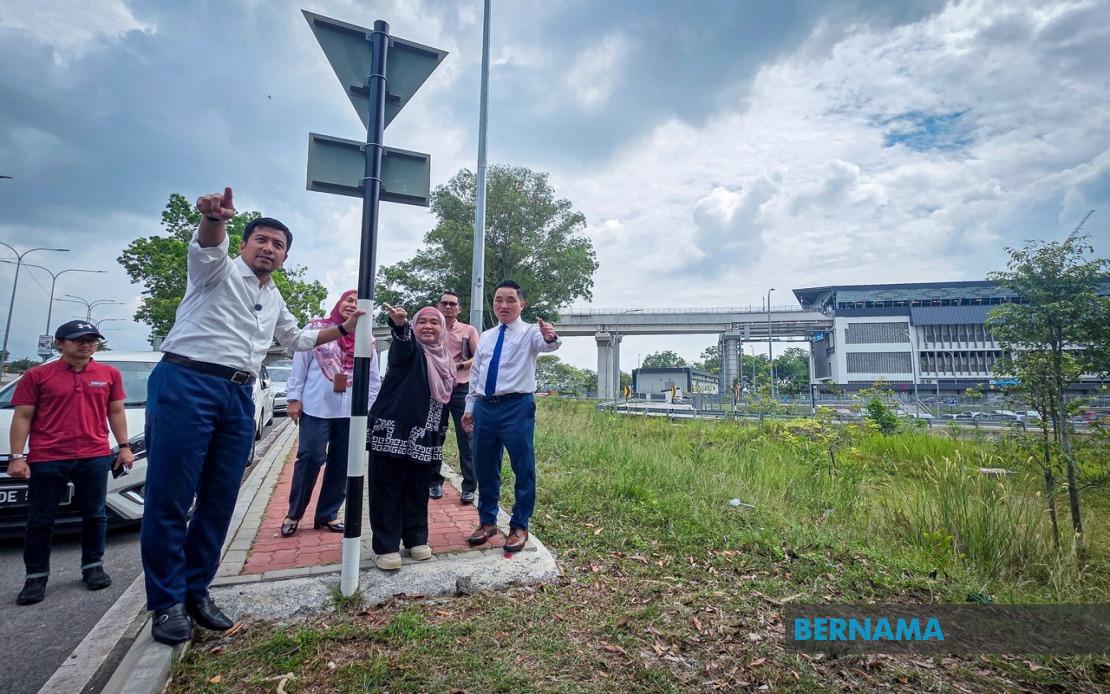
The Selangor State Government has committed to expediting the completion of connectivity infrastructure at Shah Alam Line LRT3 stations to enhance the transit experience for daily commuters. Speaking after an inspection of public facilities in Shah Alam on July 1, State Local Government and Tourism Exco Datuk Ng Suee Lim outlined the administration's proactive approach to addressing deficiencies discovered since the rapid transit line became operational. The state government recognises that while major infrastructure projects inherently contain initial shortcomings, the priority now lies in systematically identifying and rectifying these issues to ensure the LRT3 system functions optimally for users across the Selangor corridor.
Two stations have emerged as focal points for immediate intervention. At Dato' Menteri Station, officials are concentrating on expediting the installation of pedestrian walkways and zebra crossings, with Prasarana Malaysia Berhad instructed to complete these essential facilities within a two-month timeframe. The delays at this station stem partly from administrative processes including permit applications, which the state government has now fast-tracked. Simultaneously, Shah Alam Stadium Station presents a more complex timeline, as the connectivity improvements involve a tender process controlled by adjacent private developers. Nevertheless, Selangor authorities have pledged to closely monitor progress at this location to ensure developers meet agreed deadlines.
The inspection visits underscore a broader philosophy within the Selangor administration acknowledging that perfection in infrastructure delivery is aspirational rather than guaranteed. Datuk Ng articulated this candidly, noting that completed projects frequently reveal weaknesses only once actual operations commence and users interact with the facilities. By adopting a transparent stance on these initial deficiencies, the state government positions itself as responsive rather than defensive, a crucial distinction for public confidence in state institutions. The approach also signals that accountability does not end at project handover but extends throughout the operational lifecycle of major public infrastructure.
The Shah Alam City Council (MBSA) will play a coordination role in overseeing these improvements, working alongside Prasarana and private developers to ensure systematic progress. Additionally, the Selangor government has instructed all Local Authorities (PBT) with LRT3 stations within their jurisdictions to conduct comprehensive reviews identifying any connectivity gaps. This decentralised approach leverages local government structures to detect issues at the ground level, enabling faster remedial action. The coordination mechanism extends to the Royal Klang City Council (MBDK), which will similarly be tasked with monitoring implementation progress across affected districts.
The commitment to resolve these infrastructure gaps carries particular significance for Southeast Asian readers, as the LRT3 represents a major regional investment in sustainable urban mobility. Malaysia's positioning as a leader in ASEAN transportation infrastructure development depends partly on how successfully systems like the Shah Alam Line function in practice. Delayed or substandard connectivity around stations directly impacts ridership levels, operational efficiency, and the broader adoption of public transport alternatives to private vehicles. The Selangor government's decision to prioritise these matters reflects an understanding that last-mile connectivity—the journey from residential areas to transit stations—fundamentally determines whether infrastructure investments achieve their intended outcomes.
The involvement of Exco Youth, Sports and Entrepreneurship Mohd Najwan Halimi in the inspection suggests the state recognises potential ripple effects beyond pure transportation. Adequate facilities around stadium and major venues influence visitor experiences and local economic activity dependent on foot traffic. Pedestrian infrastructure, zebra crossings, and proper walkways create safer, more inviting environments that encourage public space usage and support local commerce surrounding transit hubs. In Selangor, where rapid urbanisation continues to reshape residential patterns and commuting behaviour, these connectivity investments become instruments of broader urban development policy.
The two-month deadline imposed on Prasarana for Dato' Menteri Station represents a measurable commitment that allows stakeholders to assess government resolve. Public transit systems in rapidly developing regions often suffer from perception gaps between official promises and actual delivery timelines. Clear deadlines, combined with stated monitoring mechanisms involving both state and local authorities, help narrow this gap. The fact that multiple government bodies—state exco, local councils, and Prasarana—are explicitly coordinated in overseeing these improvements suggests a shift towards more integrated project governance.
For Malaysian commuters and those planning travel to Selangor, these announcements carry practical implications. The LRT3 was designed to alleviate congestion in the Klang Valley and provide reliable connectivity between Shah Alam and central Kuala Lumpur. However, infrastructure is only as effective as the experience it creates for users. A passenger arriving at a station but finding inadequate pedestrian pathways faces barriers that discourage continued use, potentially reverting to private vehicles. Conversely, well-maintained walkways, clear markings, and accessible crossing points transform transit stations into genuine community assets.
The inspection mechanism outlined by the Selangor government also establishes a precedent for ongoing infrastructure assessment. Rather than viewing project completion as the endpoint, this approach recognises that public infrastructure requires continuous evaluation and adaptive management. Involving council members and assemblymen in gathering feedback creates multiple channels through which issues can surface, preventing problems from accumulating undetected. This distributed accountability structure, while potentially slower than centralised decision-making, tends to generate more contextualised solutions addressing specific local conditions.
The broader context of LRT3's development and current operational challenges reflects wider patterns in Southeast Asian infrastructure expansion. Rapid urbanisation, population growth, and the pressure to deliver visible results sometimes create tension between ambitious timelines and detailed execution. The Selangor government's current approach—acknowledging initial weaknesses while demonstrating commitment to systematic resolution—suggests political maturity in recognising that long-term public confidence depends on consistent follow-through rather than inaugural triumphalism.
Moving forward, the success of these initiatives will depend heavily on whether Prasarana and private developers adhere to stipulated timelines and whether local authorities execute their monitoring responsibilities effectively. The two-month window at Dato' Menteri Station will provide the first meaningful test of government determination to deliver on these commitments. Beyond these immediate priorities, the broader directive to all PBT bodies to audit connectivity at their respective stations indicates the Selangor government is treating this as a systematic challenge rather than isolated incidents. This holistic approach to infrastructure refinement, properly executed, could establish models worthy of replication across other transit systems in Malaysia and the broader Southeast Asian region.

