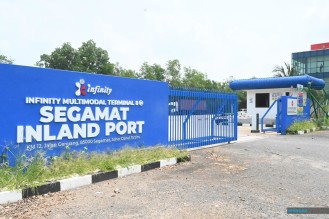
Segamat Inland Port (SIP) has set an ambitious target of handling more than 6,000 twenty-foot equivalent units (TEUs) of containers by the end of the year, building on its recent return to active operations. The facility, which reopened in late June after more than a decade of dormancy, handled approximately 1,000 TEUs during its inaugural month of operations through July, according to SIP manager Samuel Ho. This revival marks a significant shift in Malaysia's approach to freight logistics, particularly for the industrial heartland spanning northern Johor, southern Pahang, southern Negeri Sembilan and Melaka.
The reactivation of Segamat Inland Port represents a carefully considered policy response to mounting pressures on Malaysia's road transport network. With tens of thousands of container trucks clogging highways monthly, government planners recognised that rail-based alternatives could offer substantial economic and safety dividends. Ho emphasised that the shift towards rail transport addresses multiple objectives simultaneously: reducing vehicle accident risks inherent in road haulage, alleviating congestion-related delays, and diminishing diesel fuel consumption across the supply chain. A single freight train journey can substitute for approximately 80 container truck movements, a factor that reshapes the cost-benefit calculus for logistics operators serving the region.
A critical enabler of SIP's viability is the completion of double-tracking infrastructure along the railway corridor to Johor. Previously, single-track operations severely constrained scheduling flexibility, forcing freight services to defer to passenger train priorities. This structural limitation meant the facility could accommodate only about one cargo trip weekly. The infrastructure upgrade has transformed operational capacity dramatically. SIP now accommodates up to four cargo receiving and dispatch cycles per week, providing the scheduling predictability and frequency that modern supply chains demand. This represents a fourfold increase in throughput potential, fundamentally altering the facility's economic proposition.
The inland port's strategic positioning as a rail hub serves multiple industrial nodes across the Johor–Pahang–Negeri Sembilan corridor. Its location alongside Segamat Railway Station positions it as a natural consolidation point for cargo bound to and from major maritime gateways including Port Klang, Port of Tanjung Pelepas, and Johor Port in Pasir Gudang. This multipurpose connectivity transforms SIP into more than a single-purpose facility; it becomes an essential junction in Malaysia's broader logistics architecture. The implications extend beyond immediate cargo throughput to encompass broader economic restructuring, as investors increasingly factor transportation reliability into location decisions for manufacturing and warehousing investments.
The employment dimension of SIP's reactivation deserves careful attention for Malaysia's ongoing industrialisation strategy. The first phase of operations, conducted across 20.23 hectares alongside the railway station, has already generated over 200 jobs for local residents. As subsequent developmental phases materialise, employment prospects will expand correspondingly. Beyond direct employment in cargo handling and rail operations, the facility catalyses secondary job creation through expanded warehouse and logistics services in surrounding industrial zones. Ho noted the indirect potential to attract manufacturing investments to northern Johor districts such as Batu Pahat and Kluang, where existing infrastructure limitations have previously constrained economic development.
Segamat Inland Port's development unfolds across three planned phases, with the present phase representing the foundation for future expansion. This staged approach allows operators to validate market demand and operational efficiency before committing to larger capital investments. The phased model also accommodates emerging technologies and logistics methodologies, permitting adaptation as industry standards evolve. Full development could substantially expand the facility's footprint and handling capacity, positioning it as a cornerstone of Malaysia's rail-based logistics network for decades.
Academic partnerships constitute an underappreciated dimension of SIP's revival strategy. Collaboration with Universiti Tun Hussein Onn Malaysia (UTHM) establishes mechanisms for knowledge transfer and research into rail-based inland port operations. These partnerships generate fieldwork exposure for students while producing original research on operational efficiency and best practices. Such institutional linkages strengthen Malaysia's human capital in logistics specialisation and position universities as contributors to transport policy development.
The quantified environmental and congestion benefits provide compelling justification for continued investment in SIP and comparable rail alternatives. The facility's operation is projected to eliminate approximately 18,000 lorry movements—encompassing both standard trucks and articulated trailers—from Malaysian roads monthly. This reduction delivers multiple externalities: reduced fuel consumption, diminished particulate emissions, enhanced road safety through lower traffic volumes, and decreased wear on highway infrastructure. For policymakers concerned with achieving carbon reduction targets while accommodating trade growth, such rail-based solutions offer measurable pathways forward.
Transport Minister Anthony Loke Siew Fook's official launch of SIP in June positioned the facility within the government's broader Road to Rail initiative, signalling high-level policy commitment to rail transport expansion. The minister articulated expectations that SIP would catalyse regional economic development in northern Johor while strengthening Malaysia's integrated logistics capabilities. This ministerial endorsement provides political stability for long-term operational planning and signals likely continued government support for similar inland port projects elsewhere in Malaysia. The framing of SIP as a development catalyst rather than merely a logistics facility reflects contemporary understanding of transport infrastructure's role in regional economic transformation.
The original establishment of Segamat Inland Port in 1997 ended in relative dormancy, a cautionary reminder that infrastructure alone cannot guarantee success. The facility's reactivation differs fundamentally from its initial iteration through improved rail connectivity, clearer market demand, and demonstrated willingness from operators like Infinity Logistics & Transport to manage the facility professionally. These lessons—regarding stakeholder coordination, infrastructure complementarity, and operational management—inform current thinking about Malaysia's emerging logistics network.
Looking forward, Segamat Inland Port's trajectory will substantially influence Malaysia's transport sector evolution. Achievement of the 6,000-TEU target would validate the underlying logistics model and justify similar investments elsewhere. Conversely, shortfalls would prompt necessary recalibration of assumptions regarding rail logistics competitiveness. The facility thus represents both immediate economic activity and a policy experiment with implications extending across Malaysia's transport infrastructure planning.

