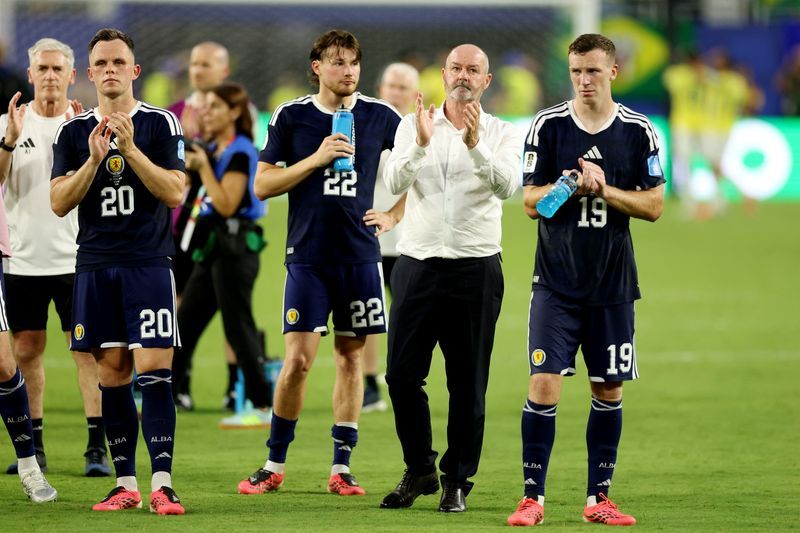
Scotland's World Cup journey is effectively over. After their 3-0 hammering at the hands of Brazil in Group C on Wednesday, coach Steve Clarke has little doubt that his team will be boarding flights home earlier than hoped, ending what was meant to be a triumphant return to football's biggest tournament after nearly three decades away. The Scots entered the final group match needing a positive result to keep alive their mathematically slender hopes of advancing as one of the eight best third-placed teams across the tournament's 12 groups, but instead delivered a performance that left their manager exasperated and convinced of their impending elimination.
While Scotland's three points do technically keep them in contention for a maiden knockout-stage appearance at a World Cup, Clarke's pragmatic assessment suggests the mathematics will work against them. The Scots currently hold the sixth-best record among third-placed teams, but with 20 group matches still to be played, Clarke believes at least two other nations will surpass their tally, relegating Scotland to the sidelines. His resignation appears rooted not in pessimism but in realism—an honest appraisal of the gap between his team's actual display and what would be required to overcome the inevitable points haul of other contenders.
The manner of Scotland's defeat weighed heavily on Clarke's mind during his post-match reflections. He offered no excuses, instead pinpointing his own team's fundamental lapses as the architects of their downfall. Brazil, Clarke acknowledged, represents a calibre of opponent that punishes mistakes with ruthless efficiency, and Scotland obliged by serving up defensive errors on a plate. The coach's candid assessment that Scotland "gave them" the first two goals and "probably the third" as well reveals the frustration of a manager watching his side engineer their own demise through careless play rather than being outclassed by superior technique alone.
Yet Clarke's criticism was not untempered. He recognised that Brazil, despite the scoreline, also squandered opportunities that could have been converted, and that goalkeeper Angus Gunn produced several crucial saves to limit the damage. Scotland created occasional opportunities of their own, though Clarke was careful to note they lacked the clinical edge or quality to trouble the Brazilian defence consistently. The portrait that emerges is of a mismatch not entirely attributable to one-sided dominance but partly to Scotland's inability to be competitive across the ninety minutes—a distinction that, while perhaps academic in outcome, matters to a coach seeking to maintain perspective about his team's true capabilities.
The 3-0 scoreline stung Clarke not because it was undeserved but because it suggested Scotland had underperformed relative to their potential. The frustration in his voice was directed at the gap between what this squad has demonstrated it can achieve in previous competitions and what they produced under the bright lights of American stadiums. Clarke made clear he was not angry with the players who engineered Scotland's first World Cup qualification in 24 years—a qualification that represents genuine achievement given the competitive strength of European qualifying groups. Rather, his disappointment stemmed from witnessing a team fall short of standards they had set for themselves during their journey to Qatar.
Beyond the immediate tournament result, Clarke used the defeat as a springboard to address systemic concerns within Scottish football itself. Reflecting on the physicality, power, and technical execution displayed by both Morocco and Brazil throughout their respective campaigns, he identified a troubling gap that demands attention from Scottish football's governing structures. Clarke's argument extends beyond excuses; he contends that Scotland's development pathways must improve dramatically to produce young talent capable of competing consistently on the world stage. The observation cuts to the heart of Scottish football's long-term ambitions and suggests that fixing the immediate problems requires investment and structural reform at youth and academy levels.
The relationship between Scotland's players and their supporters remained a bright spot in an otherwise disappointing campaign. The Tartan Army's presence in America had generated considerable goodwill and positive headlines throughout the tournament, and Clarke was keen to acknowledge their contribution and conduct. However, he also sought to reframe the narrative slightly, reminding fans that their presence in the United States existed only because of the players' achievements in qualifying. His gentle rebuke contained an important message: the team had delivered something fundamental by reaching the World Cup at all, a feat that had eluded Scotland for nearly three decades and one that supporters should not overlook in the disappointment of early elimination.
Clarke's final thoughts returned to perspective. He stressed that without this group of players, Scottish supporters would be sitting at home watching the World Cup unfold without their national team in the tournament—a reality that had been Scotland's default state since 1998. While the team's on-field performance had fallen short of expectations and their tournament run would conclude with three group matches played rather than advancement to knockout football, Clarke appeared intent on ensuring the substantial achievement of qualification was not completely overshadowed by the manner of their departure. The Scotland manager's measured tone suggested acceptance of both the team's limitations and the genuine milestone represented by their return to the World Cup stage.

