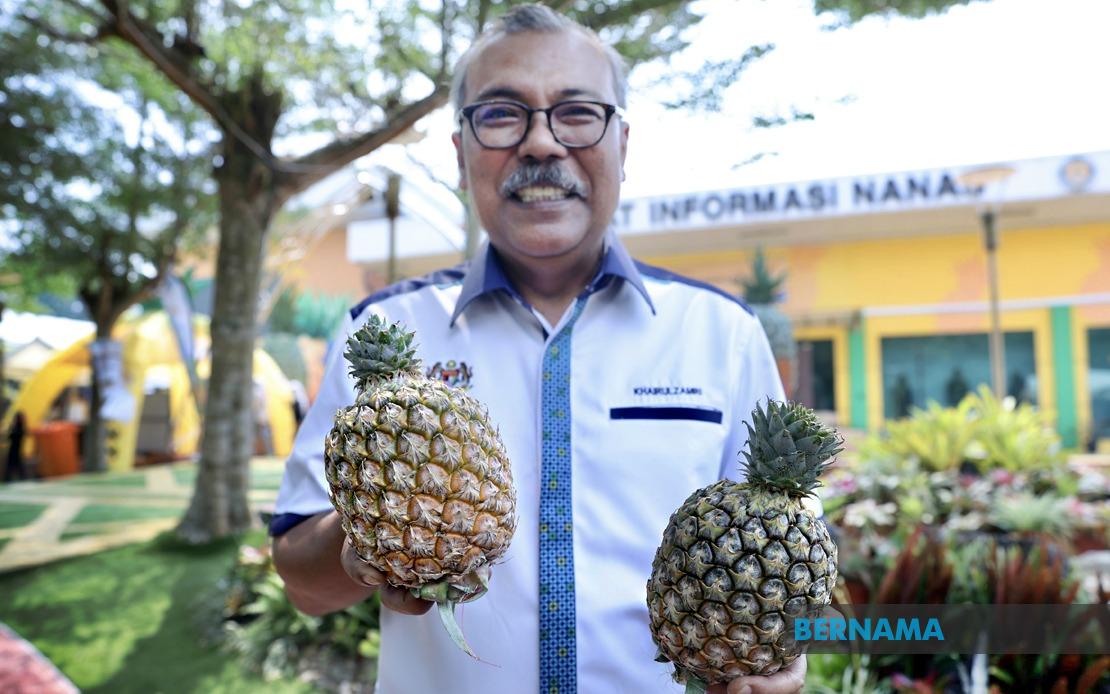
A newly developed pineapple variety originating from Sarawak is commanding visitor attention at the Malaysia Agriculture Expo Park (MAEPS) during MAHA 2026, which opened on August 28 and runs through September 6. The Sarawak Gold, designated as SG1, represents a significant agricultural innovation for Malaysia's tropical farming sector, with seven tonnes of the fruit brought in from Sarawak to provide attendees with direct experience of its distinctive characteristics.
Mohd Khairuzamri M. Salleh, director-general of the Malaysian Pineapple Industry Board (LPNM), describes SG1 as a premium variety with substantial commercial viability. First cultivated in Miri, this pineapple distinguishes itself through multiple advantageous traits that address longstanding challenges in commercial cultivation. The fruit achieves a sweetness profile competitive with MD2, the industry standard that currently dominates both domestic and international markets. Beyond flavour, SG1 exhibits an aesthetically distinctive crown with a remarkable rose-like appearance, a feature that enhances its appeal for premium market positioning and retail presentation.
The agronomic advantages of SG1 position it as potentially transformative for Malaysian pineapple growers. Unlike MD2 varieties requiring fourteen months from planting to harvest, SG1 reaches maturity within just nine months, substantially accelerating production cycles and improving farm profitability through reduced land occupation time and faster capital recovery. This faster maturation is particularly significant for smallholder farmers seeking to maximize returns from limited acreage, a critical consideration across Southeast Asia where land constraints frequently limit agricultural expansion.
Planting density represents another compelling advantage. SG1 can be cultivated at remarkably high densities between 25,000 and 30,000 plants per acre, compared to conventional spacing requirements for other varieties. This capability allows farmers to significantly increase yield per unit area without requiring substantial land acquisition, addressing sustainability concerns while improving economic efficiency. For densely populated regions of Malaysia and Southeast Asia, this characteristic offers pathways to enhanced productivity within existing geographic constraints.
Quality consistency throughout the fruit addresses a perennial challenge in pineapple commerce. SG1 delivers uniform flavour and quality from top to bottom, eliminating the variability that sometimes frustrates both consumers and export partners. This consistency strengthens commercial reliability and supports premium pricing strategies, particularly important as Malaysia seeks to differentiate its agricultural exports in increasingly competitive global markets dominated by established producers in Costa Rica, the Philippines, and Vietnam.
The LPNM is actively pursuing geographic expansion of SG1 cultivation beyond its Sarawak origins to Peninsular Malaysia. Seedlings are anticipated to reach growers through expanded distribution networks beginning next year, facilitating rapid adoption across Malaysia's primary agricultural regions. This coordinated rollout strategy suggests institutional commitment to establishing SG1 as a new competitive standard within Malaysian pineapple production, potentially reshaping the sector's competitive position.
International market development is proceeding through carefully structured trial shipments. Sarawak-origin SG1 pineapples have already been successfully exported to Singapore, establishing proof of concept for international commercial viability. This success provides confidence for pursuing larger market opportunities in jurisdictions offering premium pricing for superior quality products. China and New Zealand emerge as particularly attractive targets given their established preference for high-quality tropical fruits and willingness to command price premiums for consistency and distinctive characteristics.
The MAHA 2026 exhibition itself carries thematic significance beyond simply showcasing SG1. Presented under the banner "Value Creation for Food Security," the pineapple section aims to reshape public and industry understanding of the crop's comprehensive economic value. The messaging framework of "one planting, three harvests" encapsulates this broader perspective, moving beyond the conventional focus on fresh fruit consumption toward recognizing the entire plant's utility. Pineapple seeds represent a secondary harvest stream, while plant waste materials possess significant secondary-processing potential.
This waste valorization dimension carries substantial environmental and economic implications. Processing by-products traditionally discarded now represent feedstock for ruminant animal feed, textile manufacturing, and paper production. These value-added applications extend the economic significance of each pineapple plant substantially beyond fresh fruit sales, creating multiple revenue streams for integrated farming operations. Such circular economy approaches align with Malaysia's broader sustainability commitments while enhancing farm viability, particularly important as input costs continue escalating across Southeast Asian agriculture.
MAHA 2026 itself represents a major platform for agricultural showcase, featuring approximately 2,000 exhibitors and projecting over four million visitors through its September 6 conclusion date. Within this context, SG1's prominent placement reflects institutional recognition of its strategic importance for Malaysian agricultural competitiveness. The variety potentially addresses several concurrent pressures facing the sector: yield enhancement per unit area, production cycle acceleration, quality consistency, and export market expansion.
For Malaysian farmers, SG1 offers tangible advantages in an increasingly demanding agricultural environment. The combination of faster maturation, high-density cultivation potential, and superior export quality creates economic incentives for variety adoption that extend beyond traditional financial calculations. Regional competitors in Thailand, Vietnam, and Indonesia will observe SG1's performance closely, recognizing that successful variety development confers competitive advantage across Southeast Asian markets.
The broader significance of SG1 extends to Malaysia's positioning within global agricultural innovation. Development and commercialization of proprietary plant varieties demonstrates domestic scientific capability and creates intellectual property value. As tropical agricultural regions increasingly compete on quality and differentiation rather than volume, varieties like SG1 provide genuine competitive advantage. The combination of durability, distinctive market characteristics, and expansion-ready propagation capacity positions SG1 as a genuine strategic asset for Malaysian agricultural development.

