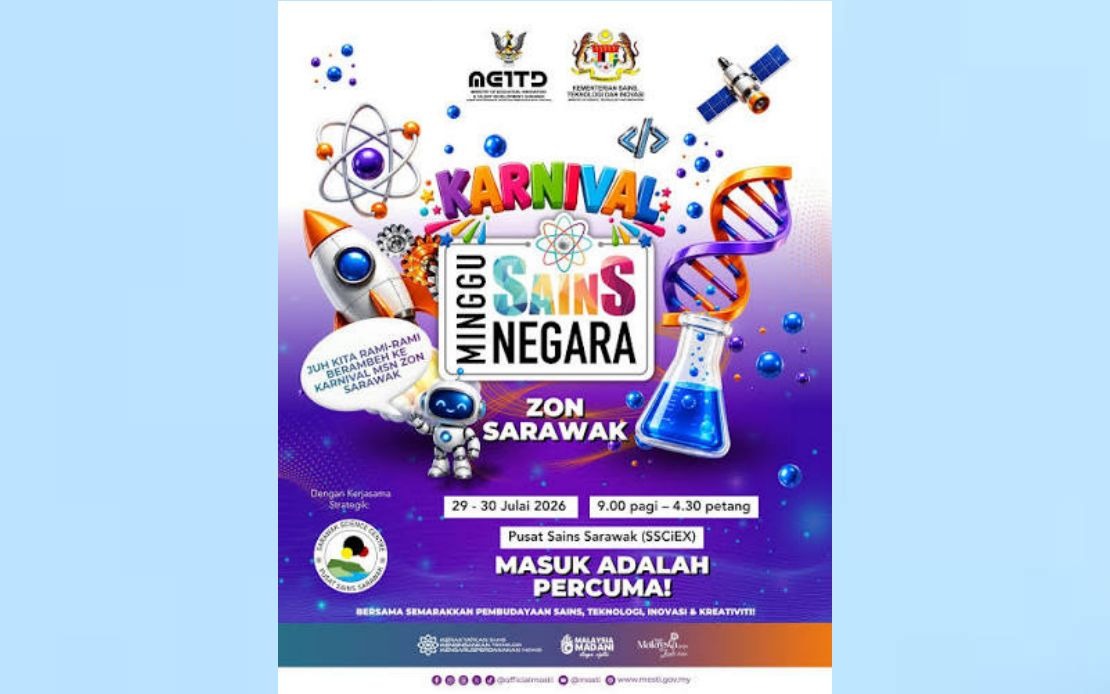
The Ministry of Science, Technology and Innovation officially unveiled the National Science Week Carnival 2026 for Sarawak in Kuching on July 30, marking a significant step in the government's effort to democratise access to science, technology and innovation across Malaysia's geographically diverse landscape. The launch, held at the Sarawak Science Centre under the patronage of the state's Minister of Education, Innovation and Talent Development Datuk Seri Roland Sagah Wee Inn, underscores a deliberate pivot towards reaching communities beyond urban centres.
A central theme of this year's carnival is the acknowledgement that scientific progress and technological advancement must not remain confined to developed areas. The initiative directly confronts Malaysia's persistent geographic divide in educational access, where interior regions and rural settlements often lack exposure to hands-on STEM learning experiences. By bringing the carnival to Sarawak's interior zones, the ministry recognises that nurturing a technology-literate generation requires intentional infrastructure and programming that extends beyond conventional urban venues.
According to MOSTI's secretary-general Datuk Dr Nagulendran Kangayatkarasu, the 2026 carnival functions as a cornerstone programme within the government's broader strategy to embed scientific thinking and innovation practices into Malaysian culture. His remarks highlighted that this is not merely an educational outreach exercise but a fundamental reimagining of how the nation approaches STEM engagement across its population. The framing of MSN 2026 as a key government initiative suggests sustained political commitment to science promotion as a development priority.
The STEM Catalysts Programme represents the operational mechanism through which the carnival achieves its geographic reach. By targeting rural schools specifically in Meradong, Bintulu and Belaga districts—areas that face genuine challenges in accessing STEM resources and expertise—the programme acknowledges that passive access to information differs fundamentally from active engagement with scientific concepts. The two-day format of the physical carnival allows for immersive experiences that classroom settings alone cannot provide, potentially sparking genuine interest among students who might otherwise have limited exposure to scientific careers and possibilities.
A particularly noteworthy element of this year's carnival is the introduction of nuclear technology advocacy as a major component. This shift carries significant implications for Malaysia's energy transition discourse. By integrating nuclear technology education into a science carnival, the government signals its openness to incorporating nuclear energy into national conversations about sustainable development and future power generation. The emphasis on public confidence and social acceptance suggests that previous resistance or unfamiliarity with nuclear technology is being deliberately addressed through education and demystification at the grassroots level.
The deployment of the sainsrakyat.my citizen science platform represents an innovative democratisation of research participation. Rather than confining scientific data collection to professional researchers, this platform invites ordinary citizens—including those in remote communities—to contribute meaningful observations and measurements to legitimate scientific research. For rural Sarawak, this means that local knowledge and environmental observations can feed into nationally significant research projects, effectively transforming community members from passive consumers of science into active contributors to knowledge generation.
The implications of this citizen science approach extend beyond immediate research applications. By involving rural communities in data collection for real-world scientific investigations, the platform challenges the perception that science is something abstract or distant from everyday life. Instead, it demonstrates how scientific methodology directly addresses local environmental, agricultural and health challenges that matter to these communities. This grounding of science in tangible local benefit potentially creates more sustained engagement than abstract educational messaging alone.
For Malaysian policymakers and educators, the Sarawak Zone carnival model offers a template that could address ongoing concerns about STEM uptake and diversity in the workforce. Many rural areas struggle to produce sufficient science and engineering graduates, partly because young people lack exposure to these fields and their career possibilities. By bringing dynamic, hands-on science experiences to secondary schools in districts like Belaga and Meradong, the initiative directly influences the educational and career aspirations of the demographic most likely to shape Malaysia's innovation capacity in coming decades.
The geographic focus on Sarawak also reflects broader Southeast Asian patterns. Many nations in the region face similar challenges in extending quality science education to rural populations, and Malaysia's structured approach to this problem could offer lessons for neighbouring countries. The combination of physical events, digital platforms, and targeted school programmes provides a comprehensive ecosystem for science engagement that doesn't rely solely on any single intervention method.
Looking forward, the success of the 2026 carnival will likely be measured not just by immediate attendance figures or media coverage, but by whether it catalyses longer-term shifts in STEM interest and participation among Sarawak's rural student populations. The integration of multiple engagement mechanisms—traditional carnival experiences, citizen science platforms, and school outreach—suggests that the ministry understands that sustainable cultural change requires multifaceted approaches rather than one-off interventions.
For the broader Malaysian innovation ecosystem, this carnival represents an investment in human capital development that extends beyond immediate economic returns. By nurturing scientific curiosity and technological literacy across geographic and socioeconomic boundaries, the nation builds foundations for inclusive development and ensures that innovation contributions can emerge from any community. The Sarawak Zone launch thus serves both immediate educational purposes and longer-term national competitiveness objectives.

