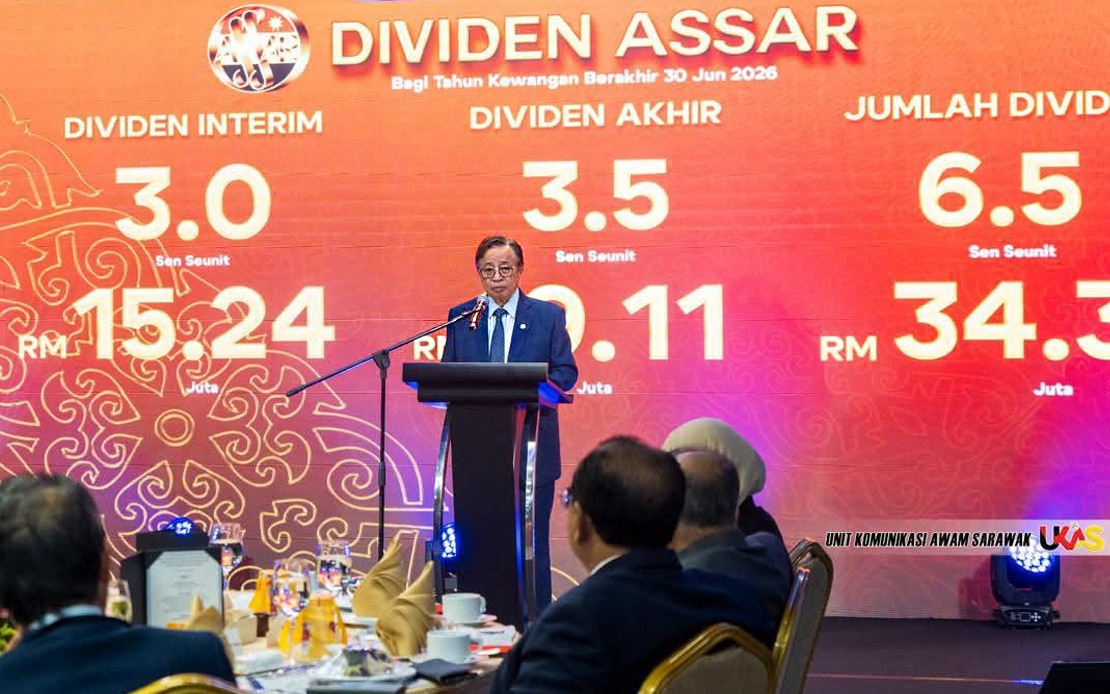
The Sarawak state government is exploring a significant expansion of its flagship investment scheme to create broader participation across the state's diverse population. At the announcement of ASSAR dividend payouts for the financial year ending June 30, 2026, Sarawak Premier Tan Sri Abang Johari Tun Openg revealed that officials are studying the feasibility of launching ASSAR 2, a parallel investment vehicle that would extend participation rights to non-Bumiputera residents currently excluded from the original Amanah Saham Sarawak scheme.
The current ASSAR structure has long served as a cornerstone of the state's wealth-sharing model, channeling investment returns to Bumiputera communities. Yet economic dynamics and demographic composition have prompted the government to reconsider whether maintaining a single-channel approach represents the most efficient use of capital accumulation potential. The proposal to establish ASSAR 2 reflects a deliberate policy shift toward what Abang Johari characterised as an inclusive approach, moving beyond traditional Bumiputera-only frameworks that have defined Malaysian investment schemes for decades.
Abang Johari indicated that the ASSAR board and management team will conduct a comprehensive review to determine whether such an expansion remains operationally and financially sound. The government is benchmarking this potential new structure against Permodalan Nasional Berhad (PNB), the federal wealth fund that has successfully managed dual-tier investment products for different participant categories. PNB's experience with multiple funds serving varying investor profiles provides a tested template that Sarawak policymakers can study to understand how parallel schemes can operate simultaneously without cannibilising each other or creating administrative redundancies.
The rationale underlying this initiative reveals an important economic calculation. Sarawak's economy has demonstrated sustained growth momentum, creating a compelling argument for deepening the pool of local capital participation. By restricting ASSAR to Bumiputera investors alone, the government acknowledges that it may be leaving substantial investment capacity on the table from the non-Bumiputera population. Launching ASSAR 2 would theoretically allow the state to mobilise additional domestic savings that might otherwise flow toward external investment vehicles or remain in unproductive cash holdings. This represents a practical approach to capital mobilisation at the state level, particularly as Sarawak pursues ambitious economic diversification and infrastructure projects.
The proposed structure carries implications extending beyond simple fund mechanics. Abang Johari specifically noted that expanding investment opportunities to non-Bumiputera Sarawakians would deepen their engagement with the state economy and foster a shared stake in economic outcomes. This framing positions the initiative as more than a financial mechanism; it becomes a tool for inclusive economic citizenship and social cohesion. In an era of rising inequality and demographic polarisation across Southeast Asia, schemes that bridge traditional communal investment boundaries merit serious consideration, provided they do not erode support for established Bumiputera frameworks.
For Malaysian investors and policymakers monitoring state-level economic innovation, the Sarawak proposal signals a pragmatic readiness to adapt inherited structures to contemporary realities. The Bumiputera principle remains constitutionally entrenched and politically sacrosanct, yet the Sarawak government's willingness to create parallel vehicles rather than dismantle existing preferences demonstrates how accommodation and expansion can proceed simultaneously. This dual-channel model acknowledges both legacy commitments and forward-looking economic inclusion.
The timing of this announcement carries additional significance given Sarawak's ongoing push for greater fiscal autonomy and economic self-determination. By developing home-grown investment instruments that capture domestic capital, the state reduces dependency on federal mechanisms and strengthens local financial institutional capacity. An expanded ASSAR architecture that includes non-Bumiputera participation would represent an assertion of Sarawak's distinctive approach to managing inter-communal economic relations, separate from federal templates that have sometimes generated tensions across Malaysia's diverse states.
Implementation will require careful attention to governance architecture. A dual ASSAR system would necessitate clear definitions regarding investment thresholds, dividend distribution mechanisms, and board representation. The success of PNB's multi-fund approach stemmed partly from transparent operational separation and distinct but complementary investment mandates. Sarawak authorities would need to ensure that ASSAR and ASSAR 2 maintain sufficient independence to serve their respective constituencies fairly while capturing sufficient operational synergies to avoid duplication and inefficiency.
From a regional perspective, this development reflects a broader Southeast Asian trend toward reconsidering rigid affirmative action frameworks in light of demographic change and growth imperatives. Thailand, Indonesia, and the Philippines have all grappled with balancing preferential access provisions against the need for capital deepening and inclusive growth. Sarawak's experimental approach could generate valuable lessons for policymakers across the region wrestling with similar tensions between equity and efficiency.
The proposal also speaks to evolving conversations about national versus state identity in Malaysia. Sarawak has increasingly articulated a vision of economic development rooted in state particularism rather than federal uniformity. An ASSAR 2 scheme serving non-Bumiputera Sarawakians would reinforce a narrative of Sarawak as a distinctive economic community with its own rules and investment logic, separate from peninsular Malaysian templates. This assertion of state-level agency in economic matters forms part of a longer political arc of Sarawak asserting greater control over resource management and economic policy.
The coming months will determine whether this proposal advances from discussion to implementation. The board's feasibility assessment will address technical questions around fund sizing, management costs, and projected participation rates. Yet the mere emergence of this proposal demonstrates that even entrenched economic structures increasingly face pressure to evolve. As Sarawak charts its economic future, the consideration of ASSAR 2 represents a meaningful inflection point in how state governments might balance historical commitments with contemporary requirements for broader-based capital mobilisation and social inclusion.

