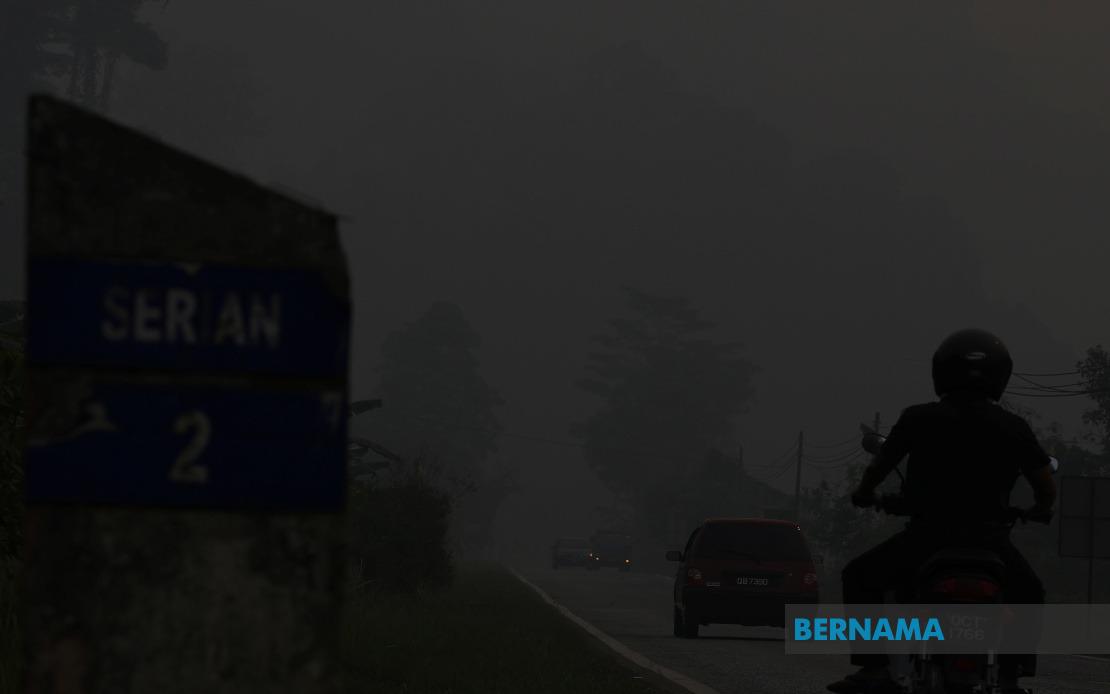
The Sarawak Disaster Management Committee has issued guidance to those planning events across the state, advising them to carefully evaluate atmospheric conditions before committing to schedules. While responsibility for final decisions rests with individual organisers, the committee emphasised the importance of putting public health considerations at the centre of such choices, particularly when outdoor activities are involved.
Datak Amar Douglas Uggah Embas, who chairs the SDMC and serves as Sarawak's Deputy Premier, stressed that organisers retain discretionary authority over their activities unless formal directives are issued by competent authorities. However, he outlined specific thresholds that should trigger organisers to reassess their plans. When air pollutant readings reach or exceed 200, outdoor physical activities, sporting events and strenuous exercise should face particular scrutiny, especially if participants include children, elderly individuals or other people at elevated health risk.
The committee encouraged event planners to explore pragmatic alternatives to cancellation when air quality deteriorates. Shifting activities from outdoor venues to indoor spaces represents one viable option, while modifying the nature or intensity of planned programmes offers another avenue. Postponement remains an option if conditions are expected to improve within a reasonable timeframe, allowing organisers to proceed without compromising participant wellbeing.
The guidance comes as Sarawak experienced a sharp decline in air quality during late August, with several monitoring stations recording readings in hazardous ranges. The Serian District Police Headquarters station registered the highest measurement at 412, indicating severely compromised air quality in that area. Samarahan followed with a reading of 332, while Kuching, the state capital, recorded 304 on the Air Pollutant Index.
Other regions across Sarawak experienced varying degrees of air degradation, with Sarikei reporting unhealthy levels at 197, while Sibu, Bintulu, Mukah, Samalaju and Kapit all fell in the unhealthy range between 156 and 190. The data originated from the Department of Environment's Air Pollutant Index Management System, which provides real-time monitoring across numerous stations throughout the state.
The SDMC outlined more stringent protocols for scenarios where conditions deteriorate substantially. Should API readings reach 500, established guidelines mandate the closure of government offices and private sector workplaces, with exceptions only for essential services. Such measures would require formal declaration by the National Disaster Management Committee designating the situation a Disaster Emergency, ensuring coordinated response across federal and state levels.
The committee is working in coordination with state and federal agencies to maintain continuous surveillance of atmospheric conditions. This collaborative approach enables the implementation of measures that escalate in proportion to the severity of air quality degradation, aligned with established protocols within the disaster management framework. Regular monitoring allows authorities to provide timely information to event organisers, enabling informed decision-making.
For Malaysian and Southeast Asian readers, the guidance reflects broader regional concerns about transboundary haze phenomena that periodically affect multiple countries. Sarawak's position on Borneo Island places it within a geography where seasonal agricultural burning practices in neighbouring regions can significantly impact air quality. Event organisers across the region face similar dilemmas during haze seasons, making the SDMC's structured approach potentially instructive for authorities elsewhere.
The emphasis on organiser responsibility rather than blanket restrictions represents a middle-ground approach that preserves economic and social activity while establishing clear health-based benchmarks for decision-making. This framework acknowledges that not all events pose equivalent risks, and that flexible responses often prove more practical than rigid prohibition. Small indoor gatherings face different air quality considerations than large outdoor athletic competitions or outdoor ceremonies.
The varying API readings across Sarawak's districts demonstrate that haze effects are geographically uneven, affecting some areas far more severely than others. Event organisers in less affected areas might reasonably proceed with activities while those in severely impacted zones undertake significant modifications. This spatial differentiation supports the committee's approach of providing guidance rather than imposing uniform mandates.
Community and private event organisers bear similar responsibility as those organising official functions, reflecting recognition that air pollution endangers all exposure populations regardless of event type or sponsorship. The inclusion of community events alongside official and private activities ensures equitable application of health protection principles across all sectors of society.

