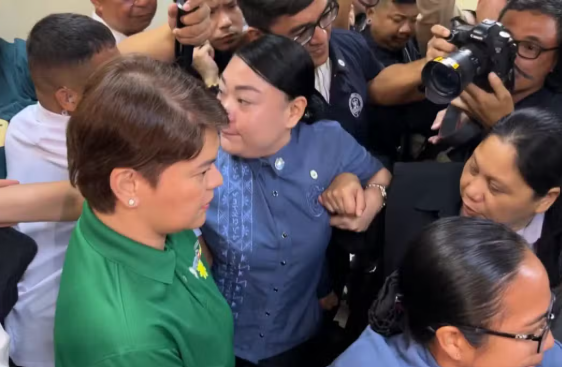
Philippine Vice President Sara Duterte arrived at the Senate on Tuesday to meet with her legal team, using the occasion to reaffirm her combative stance toward her ongoing impeachment trial. In remarks to journalists, she declared that whilst the proceedings would leave her "bloodied," she would ultimately remain "unbowed"—a defiant statement that directly echoes the famous closing lines of William Ernest Henley's poem "Invictus," which explores themes of human resilience and refusal to capitulate in the face of overwhelming pressure. The choice of rhetoric underscores how Duterte is framing her legal battle not merely as a constitutional process but as a test of her personal fortitude.
This latest pronouncement represents a continuation of Duterte's combative approach to the impeachment process, which she first publicly characterised as a "bloodbath" in May 2025. Her willingness to embrace such inflammatory language reveals her strategy of controlling the narrative surrounding the trial—positioning herself as a victim of political persecution rather than as a public servant answering legitimate questions about her governance. However, this rhetorical posturing stands in sharp contrast to her actual engagement with the proceedings. Duterte has notably abstained from attending most impeachment hearings held in 2025 and 2026, a boycott that has drawn considerable criticism from both opposition lawmakers and commentators who argue that her absence undermines the legitimacy of her claims about the trial's unfairness.
The four articles of impeachment levelled against Duterte encompass a broad range of allegations that, if proven, could result in her removal from office and permanent disqualification from holding any elected position. The first article concerns the alleged misappropriation of confidential funds totalling P612.5 million—P500 million drawn from her own office budget and P112.5 million from the Department of Education. These funds, the impeachers argue, were used without proper accounting or transparent justification, raising questions about executive accountability and the proper use of public resources.
The second article targets her financial transparency, alleging that Duterte failed to accurately disclose her assets in her Statements of Assets, Liabilities and Net Worth across the years 2022 to 2024. The complaint further suggests that she maintained undisclosed business interests whilst simultaneously failing to divest from existing commercial holdings—violations that suggest either deliberate concealment or gross negligence in meeting her constitutional obligations as a public official. Such allegations strike at the heart of governance integrity, as public servants are expected to maintain clear separation between personal financial interests and governmental duties to prevent conflicts of interest.
The third article brings more serious allegations of criminal conduct, specifically linking Duterte to bribery schemes and procurement irregularities involving Department of Education officials. These charges suggest that corrupt transactions may have occurred within a government agency under her purview, potentially involving her direct participation or tacit approval. Such allegations, if substantiated, would constitute not merely administrative failures but criminal wrongdoing that violates the public trust.
Perhaps most gravely, the fourth article accuses Duterte of making or directing assassination threats against President Ferdinand Marcos Jr., First Lady Liza Araneta-Marcos, and former House Speaker Martin Romualdez. This charge carries the most serious implications for national stability and rule of law, as threats against state leaders represent attacks on constitutional order itself. The allegations emerged amid a broader political deterioration between Duterte and the Marcos administration, reflecting deepening fractures within the Philippine political establishment.
The impeachment trial is anticipated to span approximately 92 days, potentially extending into early 2027, requiring senators to evaluate evidence and hear arguments across multiple months. Under the 1987 Philippine Constitution, conviction demands the affirmative vote of at least two-thirds of all senator-judges present during the proceedings—a high threshold that reflects the gravity of removing a sitting vice president. This constitutional requirement means that conviction will require broad consensus rather than simple majority support, a standard designed to prevent the weaponisation of impeachment as a purely partisan tool.
For Malaysian observers and Southeast Asian analysts, the Duterte impeachment trial offers instructive lessons about institutional resilience and the challenges facing democracies in the region. The Philippines' willingness to pursue formal impeachment proceedings against a sitting vice president demonstrates that constitutional mechanisms for accountability remain functional, even when facing political resistance from powerful figures. However, the trial simultaneously reveals vulnerabilities in democratic practice—the capacity of high officials to evade scrutiny through boycotts and media manipulation, and the potential for impeachment itself to become a vehicle for political vendetta rather than genuine accountability.
The financial allegations are particularly relevant to Malaysian concerns about political corruption and public fund management. The alleged P612.5 million misappropriation—if substantiated—would represent substantial sums equivalent to significant development budgets that could otherwise serve public welfare. Similar concerns about confidential funds and inadequate transparency have surfaced intermittently in Malaysian governance contexts, making the Philippine proceedings a sobering case study in how weak oversight mechanisms enable financial malfeasance at the highest levels.
Duterte's invocation of "Invictus" and her declaration that she will remain unbowed despite the charges presents an intriguing psychological and political strategy. By framing impeachment as something to be endured rather than contested substantively, she implicitly acknowledges the weight of allegations whilst simultaneously mobilising her supporters through appeals to defiant pride. Whether this rhetorical strategy will prove effective depends largely on whether ordinary Filipinos view her stance as admirable resilience or as arrogant dismissal of legitimate accountability mechanisms.
The trial's extended timeline extending into 2027 suggests that Philippine politics will remain consumed by this high-stakes constitutional drama for an extended period. The gradual accumulation of testimony and evidence over months may shift public perception, particularly if damaging revelations emerge regarding the fund misuse or threats allegations. Alternatively, the trial's length may fatigue public attention, allowing Duterte to escape meaningful political consequences despite the formal proceedings.
Ultimately, the Duterte impeachment trial represents a critical test of whether the Philippine constitutional system can hold even its most powerful figures accountable. The outcome will reverberate across Southeast Asia, signalling either that institutional mechanisms remain robust despite elite resistance, or conversely, that even formal impeachment proceedings may prove insufficient against determined political actors willing to challenge the legitimacy of the process itself.

