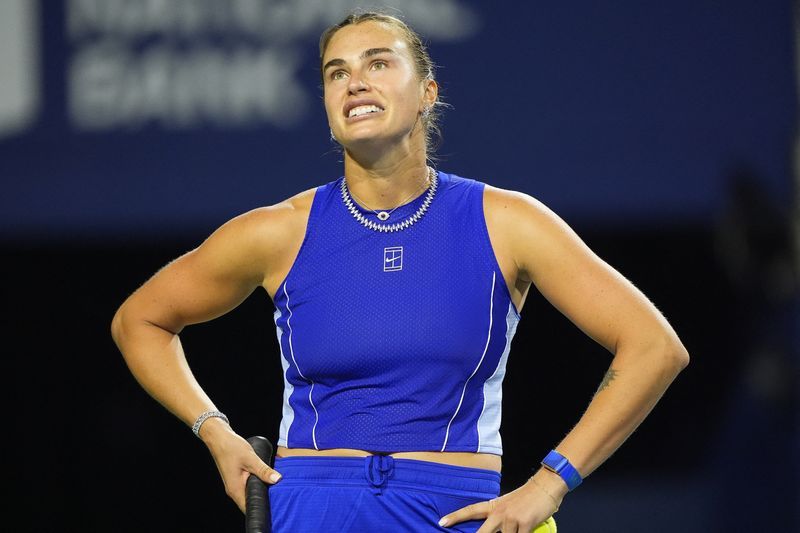
The world's top-ranked tennis player Aryna Sabalenka encountered unexpected resistance at the Canadian Open in Toronto on Saturday, falling to 16th-seeded Ekaterina Alexandrova in a grueling fourth-round encounter that stretched beyond two hours. The Belarusian suffered a three-set defeat with a scoreline of 7-6(3) 4-6 6-4, marking a significant blemish on her preparation for next month's U.S. Open, where she aims to successfully defend her 2023 championship crown.
This defeat carries particular weight given Sabalenka's credentials and recent form. As a four-time Grand Slam winner and the reigning U.S. Open champion, she entered Toronto as a heavy favourite in the draw. Her ranking at the top of the women's game represents the culmination of sustained excellence, yet the loss exposes vulnerabilities that could prove costly in the sport's most demanding tournaments. The manner of defeat—squandering multiple match points in the final set—suggests mental lapses rather than pure physical overmatches, a concerning pattern for any champion.
Alexandrova's victory emerged from a match of genuine dramatic intensity. The Russian won the opening set through a tiebreak after Sabalenka had initially broken serve. The deciding moments came in the tiebreak itself, where precise shot-making from Alexandrova proved decisive. This opening set proved crucial; it gave the underdog momentum and forced Sabalenka into catch-up mode for the remainder of the contest.
Sabalenka rallied in the second set, breaking Alexandrova's serve to establish a 4-3 advantage and subsequently holding her service games to level the match at one set apiece. This recovery demonstrated the champion's competitive instincts and capacity to respond to adversity. However, the decider would tell a different story. As the final set unfolded, Sabalenka's unforced error rate climbed, providing openings that Alexandrova exploited with aggressive groundstroke play. The Russian's tactical approach of maintaining attacking intent rather than retreating into defensive patterns proved effective against the world number one.
The climactic moments encapsulated the match's trajectory. With Sabalenka serving at 4-5, desperately trying to extend the contest, she saved two match points through aggressive play and precision serving. Yet on the third match point opportunity, a double fault handed victory to Alexandrova—a telling conclusion that highlighted the psychological pressure mounting on the defending champion.
Alexandrova's post-match commentary revealed her tactical clarity throughout the encounter. She articulated that playing each point as though it represented a final opportunity reflected her determination to maximise limited chances against Sabalenka's formidable game. Her admission that she attempted to ignore the score and focus purely on ball-striking demonstrates the mental discipline required to upset top-ranked opponents. Following her second-set loss, she believed her chances had diminished significantly, yet she recovered to claim victory—a testament to her resilience and refusal to surrender mentally despite apparent disadvantage.
The tournament's trajectory continues with Alexandrova advancing to face Ukraine's Elina Svitolina in the quarter-finals. Svitolina reached this stage by dispatching eighth-seeded American Amanda Anisimova with a straightforward 6-2 6-4 victory. This matchup between Alexandrova and Svitolina promises competitive quality, with both players demonstrating the consistency and tactical sophistication required to navigate deep into major tournaments.
For Southeast Asian tennis followers and sports analysts observing from the Malaysian perspective, this upset carries broader implications. The Canadian Open serves as the penultimate major tune-up before the U.S. Open, with only a few tournament weeks separating Toronto from New York. Sabalenka's unfamiliar stumble raises questions about her physical conditioning, mental preparation, and confidence heading into her title defence. In professional tennis, momentum operates as a potent force; while one tournament loss need not unravel a champion's U.S. Open prospects, it introduces doubt where certainty previously existed.
Alexandrova's breakthrough victory also underscores tennis's competitive unpredictability. Despite her 16th seeding in Toronto, she possessed sufficient skill and tactical awareness to trouble the world's most accomplished player. This dynamic—where lower-ranked competitors possess capability to topple titans—characterises modern tennis and prevents any single player from establishing the dominance witnessed in earlier eras.
Sabalenka's path forward requires tactical reassessment before the U.S. Open commences. Her double-fault at the decisive moment suggests pressure management may demand attention. Additionally, her unforced error accumulation in the final set indicates that Alexandrova's aggressive approach succeeded in disrupting her rhythm and forcing hurried decision-making. The two-week interval before the U.S. Open permits recovery and recalibration, yet confidence—once fractured against an unseeded opponent—takes longer to rebuild.
For tournament observers throughout Asia-Pacific, this result demonstrates that no ranking provides absolute protection in sport's most prestigious competitions. While Sabalenka remains the favourite for the U.S. Open, and her overall body of work confirms her status as the tour's leading player, Toronto provided a stark reminder that excellence requires sustained focus and that complacency carries consequences. The stage is set for compelling drama in New York, where questions about Sabalenka's form and mental resilience will receive definitive answers.

