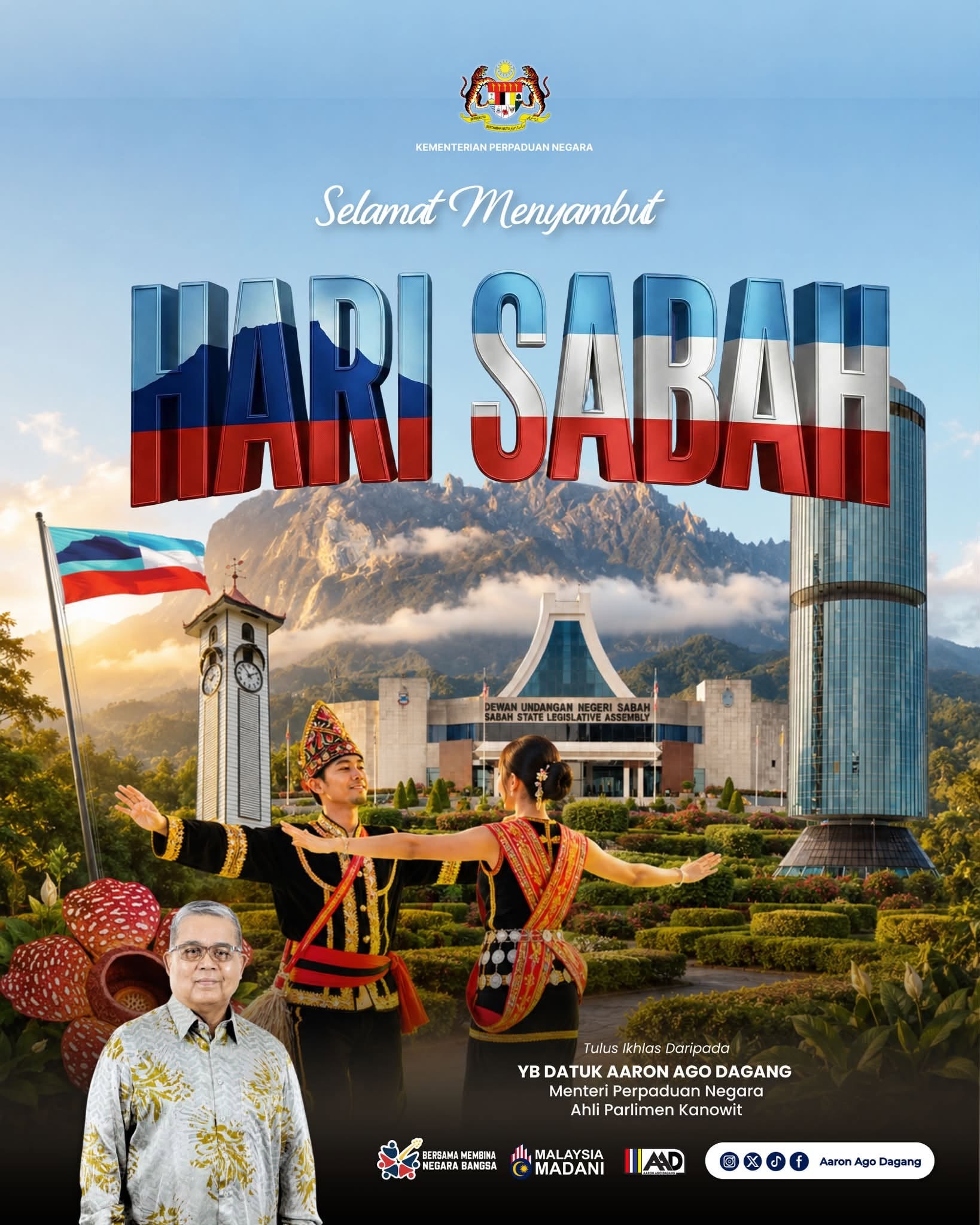
National Unity Minister Datuk Aaron Ago Dagang has positioned Sabah's rich ethnic and cultural diversity as a defining strength for both the state and Malaysia as a whole, underlining how the region's multiracial character underpins social cohesion. Speaking during Sabah Day commemorations on August 31, Ago Dagang described the state's composition of 35 distinct ethnic groups and 217 sub-groups as integral to understanding what makes contemporary Sabah distinctive within the Malaysian federation.
The minister's remarks reflect an important political narrative being cultivated around Malaysia's approach to managing its pluralistic society. Rather than treating ethnic and cultural differences as potential flashpoints for conflict, Ago Dagang framed diversity as an intrinsic source of resilience and collective identity. This messaging carries particular weight in Sabah, where indigenous communities, migrant groups, and religious minorities have historically coexisted, though not always without friction. The deliberate emphasis on harmony emerging from mutual understanding speaks to ongoing efforts to reinforce social bonds in a state where resource competition and immigration debates have occasionally strained inter-community relations.
The enumeration of specific communities—Kadazan, Dusun, Bajau, Murut, Rungus, Bisaya, Lotud, Lundayeh and others—serves a recognition function often overlooked in national discourse. Each group maintains distinct languages, traditional attire, musical expressions, dance forms and heritage practices that collectively constitute Sabah's cultural landscape. This specificity matters because it demonstrates awareness of complexity beyond generic invocations of multiculturalism. The state's identity cannot be adequately captured through simplified categories; rather, it emerges from the intricate interplay of dozens of communities, each contributing unique elements to the broader whole.
Ago Dagang's central thesis—that diversity functions as strength precisely because communities choose mutual respect and acceptance—represents a conditional argument frequently mobilized in multicultural politics. The premise suggests that diversity itself is morally neutral; its character as asset or liability depends entirely on how different groups engage with one another. This formulation places responsibility on citizens to actively construct harmony rather than treating it as an inevitable byproduct of coexistence. For Malaysian readers, this framing may resonate with ongoing national conversations about whether social cohesion requires constant reinforcement through deliberate engagement or whether underlying institutional structures adequately safeguard pluralistic society.
The historical context Ago Dagang invoked—tracing Sabah from its North Borneo era through British North Borneo Company administration, Japanese occupation, and subsequent British rule before 1963 self-governance—situates contemporary diversity within a longer narrative of external influence and eventual self-determination. The August 31 date itself marks Sabah's achievement of internal autonomy, while September 16, 1963 signifies formal incorporation into the Malaysian federation. This chronological layering matters because it establishes that the state's multicultural character predates federation; diversity was not imposed by Malaysian structures but rather brought into the federation as an existing characteristic.
For Southeast Asian observers, Sabah's experience offers instructive lessons about managing heterogeneous populations across regional borders. Unlike some neighbouring jurisdictions where ethnic nationalism has intensified, Sabah has maintained relatively stable inter-community dynamics despite significant internal variation. The state's geographic position at the eastern edge of Malaysia, combined with its distinct political history, creates a somewhat different context from peninsular states, allowing for certain policy approaches and social arrangements that might not translate elsewhere in the country.
The minister's appeal to collective memory and ancestral contribution serves an important rhetorical purpose within Malaysia's political landscape. By invoking the sacrifices of previous generations and their role in developing Sabah, Ago Dagang positioned historical consciousness as essential to contemporary identity. This backward-looking invocation subtly reshapes forward-looking responsibility—contemporary Sabahans inherit not merely territory or institutions but an obligation to honour the work of predecessors while advancing progress across education, economic development, and technological capacity.
The challenge inherent in Ago Dagang's framing deserves examination. Asserting that harmony emerges from understanding and respect presupposes these conditions already exist or can be cultivated through rhetoric alone. In reality, inter-community relations often turn on tangible questions of resource distribution, political representation, land rights, and economic opportunity. The state's significant immigrant populations—particularly from Indonesia and the Philippines—introduce complications that ethnic heritage narratives may not adequately address. Sabah's diversity includes not only indigenous groups with centuries of presence but also more recent arrivals with different legal statuses and claims on state resources.
The establishment of August 31 as official Sabah Day in 2024 represents recent institutionalization of state-specific commemoration within Malaysia's national calendar. This decision signals recognition that Sabah's historical trajectory merits distinct recognition alongside national Federation Day on September 16. The calendrical separation allows space for state-specific narratives without displacing federal unity messaging, a solution that balances particular and universal identities. For other Malaysian states, such recognition of distinctive historical experience might carry implications for how regional identity and national belonging are negotiated.
Ago Dagang's positioning of the current generation as stewards responsible for advancing Sabah while protecting its cultural inheritance reflects a familiar tension in developing regions: balancing modernization with heritage preservation. Economic development, technological advancement, and educational expansion represent universally valued objectives, yet their pursuit sometimes conflicts with maintaining traditional practices and community autonomy. The minister's language suggested these need not be mutually exclusive, though achieving genuine integration of development imperatives with cultural protection remains genuinely complex. For Malaysian policymakers across all states, this tension warrants continued attention as economic and social transformation accelerates.

