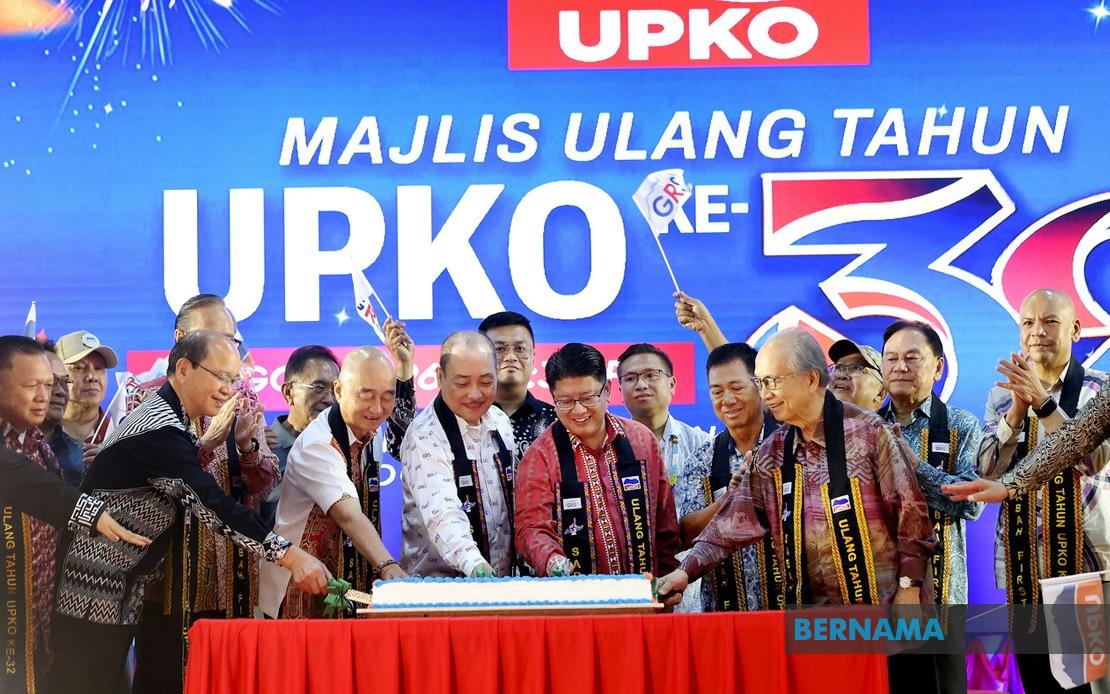
Sabah's commitment to reinvesting federal allocations directly into community welfare and infrastructure represents a significant policy statement from Chief Minister Datuk Seri Hajiji Noor, who announced the strategy during celebrations marking the United Progressive Kinabalu Organisation's 32nd anniversary in Kota Kinabalu. The declaration underscores the state government's approach to managing increased financial support from the federal level, particularly the recent boost to interim special grant payments.
The centrepiece of this undertaking is the expanded interim special grant, which has been increased to RM1.5 billion annually under Prime Minister Datuk Seri Anwar Ibrahim's administration. Hajiji emphasised that the entire amount will serve tangible development objectives rather than being absorbed into general revenue accounts. This commitment carries particular weight given Sabah's historical concerns about federal funding parity compared to other Malaysian states, making transparent allocation of these resources a matter of public significance.
Infrastructure development emerges as a primary focus for these funds, with Hajiji identifying road construction and bridge building as immediate priorities. Beyond connectivity, the grant will address long-standing service deficits in water and electricity supply across the state's diverse geography. These utilities remain inconsistently distributed throughout Sabah's sprawling terrain, where rural communities particularly struggle with unreliable access to essential services. Investment in these areas could have multiplier effects, potentially attracting investment and supporting economic activity in underserved regions.
Housing initiatives represent another critical allocation channel. The state government plans to expand the Rumah Mesra Sabah Maju Jaya programme, which targets construction of affordable housing units. This scheme addresses housing shortages affecting lower and middle-income Sabahans, a demographic concern that has grown more acute as property prices in key urban centres have risen. The SYUKUR programme, complementing housing efforts, directs assistance toward vulnerable populations in need of direct support.
The timing of this allocation reflects shifts in federal-state fiscal dynamics under the current federal administration. Sabah had previously received RM600 million of the RM1.5 billion commitment in June, suggesting the disbursement occurs in tranches rather than lump sums. Understanding the payment schedule becomes important for state-level budgeting and project planning. For investors and development stakeholders, clarity on funding timelines is essential for evaluating infrastructure project viability.
Beyond federal grants, Sabah's own revenue generation capacity has become increasingly significant. The state government maintains annual internal revenue collections at approximately RM7 billion since 2022, with expectations to reach RM8 billion during the current fiscal year. This trajectory indicates improved tax compliance and economic activity within Sabah, suggesting the state's economy continues generating substantive local income despite global economic uncertainties. The growth in state-generated revenue provides additional flexibility for government spending independent of federal allocations.
Economic resilience has become a recurrent theme in official narratives about Sabah's development prospects. Hajiji's assertion that the state maintains strategic investment appeal despite domestic and international headwinds reflects efforts to position Sabah as a stable destination for business expansion. This positioning matters considerably for a state where private sector development can complement public infrastructure initiatives. Regional competition for investment capital means that consistent governance messaging about stability and opportunity becomes part of broader economic competitiveness strategy.
The policy articulation during the UPKO conference carries additional political significance. UPKO, as a component of the Barisan Nasional coalition, represents indigenous Sabahan political interests within the broader federal framework. Hajiji's statements thus address both party faithful and the broader Sabahan electorate, demonstrating responsiveness to constituency demands for visible returns on federal resource transfers. This is particularly salient in a state where political sentiment remains acutely sensitive to perceptions of federal-state equity.
For Malaysian readers more broadly, Sabah's experience illuminates patterns in federal-state fiscal relationships that influence development across the federation. The state's historical arguments for greater resource allocation have reflected legitimate geographic and demographic challenges. Increased grant levels, therefore, represent potential recognition of these structural disadvantages. How effectively Sabah deploys these resources will offer insights into state government capacity and project implementation efficiency, with implications for evaluating similar federal transfer mechanisms elsewhere.
The announcement also implicitly addresses concerns about resource leakage or inefficient allocation. By publicly committing to channelling funds toward visible, measurable projects—roads, bridges, housing, utilities—the government sets benchmarks against which performance can be measured. This transparency contrasts with historical opaqueness sometimes characterising development spending, establishing a framework for accountability that citizens can monitor through observable infrastructure changes across their communities.
Implementation challenges, however, remain substantial. Executing large infrastructure programmes in a geographically dispersed state requires coordinated planning, contractor management, and maintenance protocols. The capacity of state agencies to absorb and efficiently spend RM8 billion annually in total revenue warrants examination. Delays in project delivery or quality issues could undermine public confidence in government stewardship of these resources. Conversely, successful project completion could validate both the resource transfer and the government's deployment strategy.

