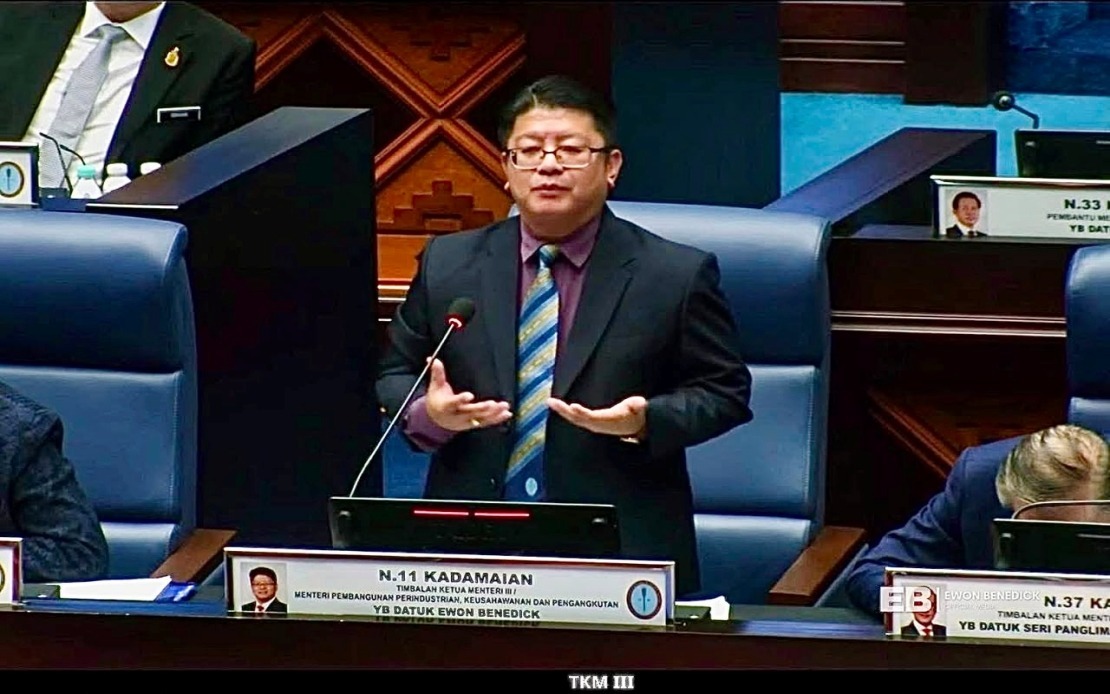
The Sabah state government has moved decisively to clear a longstanding congestion problem at Sepanggar Port by introducing revised pricing structures that discourage container hoarding, according to statements made during legislative proceedings in Kota Kinabalu. Deputy Chief Minister III Datuk Ewon Benedick reported to the Sabah State Legislative Assembly that the initiative has produced tangible results, with operators removing 103 containers that had accumulated at the facility, some remaining idle for extended periods.
The scale of the problem had become increasingly pronounced, with certain containers left abandoned for as long as 407 days while others accumulated at the port for periods exceeding 21 days. This stagnation represented a significant drain on port capacity and operational efficiency, preventing the facility from servicing fresh shipments and contributing to broader logistics challenges across the state. The accumulation of dormant containers effectively reduced available berth space and handling capacity, creating ripple effects throughout Sabah's shipping and import-export sectors.
The root cause of the congestion lay in the structure of previous tariff arrangements. Port fees had been set at levels insufficiently high to discourage storage, making Sepanggar Port an economical alternative to renting dedicated warehouse or container depot facilities elsewhere. Operators facing space constraints found it financially advantageous to leave containers at the port rather than transfer them to external storage facilities, gradually transforming the maritime facility into a makeshift storage depot. This dynamic highlighted how pricing mechanisms fundamentally shape utilisation patterns in port infrastructure.
Under the revised framework, port management has implemented new charges coupled with explicit disposal provisions. The policy stipulates that any container remaining at the facility beyond 21 days may be removed and disposed of in accordance with applicable regulations. This dual approach—combining financial disincentives with enforceable consequences—has proven remarkably effective. Upon notification that containers would face disposal, owners acted swiftly to collect their cargo, rapidly freeing up operational space and restoring the port's cargo handling capacity.
Ewon, who holds the portfolio of Sabah Minister of Industrial Development, Entrepreneurship and Transport, acknowledged that stakeholder communities had raised concerns regarding the new charges. Port user associations have urged the government to reconsider certain fee adjustments, recognising that sudden cost increases can affect operational profitability and competitiveness within regional shipping markets. Rather than dismissing these concerns, the ministry has signalled willingness to engage stakeholders in ongoing dialogue aimed at identifying sustainable solutions that balance governmental objectives with industry needs.
To facilitate this collaborative approach, the government has established a structured engagement mechanism through a task force that incorporates representatives from port user associations, shipowners' associations, and shipping industry bodies. This inclusive framework enables monthly discussions where stakeholders can present concerns, provide data on cost impacts, and propose alternative measures. Such institutionalised consultation represents a departure from top-down implementation and reflects evolving governance practices within Malaysian state administrations.
The legislative framework underpinning these port management changes underwent significant restructuring. The Sabah Ports (Privatisation) (Amendment) Bill 2026, which passed the assembly following debate among four assemblymen, reflected bureaucratic realignment within the state government. Port affairs responsibilities transferred from the Ministry of Works and Utilities to the Ministry of Industrial Development, Entrepreneurship and Transport, necessitating corresponding legal amendments to clarify ministerial definitions and authorities. The Bill also sought to harmonise terminology between the Sabah Ports (Privatisation) Enactment 1998 and the Sabah Ports Authority Enactment 1981, eliminating inconsistencies that had accumulated across multiple legislative instruments.
Sepanggar Port's operational challenges must be contextualised within Sabah's broader economic geography. As Sabah's primary container gateway, the facility represents critical infrastructure for the state's trading economy, agricultural exports, and resource-based industries. Port inefficiencies directly translate into higher logistics costs that ultimately affect commodity prices, manufacturing competitiveness, and trade flows. Clearing chronic congestion therefore generates benefits extending well beyond port operations, enhancing economic efficiency across multiple sectors dependent on maritime connectivity.
The legislative session simultaneously addressed complementary governance matters affecting rural administrative structures. The Sabah Native Affairs Council (Amendment) Bill 2026 expanded the council's advisory mandate to encompass customary education and indigenous legal frameworks, recognising the importance of preserving traditional heritage alongside modernisation. This amendment created an additional administrative post—the Native Affairs Officer—tasked with managing proceedings involving customary offences within Native Courts. These measures reflect governmental commitment to reinforcing traditional governance institutions even as contemporary port management undergoes technological and structural evolution.
The District Chief, Native Chief and Headman Bill 2026 established comprehensive legal parameters governing the appointment, functions, and accountability of village-level administrators. The framework specifies that appointments occur through ministerial recommendation following District Officer evaluation, with revocation provisions addressing incapacity, financial insolvency, criminal conviction, misconduct, or relocation outside administrative areas. Such specification represents an attempt to professionalise rural administration and clarify accountability relationships that had previously existed in less formalised arrangements.
For maritime and logistics observers throughout Southeast Asia, Sabah's container congestion resolution offers instructive lessons regarding port governance and pricing mechanisms. The success of charging structures in modifying user behaviour demonstrates that economic instruments can effectively address infrastructure utilisation problems without requiring capital-intensive expansions. This approach possesses particular relevance for regional ports facing similar accumulation challenges, suggesting that tariff adjustments merit serious consideration before undertaking costly infrastructure enhancements or dredging operations.
The outcomes at Sepanggar Port also underscore the critical importance of stakeholder engagement in policy implementation. By incorporating port users and shipping associations into decision-making processes, the Sabah government transformed what might have become a contentious initiative into a collaborative framework. This stakeholder-inclusive approach appears positioned to generate sustainable solutions rather than merely displacing problems temporarily. As Malaysian ports compete within increasingly integrated regional logistics networks, such collaborative governance models may prove essential for maintaining competitiveness while managing growth pressures.
Looking forward, the success of Sabah's container clearance initiative may prompt similar reviews at other Malaysian port facilities where accumulation issues exist. Port operators and state authorities elsewhere may consider whether their own tariff structures adequately discourage long-term container storage and whether engagement mechanisms with shipping communities require enhancement. The Sabah experience suggests that moderate pricing adjustments, when coupled with clear enforcement provisions and inclusive stakeholder dialogue, can resolve significant operational inefficiencies while maintaining constructive industry relationships.

