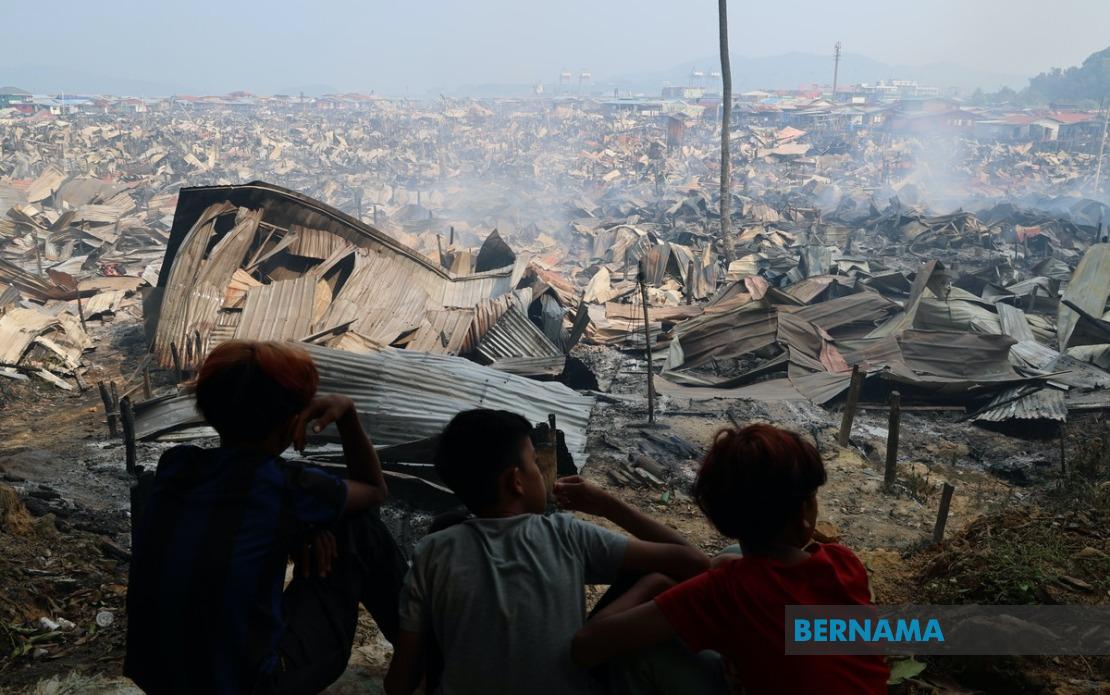
The Sabah state government has announced a comprehensive relief package worth RM3,000 for each Malaysian household head affected by a devastating fire that ravaged Kampung Lok Buta in the Numbak area of Kota Kinabalu early yesterday morning. The blaze, which erupted at approximately 1.40 am, destroyed more than 200 residences and left hundreds of families displaced, making it one of the year's most significant fire disasters in East Malaysia. Chief Minister Datuk Seri Hajiji Noor unveiled the assistance scheme during a visit to victims sheltering at the Likas Multipurpose Hall temporary relief centre, demonstrating the state's commitment to rapid humanitarian response in the aftermath of the tragedy.
The RM3,000 aid package comprises equal contributions from three sources: the Sabah state government, the federal government, and the Yayasan Kebajikan Sabah (Sabah Welfare Foundation), with each entity providing RM1,000 per household. This tripartite funding arrangement underscores coordination between state and federal authorities in addressing the immediate needs of displaced families. The decision to pool resources from multiple government bodies reflects the scale of the disaster and the recognition that no single entity should bear the entire financial burden of relief operations. By structuring the aid this way, the government ensures sustainable support while demonstrating inter-agency cooperation in crisis management.
Beyond the immediate cash assistance, the Sabah administration is mobilizing additional resources to address the broader needs of affected communities. State officials are coordinating with the State Secretary's Office and Majlis Amanah Rakyat (MARA) to establish a pathway for reconstructing destroyed homes. The government has made clear that housing reconstruction will proceed in a deliberate manner, with careful assessment of suitable locations for rebuilding. Authorities acknowledge that returning residents to their original sites may not always be feasible or advisable, and alternative locations will be evaluated based on environmental safety, infrastructure availability, and community preferences.
Recognizing the diverse composition of Malaysian communities, the Sabah government has extended humanitarian assistance to non-Malaysian household heads affected by the disaster. Each non-Malaysian head of household will receive RM1,000 from the state government, a gesture that emphasizes the inclusion of migrant communities and reflects Malaysia's commitment to universal humanitarian principles. This provision is particularly significant in Sabah, where migrant populations represent a substantial portion of the workforce and contribute meaningfully to the state's economy. The decision sends an important message that disaster relief will not be contingent on citizenship status, though the amounts differ to reflect varying entitlements.
Immediate material support is also being mobilized to ensure displaced families have access to essential goods and services during the critical early phase of recovery. The government is distributing basic necessities including food supplies and household items through relief centres, ensuring that families have sufficient provisions while they navigate the immediate aftermath of losing their homes. These distribution efforts are crucial during the first weeks following a disaster, when many families lack resources to purchase even basic items. The provision of food and household goods complements the cash assistance by addressing both immediate survival needs and the longer-term process of household re-establishment.
The human cost of this tragedy extends beyond material loss, as the fire claimed the lives of three young children. The victims were identified as four-year-old Nana Abdullah, six-year-old Mohd Asrul (her brother), and their eight-year-old cousin Nurfarahdilah Mohd Tajihah. These deaths represent an immeasurable loss to their families and the broader Kampung Lok Buta community, adding a profound emotional dimension to the disaster response. The loss of young lives underscores the critical importance of fire safety awareness, building code enforcement, and rapid emergency response capabilities in preventing similar tragedies.
The Kg Lok Buta fire serves as a sobering reminder of fire risks in densely populated residential areas, particularly in informal or informal-adjacent settlements where wooden structures may be prevalent and fire safety infrastructure inadequate. The rapid spread that consumed over 200 homes in a single incident suggests structural vulnerabilities and possible gaps in fire prevention measures. For Malaysian policymakers and urban planners, this incident provides impetus to review fire safety standards across informal housing areas nationwide, examine the adequacy of fire station coverage and response times, and strengthen building codes in vulnerable communities.
The disaster also highlights the importance of comprehensive disaster management frameworks that integrate immediate relief, medium-term recovery support, and long-term community rebuilding. Sabah's response—combining emergency cash assistance, goods distribution, and housing reconstruction planning—demonstrates a multi-phase approach. However, the success of such programmes depends on transparent implementation, efficient fund disbursement, and genuine engagement with affected communities in determining suitable reconstruction approaches. The involvement of MARA in rebuilding efforts could facilitate access to housing finance and technical expertise, though it remains crucial that reconstruction timelines and processes are clearly communicated to victims.
For Southeast Asian readers observing Malaysia's approach to disaster relief, the Sabah model offers insights into balancing rapid humanitarian response with systematic recovery planning. The generous aid allocation of RM3,000 per household compares favourably with international disaster relief standards, though the adequacy of such assistance depends on local housing costs and the extent of each family's losses. Regional observers may note that Malaysia's federal structure permits states like Sabah to mobilize resources through collaboration with federal agencies, a coordination mechanism that proves valuable during large-scale disasters.
Moving forward, the effectiveness of this relief initiative will depend on several implementation factors. Disbursement mechanisms must be transparent and accessible to all eligible households, including those with limited documentation. Housing reconstruction timelines should be realistic and resource-backed to prevent prolonged displacement. Community engagement should inform decisions about rebuilding locations and designs, ensuring that reconstructed settlements meet residents' needs while incorporating enhanced fire safety features. Additionally, authorities should conduct thorough investigations into the fire's origin and spread patterns to identify preventive measures that could protect similar communities elsewhere in Sabah and Malaysia.
The tragedy in Kg Lok Buta represents a significant test of Sabah's disaster response capabilities and social safety net systems. Chief Minister Hajiji Noor's swift announcement of comprehensive aid reflects political will to address the crisis, yet sustained commitment will be judged by how effectively these resources reach intended beneficiaries and how successfully communities are rebuilt. For Malaysian citizens across the country, this incident underscores the unpredictable nature of fire disasters and the importance of maintaining robust emergency services, enforcing fire safety standards, and ensuring that vulnerable communities receive proportionate protection and support when calamity strikes.

