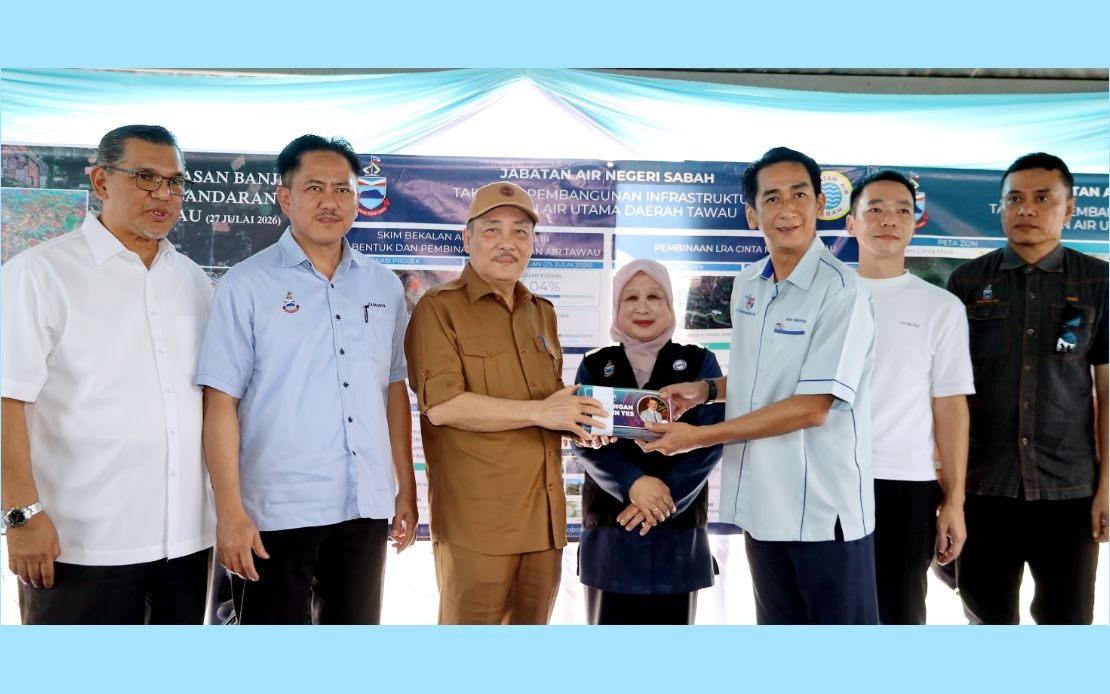
Sabah Chief Minister Datuk Seri Hajiji handed over RM30,600 in humanitarian assistance to the Tawau Municipal Council on behalf of Yayasan Kebajikan Sabah, channelling much-needed relief to families devastated by recent flooding in the district. The donation, presented to council president Mohd Shoffian Mohd Said, represents a direct intervention by the state's charitable foundation to address the immediate financial hardship faced by displaced residents in one of Sabah's busiest commercial centres.
The relief initiative targets 102 household heads whose homes and livelihoods were severely disrupted by the calamity. Each family receives RM300 in direct cash assistance—a modest but meaningful sum intended to help households purchase emergency supplies, restore damaged property, and bridge the financial gap during their recovery period. While the amount per household reflects budgetary constraints, the rapid deployment of funds demonstrates the government's commitment to supporting constituents during crisis situations.
The Tawau flooding event occurred on July 25, unleashing waters that forced emergency authorities to evacuate 362 residents to temporary shelter at Dewan Serbaguna Kompleks Sukan Tawau. The scale of displacement underscores the intensity of the disaster and the vulnerability of low-lying communities in the district, which frequently experience seasonal flooding during monsoon periods. For a coastal trading hub like Tawau, such disruptions carry cascading economic consequences beyond individual households, affecting commerce, transportation, and service delivery.
Hajiji's statement acknowledged the extraordinary efforts of multiple agencies that coordinated disaster response operations throughout the emergency. The Civil Defence Force, Royal Malaysia Police, Fire and Rescue Department, and Ministry of Health personnel worked alongside the Tawau Disaster Management Committee and various local bodies to protect lives and provide emergency shelter. This multi-agency coordination reflects the matured disaster management protocols that have evolved across Malaysian states following successive flood seasons and cyclical natural disasters.
The Chief Minister emphasised that interagency cooperation and professional disaster management infrastructure were instrumental in minimising casualties and protecting vulnerable populations during the crisis window. Effective coordination between federal agencies, state authorities, and municipal administrations has become increasingly critical as climate variability produces more intense weather events across Malaysian regions. The Tawau incident, while serious, demonstrates how established protocols can mitigate worst-case scenarios when properly implemented.
Tawau's recurring flood vulnerability reflects broader environmental and infrastructure challenges facing Sabah's eastern coast. The district sits at the convergence of drainage patterns that channel rainfall from inland areas, and topography in certain residential zones places populations at elevated risk during heavy precipitation. While long-term solutions require substantial infrastructure investment in drainage systems, flood barriers, and potentially strategic relocation of high-risk settlements, immediate assistance like the Yayasan Kebajikan Sabah donation provides critical breathing room for affected families.
The RM300 per-household assistance, though limited in absolute terms, carries symbolic weight in Malaysian disaster response culture. Such distributions signal government acknowledgement of citizen suffering and demonstrate responsive governance at moments of genuine vulnerability. For families already managing property damage, business interruption, and psychological trauma, even modest cash transfers enable household decision-making and restore some agency during periods when disaster-affected persons often feel helpless and marginalised.
Sabah's charitable foundation operates within a broader ecosystem of state-level humanitarian institutions designed to supplement federal disaster management frameworks. Yayasan Kebajikan Sabah's deployment of resources in this instance reflects state-level governance priorities and the foundation's mandate to address social welfare gaps. As climate-related disasters become more frequent across Southeast Asia, such foundations increasingly serve as rapid-response mechanisms that complement slower bureaucratic processes.
The timing of relief distribution—occurring within days of the flooding event—reflects operational efficiency in Sabah's disaster management apparatus. Rapid needs assessment, fund mobilisation, and distribution mechanisms are critical for maintaining public confidence in government institutions and preventing secondary crises involving hunger, disease, or desperation among displaced populations. The speed with which Yayasan Kebajikan Sabah processed and delivered assistance suggests administrative capacity comparable to better-resourced Malaysian states.
For Malaysian readers and regional observers, the Tawau relief initiative illuminates how state governments operationalise humanitarian response during natural disasters. The coordination between political leadership, statutory boards, charitable institutions, and operational agencies demonstrates the institutional maturity required for effective disaster governance. While RM300 per household remains inadequate for comprehensive recovery, the relief operation embodies systematic government engagement with constituent suffering—an increasingly important dimension of governance legitimacy in disaster-prone regions.

