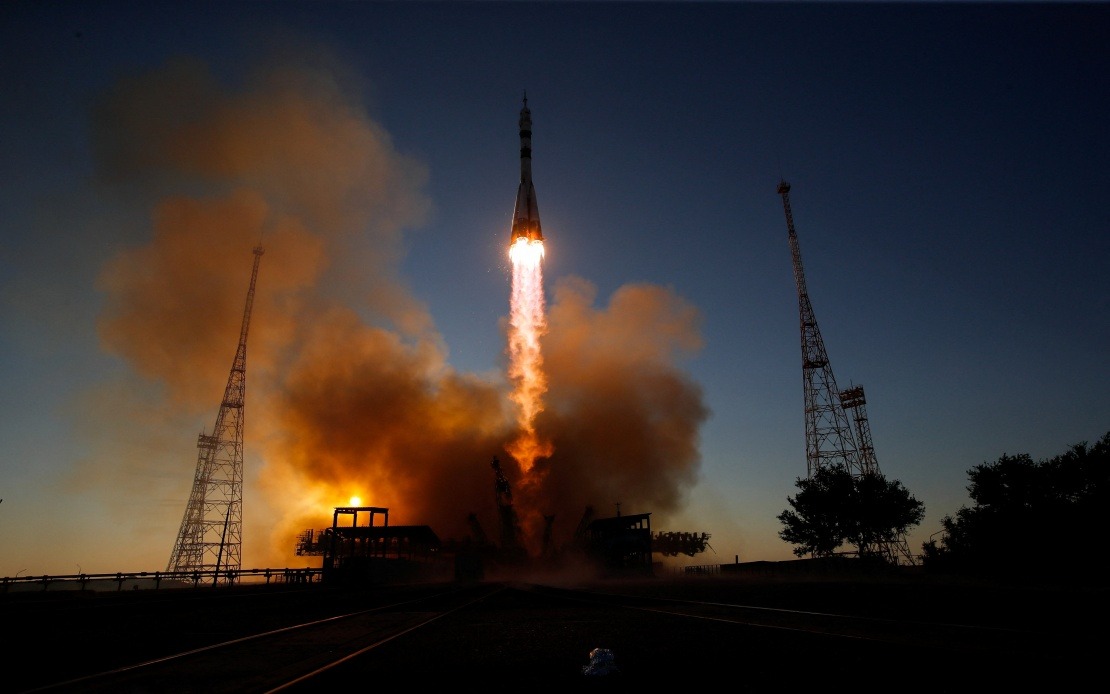
A Soyuz MS-28 spacecraft carrying two Russian cosmonauts and one American astronaut has undocked from the International Space Station, marking the conclusion of their eight-month mission in orbit. The departure, confirmed by Russian space agency Roscosmos through its live broadcast coverage, represents the latest in a series of crew rotations that keep the orbiting laboratory continuously staffed with international personnel.
Aboard the returning capsule are cosmonauts Sergey Kud-Sverchkov and Sergey Mikayev of Russia, alongside NASA astronaut Christopher Williams of the United States. The trio will now embark on a carefully orchestrated descent procedure designed to ensure their safe return to Earth. Following Roscosmos protocols, the spacecraft must first achieve sufficient separation from the ISS before executing its deorbit manoeuvre, a critical phase that reduces the vessel's orbital velocity and initiates re-entry into the atmosphere.
The descent sequence involves the Soyuz capsule separating into its various modules during re-entry. Only the heavily shielded descent module, protected by its heat shield, is designed to withstand the extreme temperatures generated by atmospheric friction during the final stages of the journey home. This modular separation is a fundamental aspect of Soyuz vehicle design that has been refined over decades of spaceflight operations.
Moscow time has been designated as the reference for landing operations, with Roscosmos announcing that touchdown is scheduled to occur at approximately 12:50 pm local time, equivalent to 09:50 GMT. The primary landing zone designated for the crew's arrival is located near Zhezkazgan, a city situated in the expansive Kazakh steppe. This region has served as the primary recovery zone for Soyuz landings for many years, with extensive support infrastructure and recovery teams positioned to locate and assist returning crews.
The three crew members have spent nearly eight months aboard the ISS, having launched from Earth on November 27 of the previous year. During their tenure in orbit, they conducted scientific experiments, maintained critical station systems, and participated in the continuous human presence programme that ensures the space station remains operational. The ISS, a collaborative endeavour involving NASA, Roscosmos, ESA, and other international partners, depends upon regular crew rotations to maintain its scientific and operational capabilities.
The return of Kud-Sverchkov, Mikayev, and Williams underscores the ongoing reality of international cooperation in space exploration, even amid broader geopolitical tensions between their respective nations. The Soyuz vehicle remains the sole means by which astronauts and cosmonauts can reliably travel to and from the ISS, a dependency that has persisted since the retirement of the Space Shuttle programme and highlights the interconnected nature of modern space operations.
For Southeast Asian observers and space enthusiasts, such missions demonstrate the maturity and reliability of Russian spacecraft technology, which continues to serve as a critical component of humanity's presence in low Earth orbit. Malaysia, whilst not directly involved in crewed spaceflight programmes, maintains interests in satellite technology and remote sensing applications that benefit from the scientific research conducted aboard the ISS. The station's orbit and mission profile remain subjects of discussion within regional space agencies and the broader international community.
The landing procedure itself represents the culmination of months of planning and preparation by Roscosmos personnel. Recovery teams equipped with helicopters, vehicles, and medical personnel will be stationed across the expected landing zone to rapidly locate the capsule and assist the crew members following their return to Earth's gravity field. These individuals will require medical attention and support as their bodies readapt to terrestrial conditions after an extended period of microgravity exposure.
The successful undocking and descent of Soyuz MS-28 continues a tradition of regular crew exchanges that has maintained the ISS as a functioning research platform since its establishment. Future missions will similarly depend upon the reliability of the Soyuz platform, ensuring that the international partnership that operates the station can continue its scientific endeavours in the years ahead. For the wider international community, including nations in Southeast Asia with emerging space ambitions, the professionalism displayed by participating agencies in these complex operations provides a model for responsible and sustainable space exploration practices.

