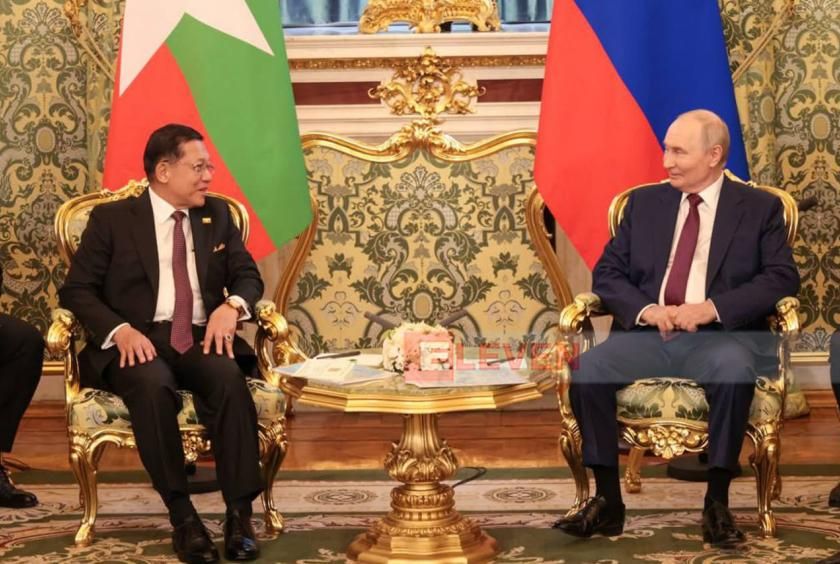
Russian President Vladimir Putin has signalled Moscow's readiness to deepen economic partnerships with Myanmar, positioning energy exploration and infrastructure development as central pillars of renewed bilateral engagement. Speaking alongside Myanmar President U Min Aung Hlaing at a joint media appearance on August 18, Putin outlined an expansive vision for cooperation that extends far beyond traditional energy sectors into nuclear power, industrial manufacturing, and digital technology.
The most significant thrust of Putin's remarks focused on Myanmar's hydrocarbon potential, particularly offshore reserves. Russia has expressed willingness to participate in exploring and extracting natural resources across Myanmar's territorial waters, with Putin suggesting liquefied natural gas could be supplied domestically or re-exported to regional partners. This proposition carries strategic weight for Southeast Asia, as Myanmar sits on considerable untapped gas reserves in the Andaman Sea—resources that have long attracted international interest but remain largely underdeveloped due to political instability and investment uncertainty. Russian involvement could shift the competitive dynamics around Myanmar's energy future, challenging existing partnerships with other major powers.
Beyond offshore drilling, the two nations have already initiated work on several substantial infrastructure projects that underscore the breadth of their ambitions. Coal-fired power plants and oil refineries are under construction, while a nuclear power plant development programme was formalized through a bilateral agreement signed the previous year. Putin described the nuclear initiative as foundational to both nations' long-term energy security—a characterization that reflects Moscow's broader push to export civilian nuclear technology throughout Asia as a counterweight to Western influence. Steel and fertilizer manufacturing plants are also in development phases, alongside discussions concerning a deep-sea port facility in southern Myanmar, a project with obvious implications for regional maritime trade and Chinese Belt and Road competition.
The energy partnership must be understood within the context of Russia's historical relationship with Myanmar, which Putin traced back to the Soviet era of the 1950s and 1960s. During that period, the Soviet Union invested substantially in Myanmar's social infrastructure, establishing hospitals and educational institutions that continue to serve the population today. Putin's invocation of this history signals that Moscow views its contemporary engagement not as opportunistic but as a continuation of longstanding strategic alignment. For Myanmar's military-dominated government, which has grown increasingly isolated from Western nations following the 2021 coup, Russian partnership offers both economic relief and diplomatic legitimacy.
The bilateral relationship extends significantly into defence and security domains. Military-technical cooperation between the two countries remains active and expanding, with joint naval exercises regularly conducted in Myanmar's territorial waters and frequent port calls by Russian warships. This dimension of the partnership reflects mutual strategic interests in counterbalancing Western regional influence and maintaining a buffer against perceived encroachment from other powers. For Malaysia and other Southeast Asian nations, the deepening Russia-Myanmar military nexus carries implications for regional security architecture and the broader competition between great powers in the Indo-Pacific.
Cultural and educational exchanges form another pillar of engagement that Putin emphasized. Approximately 400 Myanmar nationals are currently enrolled at Russian universities, building on a substantial historical foundation—some 17,000 Myanmar citizens have graduated from Russian institutions over previous decades. Russian language instruction has expanded into universities in Yangon and Mandalay and even into military academies, indicating systematic effort to cultivate a pro-Russian intellectual class within Myanmar. A visa-free travel arrangement facilitates movement of students, scientists, athletes, and tourists between the nations, while Myanmar has established cultural and religious centres in multiple Russian cities. Approval has been granted for construction of a Russian Orthodox church in Yangon, symbolizing Moscow's commitment to visible cultural presence within Myanmar.
The bilateral relationship framework rests on foundations of mutual political alignment on international issues, according to Putin. Both nations share opposition to what they characterize as interference in sovereign affairs and unwarranted intervention in international organizations. This convergence of positions on global governance reflects Myanmar's isolated status following international condemnation of military actions and Russia's confrontational stance toward Western-led institutions. The alignment provides each nation diplomatic support on issues ranging from United Nations voting to regional security frameworks.
During President U Min Aung Hlaing's visit to Russia, the two governments signed twelve memorandums of understanding covering multiple sectors. These agreements institutionalize cooperation across domains already discussed—energy, infrastructure, defence, education, and cultural exchange. While memorandums of understanding typically indicate intent rather than binding commitment, their proliferation demonstrates the breadth of engagement Moscow seeks to establish. The systematic nature of these agreements suggests Russia is executing a long-term strategy to embed itself within Myanmar's strategic and economic structures.
For the broader Southeast Asian region, the Russia-Myanmar partnership trajectory warrants close attention. Myanmar's geographic position controlling access to the Bay of Bengal and its substantial natural resource endowment make it strategically valuable. Russian investment in Burmese energy infrastructure and port facilities could reshape regional trade patterns and energy flows. Additionally, the military-technical dimension of the relationship means Myanmar may serve as a platform for expanding Russian defence influence throughout Southeast Asia, potentially complicating existing security partnerships and military relationships that many regional nations maintain with Western powers.
The deepening Russia-Myanmar relationship also reflects constraints on both nations stemming from international isolation. Myanmar faces economic sanctions and diplomatic exclusion following the coup, creating openness to partnerships that other Southeast Asian nations might approach more cautiously. Russia similarly operates under Western sanctions related to Ukraine and seeks to expand influence in regions where Western presence has receded. The convergence of these interests creates powerful incentives for expanded cooperation, suggesting the bilateral relationship will likely deepen further regardless of international criticism or regional concerns about Russian expansion in the Indo-Pacific.

