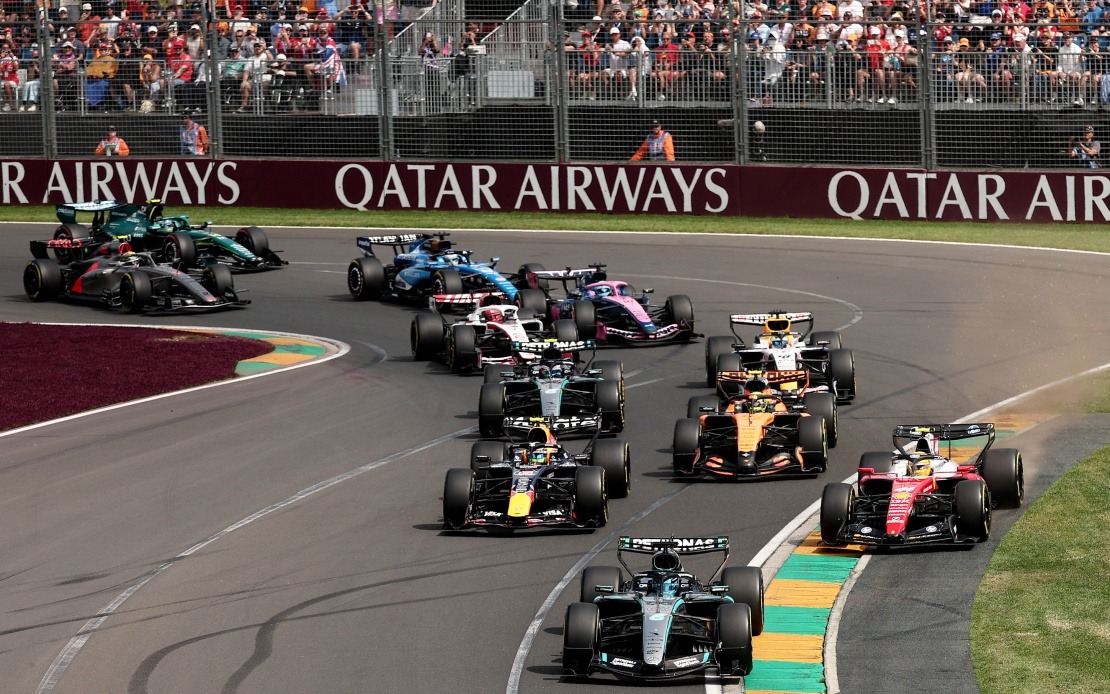
George Russell's championship ambitions took another significant blow at Spa-Francorchamps on Sunday, when a collision with teammate Lewis Hamilton ended his race following what has become a recurring nightmare for the British driver: mechanical failure. The incident came after Russell's car was exposed to competitors early in the race due to an engine glitch on the first lap, leaving him vulnerable to the pursuing pack. Russell's unfiltered reaction came through the team radio, with the frustrated driver demanding answers about his car's battery management system as he watched his title hopes slip further away.
The gap between Russell and his rival continues to widen dramatically. His teammate Kimi Antonelli, the Italian teenager who leads the championship, secured his sixth victory from ten races contested so far, extending his advantage over Russell to 50 points. This substantial margin reflects a troubling pattern for Russell, who finds himself increasingly outpaced and outmaneuvered by the prodigy in the other Mercedes. For a driver of Russell's calibre and experience, the situation represents both a professional embarrassment and a genuine threat to his career momentum.
Russell's weekend at the Belgian circuit had been compromised from the outset. During qualifying, he found himself half a second down to Antonelli, a gap that proved decisive when racing began. Initial investigations suggested the problem stemmed from Russell's driving technique, a narrative that quickly unraveled when engineers found no evidence supporting that theory. Instead, they identified an issue with the car's deployment system—a critical component in modern Formula 1 where managing electrical power distribution determines performance across a lap.
The technical malfunction proved particularly frustrating because it struck at the heart of Mercedes' engineering credibility. The team had initially misdirected blame toward their driver, only to eat humble pie when the actual culprit emerged from deeper analysis. This sequence of events underscores the pressure bearing down on Mercedes' technical operations as they struggle to deliver consistent reliability alongside competitive performance.
Russell's emotional state deteriorated visibly as the weekend progressed. Speaking candidly after the race, he expressed his desperation for solutions ahead of the Hungarian Grand Prix, the final round before the summer shutdown. More tellingly, Russell acknowledged that he has grown numb to disappointment, a concerning admission from a driver who should be fighting with hunger and optimism for victories. The accumulation of mechanical failures throughout the season has eroded his emotional resilience and competitive spirit.
Mercedes team principal Toto Wolff responded to Russell's outburst with measured sympathy, acknowledging the immense emotional toll that repeated mechanical failures inflict on any driver. Wolff positioned Russell's frustration as a natural response to an abnormal sequence of misfortunes, whilst simultaneously reminding him of the privilege associated with driving for one of Formula 1's most storied teams. This diplomatic balancing act suggests internal tensions simmering beneath Mercedes' professional facade.
Wolff's own analysis of the engine issue revealed the extraordinary complexity inherent in contemporary Formula 1 power units. The system governing energy harvesting and deployment interacts intricately with driver inputs, creating a multifaceted puzzle that requires precise calibration. Wolff indicated that Russell had indeed suffered reduced energy availability at Turn 18 specifically, representing roughly half of his qualifying deficit to Antonelli. This technical precision offers cold comfort to Russell, who remains mired in an uncompetitive position.
The Mercedes principal acknowledged that reliability challenges often accompany regulatory upheaval, a pointed reference to Formula 1's recent technical regulations. However, he also committed the team to intensive remedial work, signalling that the organization views current problems as solvable rather than systemic. For Malaysian and Southeast Asian fans watching this unfold, the narrative mirrors broader themes in international motorsport: the relentless pursuit of technical optimization and the human cost when that pursuit falls short.
The timing of this malfunction discovery presents a curious silver lining within Wolff's framing. Budapest, the location of next weekend's crucial race, operates as a circuit less dependent on electrical power deployment than Spa. Therefore, the issue might have gone undetected during Hungarian Grand Prix running, potentially compounding Russell's problems with undiagnosed technical gremlins. Identifying the fault in Belgium, despite the damage already sustained, at least provides Mercedes engineers with a clear target for corrective action.
Russell's predicament raises uncomfortable questions about Mercedes' development trajectory and resource allocation. The team currently finds itself in the unfamiliar position of trailing a teammate in both performance and reliability metrics. For an organization accustomed to championship dominance, this reversal demands urgent strategic recalibration. Whether Mercedes can arrest Russell's decline before the summer recess remains uncertain, but the championship mathematics grow increasingly unforgiving with every mechanical retirement.
The broader context for Southeast Asian followers involves recognizing how Formula 1's elite teams respond to adversity. Mercedes' challenges this season illustrate that engineering excellence requires constant vigilance and that even the best-resourced teams experience periods of vulnerability. Russell's frustration, though unprofessional in its expression, reflects the genuine psychological strain of competing at sport's highest level whilst battling equipment failures beyond a driver's control.
Looking ahead to Budapest, Russell carries mounting pressure both internally and externally. The Hungarian Grand Prix offers a relatively compact circuit where mechanical reliability issues may prove less consequential than at power-hungry venues, theoretically favoring a driver desperate for points. However, Russell's morale has undoubtedly suffered, and psychological momentum in Formula 1 translates directly into on-track performance. Mercedes faces a critical window to restore confidence and deliver a car worthy of their driver's abilities.

