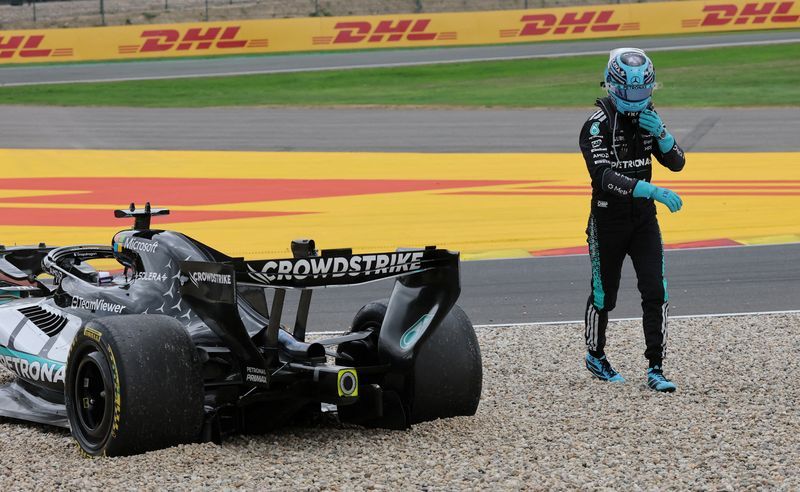
George Russell's weekend at Spa-Francorchamps ended in frustration on Sunday when a first-lap collision with Lewis Hamilton forced him out of the Belgian Grand Prix, dealing a substantial blow to his championship aspirations. The Mercedes driver, who had qualified third, found himself in the gravel after making contact with his former teammate while attempting to recover positions lost through a series of mechanical gremlins. The incident typified what has become an increasingly difficult campaign for the 26-year-old Briton, who acknowledged feeling emotionally drained by the mounting setbacks.
Russell's race fell apart almost immediately despite a strong start into the opening sequence of corners. He had positioned himself directly behind Red Bull's Max Verstappen heading into the high-speed Eau Rouge section, seemingly well-placed to challenge for strong points. However, a battery charging failure at Turn One proved catastrophic to his prospects. The power unit, which forms the energy recovery heart of modern Formula One power plants, refused to recharge properly, leaving him severely compromised for electrical boost deployment through the demanding first lap.
The battery failure cascaded into further complications that undermined Russell's ability to maintain competitive pace. Without adequate stored energy, the turbocharger system failed to operate at full efficiency, depriving him of crucial power delivery when accelerating out of corners. By the time he crested Eau Rouge, the highest point on the Spa circuit, Russell's battery state had depleted to zero percent, leaving him with no hybrid assistance whatsoever. This technical deficit forced him to surrender approximately 35 percentage points of available performance compared to his rivals operating at full capacity.
The combination of mechanical failure and consequent loss of pace made Russell vulnerable to the cars behind, and he was quickly overwhelmed. Three competitors seized the opportunity to overtake, pushing the Mercedes driver further down the order and deeper into the midfield melee. Russell's frustration stemmed less from the eventual collision with Hamilton than from the underlying technical issues that placed him in an impossible situation. He was never in a position to defend or compete fairly under those degraded conditions, something he had flagged to his team during Saturday's qualifying session.
The contact with Hamilton occurred as Russell attempted to recover ground and salvage something from the damaged round. Fighting back through the field, Russell went side by side with the Ferrari driver, and their cars made contact as they battled for position. The collision sent Russell's Mercedes into an immediate spin, depositing the car in the gravel trap where it came to rest. Russell climbed from the cockpit and walked away as the safety car was deployed to clear the scene. Stewards subsequently investigated and judged that Hamilton bore primary responsibility, handing the former champion a five-second penalty for causing the collision.
Russell's characterisation of the incident as a racing accident, while placing greater blame on Hamilton, reflected his broader frustration with the accumulated disappointments of his season. The driver observed that Hamilton had not acted recklessly but rather made an understandable driving decision that went wrong. He reserved his sharper criticism for the underlying technical problems that had compromised his race from the outset. Speaking to media afterwards, Russell appeared emotionally exhausted by the pattern of failures, noting that experiencing multiple setbacks across consecutive race weekends had left him feeling numb to the disappointment rather than acutely devastated.
This marks the third consecutive race where Russell has failed to score championship points, representing a significant stretch without meaningful returns for his title campaign. His championship leader teammate Kimi Antonelli, by contrast, extended his advantage to 25 points after nine races of the 22-round season. Antonelli had started Sunday's race from pole position, positioning himself well to capture his sixth victory of the year. The widening gap in the standings reflects not simply differences in driver performance but also emerging mechanical reliability issues that have plagued Russell's car during this phase of the season.
Russell's acknowledgment of numbness to disappointment carries weight beyond mere sporting frustration. When drivers reach a point where setbacks no longer trigger acute emotional responses, it often signals either a concerning loss of competitive fire or a psychological coping mechanism for systems-level failures beyond individual control. In Russell's case, the evidence suggests the latter interpretation holds true. His detailed technical explanation of the battery and turbo problems indicated an engineer's grasp of the mechanical failures rather than driver error, pointing instead toward issues requiring attention from Mercedes' engineering departments.
The Belgian Grand Prix result underscores how technical reliability has become a decisive factor in Formula One championship battles. Even drivers piloting top-tier machinery cannot overcome fundamental power unit failures that rob them of electrical deployment. Russell's experience at Spa demonstrates that qualifying position and early-race pace mean little when mechanical systems refuse to function as designed. For Malaysian spectators following the championship, the outcome illustrates how closely title fights depend not merely on driver skill but on the complex interplay between engineering excellence, equipment reliability, and the execution of race-day tactics.
With 13 rounds remaining after Spa, Russell faces a critical juncture in his championship challenge. The accumulation of blank results combined with Antonelli's consistent performance has created a scenario where Russell requires not simply podium finishes but victories to claw back into genuine contention. Whether Mercedes can resolve the mechanical gremlins that have plagued his recent races will likely determine whether his title hopes can be revived or whether this period of misfortune will prove permanently damaging to his championship credentials.

