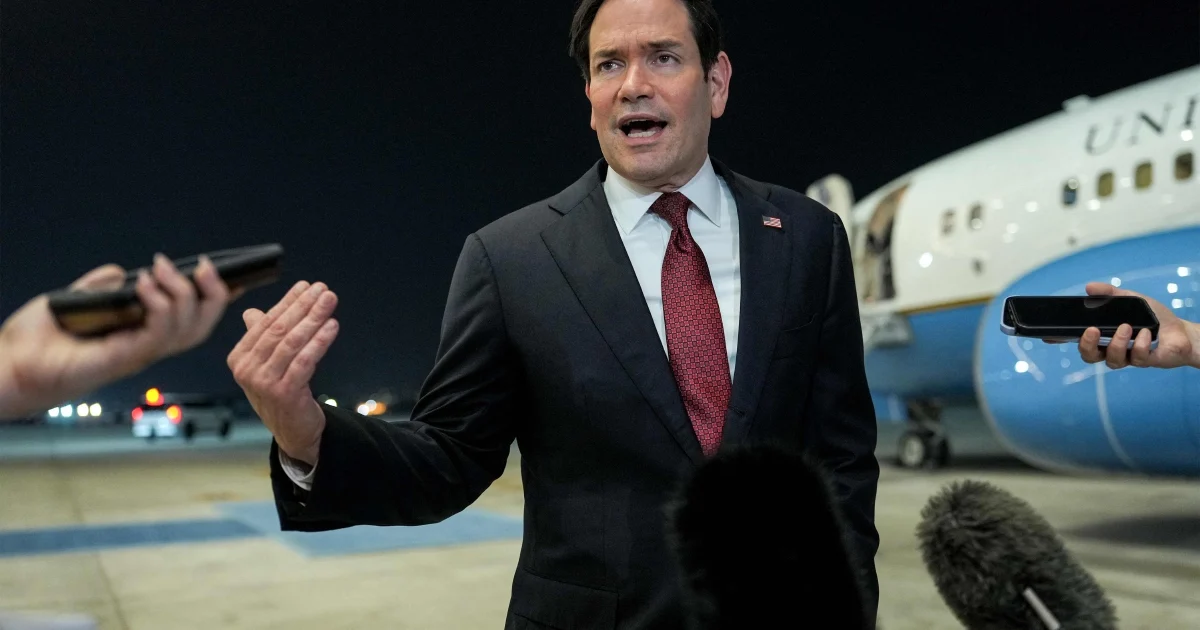
US Secretary of State Marco Rubio has publicly rejected Iranian proposals to levy charges on vessels transiting the Strait of Hormuz, marking a significant flashpoint as negotiations between Washington and Tehran encounter mounting obstacles on multiple fronts. Speaking on Tuesday, Rubio made clear that the United States will not countenance any Iranian attempt to extract fees or tolls from international shipping passing through one of the world's most strategically vital waterways, a position that underscores the fundamental disagreements emerging in early diplomatic discussions.
The Strait of Hormuz remains one of the globe's most critical maritime chokepoints, with roughly one-third of all seaborne oil trade flowing through its narrow passage between Iran and Oman. Any restrictions, disruptions, or financial barriers imposed on this corridor would reverberate through international energy markets and destabilise the global economy. For Southeast Asian nations like Malaysia, Singapore, and others whose economies depend heavily on stable energy supplies and uninterrupted maritime commerce, the stakes of this dispute are particularly acute. A prolonged crisis over Hormuz access could drive up fuel costs, disrupt supply chains, and constrain economic growth across the region.
Rubio's direct repudiation of Iranian toll proposals reflects the administration's intransigence on what it views as core American interests in the Middle East. The rejection comes at a moment when diplomatic channels between Washington and Tehran were anticipated to address the broader question of how to stabilise the Middle East conflict, yet the conversation has quickly fragmented into competing demands and red lines. The Iranian government had apparently ventured the idea that compensation in the form of passage fees could offset economic losses sustained through Western sanctions and regional military actions, but Washington has determined such arrangements fall outside acceptable parameters for any comprehensive settlement.
Beyond the Hormuz dispute, negotiations have become entangled in disputes over nuclear inspections and missile programmes, two issues that have historically proven intractable in US-Iran relations. The International Atomic Energy Agency's access to Iranian nuclear facilities and verification mechanisms remains contested terrain, with each side maintaining fundamentally incompatible positions on transparency and monitoring. Iran views unrestricted inspections as an infringement on national sovereignty, while the United States and its allies demand comprehensive oversight to prevent nuclear weapons development. This structural misalignment has plagued previous diplomatic initiatives and threatens to derail the current process before substantive progress can materialise.
The missile question introduces yet another layer of complexity. Iran's development of ballistic and cruise missile capabilities poses concerns not merely to the United States but to allies throughout the Gulf region and beyond. Regional powers worry about Iranian ability to project force, whilst Tehran argues its missile programme constitutes legitimate self-defence against a region saturated with American military hardware and hostile regional actors. Reconciling these competing security calculations represents perhaps the most challenging aspect of any comprehensive settlement, as neither side appears willing to compromise on what it considers fundamental to its strategic position.
The emergence of these multiple points of contention so early in negotiations suggests that the diplomatic pathway toward resolving the Middle Eastern conflict remains extraordinarily rocky. Each dispute alone presents formidable obstacles to agreement; the combination multiplies the difficulty exponentially. Observers who had hoped for swift progress toward a framework addressing the broader regional crisis now face the prospect of protracted, gruelling talks with uncertain outcomes. The pattern echoes previous diplomatic episodes in US-Iran relations, where initial optimism gave way to deadlock as the full scope of disagreement became apparent.
For Malaysia and the broader Southeast Asian community, the implications extend beyond immediate economic calculations. A prolonged period of US-Iran tension creates uncertainty for regional states attempting to balance relationships with Washington against maintaining pragmatic engagement with Tehran. Several Southeast Asian nations conduct significant trade with Iran and maintain diplomatic relations, yet also depend on American security guarantees and regional stability. Escalating hostilities or failed negotiations could force uncomfortable choices on how to position themselves in an increasingly polarised geopolitical landscape.
The Hormuz toll controversy specifically illustrates the challenge of negotiating with parties that possess fundamentally different concepts of legitimate sovereign authority over maritime spaces. Iran invokes rights to regulate traffic in its territorial waters, whilst the international community and maritime powers insist on freedom of navigation as a cornerstone of global commerce. This philosophical divergence cannot be easily bridged through compromise, as one side's gain necessarily becomes the other's loss.
Rubio's unambiguous statement may have been intended to establish an immovable American negotiating position, signalling that certain demands simply cannot form the basis for any agreement. However, it also raises questions about the flexibility Washington is prepared to demonstrate on issues where Iran claims legitimate grievances. If the United States enters negotiations with an extensive list of non-negotiable demands while offering minimal reciprocal concessions, the entire diplomatic framework risks collapse under the weight of mutual intransigence.
The coming weeks will reveal whether these early disputes represent temporary bargaining positions or fundamental incompatibilities that render resolution impossible. The international community watches closely, understanding that the outcome of US-Iran negotiations carries consequences far beyond the Middle East, reaching directly into the economic and security interests of maritime trading nations throughout Asia.