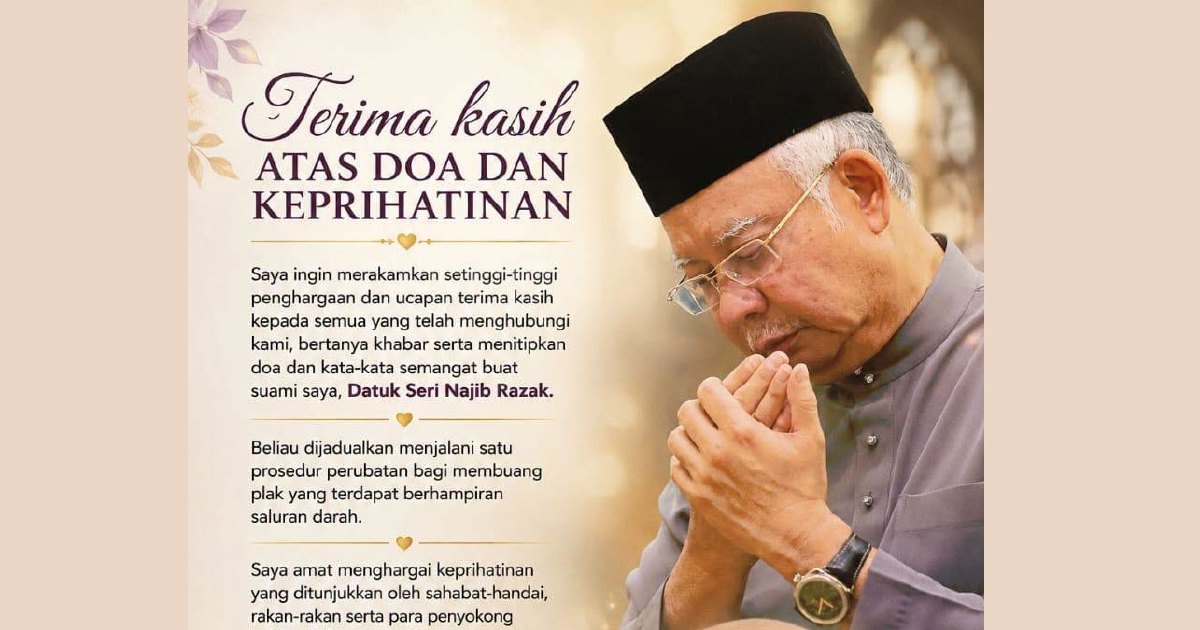
Datin Seri Rosmah Mansor made a public appeal on Wednesday for Malaysians to remember her husband, former Prime Minister Datuk Seri Najib Razak, in their prayers as he prepares to undergo a medical procedure designed to clear plaque accumulation in a blood vessel. The procedure, scheduled to take place in the coming days, involves the removal of fatty deposits that have narrowed one of his arteries, a condition that can restrict blood flow and pose cardiovascular risks if left untreated.
Speaking through media channels, Rosmah expressed gratitude towards those who have extended their support and well-wishes to the family during this period. She acknowledged the concern shown by well-wishers and members of the public, describing their solidarity as a source of strength for the household. The appeal reflects a moment of vulnerability for the former first lady, who has increasingly maintained a lower public profile in recent years following the conclusion of several high-profile legal proceedings involving her and her husband.
Najib's health situation arrives at a time when he continues to manage his legal obligations following his tenure as Prime Minister from 2009 to 2018. The former leader has faced and navigated numerous court cases in recent years, with various matters proceeding through Malaysia's judicial system. His health concerns underscore the personal toll that extended litigation and public scrutiny can exact on individuals, regardless of their former office or prominence.
Vascular procedures to remove arterial plaque, medically referred to as angioplasty or carotid endarterectomy depending on the specific location and nature of the blockage, are increasingly common interventions in modern medicine. These procedures aim to restore proper blood circulation and reduce the risk of stroke or heart attack—conditions that remain among the leading causes of mortality and disability globally. The decision to proceed with such treatment typically reflects recommendations from medical specialists who have assessed the severity of the arterial narrowing and determined that intervention is warranted to prevent more serious cardiovascular events.
The public nature of Rosmah's request for prayers indicates a broader cultural practice in Malaysia, where faith and communal support play significant roles during medical crises affecting public figures. Religious and spiritual observances form a cornerstone of Malaysian society across different communities, and appeals for prayer—whether through Islamic, Christian, Hindu, or Buddhist traditions—resonate deeply with the nation's diverse population. Such requests also serve to humanize public figures, reminding Malaysians that regardless of one's political history or legal circumstances, health challenges affect all individuals and families in broadly similar ways.
The couple's relationship has been subject to intense scrutiny since the collapse of the Barisan Nasional government in 2018 and the subsequent investigations into financial improprieties during Najib's administration. Nevertheless, Rosmah's public statement demonstrates her continued commitment to her family's wellbeing and her willingness to seek communal support through transparent communication with the Malaysian public. Such moments often generate reflection about separating personal family matters from political history and legal proceedings.
Medically, the timing of Najib's procedure is significant given Malaysia's well-developed healthcare infrastructure, both in the public and private sectors. The country has access to world-class cardiothoracic and vascular surgical expertise, with several institutions recognized for excellence in cardiovascular treatment. The availability of advanced diagnostic tools and minimally invasive techniques has made such procedures safer and more effective than in previous decades, with recovery times substantially reduced compared to traditional open surgery approaches.
For families navigating serious health procedures, the psychological and emotional dimensions are as important as the medical aspects. The public's response to Rosmah's appeal demonstrates the capacity for Malaysians to set aside political differences when confronted with personal human challenges. This sentiment transcends ideological lines and reflects a fundamental empathy that persists within society, even amid polarized political divisions that have characterized recent years of Malaysian public discourse.
The broader context of aging among Malaysian political leaders and public figures underscores an important demographic reality—the founding generation of modern Malaysia is advancing in years, and health issues have become increasingly commonplace among those who shaped the nation's post-independence history. Such circumstances often prompt reflection on succession planning, institutional continuity, and the transition of leadership within both political parties and the broader society.
As Najib prepares for his medical intervention, the coming weeks will likely see continued public interest in his condition, with sympathetic messages expected to flow from various quarters of Malaysian society. The successful outcome of such procedures typically depends on multiple factors including the patient's overall health status, the extent of arterial narrowing, the skill of the surgical team, and the quality of post-operative care and rehabilitation. Medical professionals remain cautiously optimistic about outcomes for well-managed vascular interventions in otherwise stable patients.
Rosmah's appeal ultimately represents a private family's trust in the power of collective prayer and public goodwill during a vulnerable moment. Whether viewed through a religious, cultural, or humanistic lens, the request resonates with universal themes of family solidarity, the fragility of health, and the importance of compassion during times of medical uncertainty. The coming weeks will prove decisive for Najib's health trajectory and for his and Rosmah's ability to move forward beyond this latest chapter of challenge.

