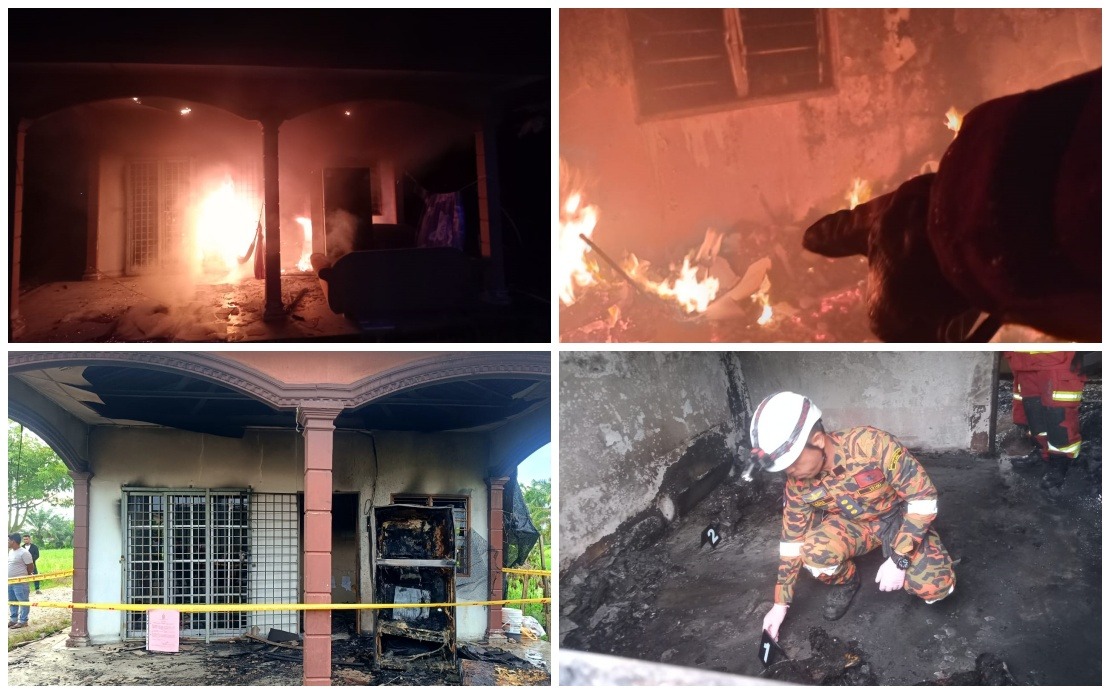
A tragic house fire in Taman Serai Maju, Bagan Serai, claimed the lives of three members of a Myanmar refugee family on Friday morning, leaving the household's surviving matriarch with serious burn injuries. The incident, which occurred in the early hours, claimed the life of Mohd Yunus Nor Ali, 27, alongside his two young sons Muhammad Woheed Mohd Yunus, 6, and Mohamad Aheed Mohd Yunus, 3. His wife, Saniya Jahan Juma Abul Kasim, 24, also a Myanmar national, sustained significant burns to her hands and feet in the blaze and was hospitalised for treatment.
The Perak Fire and Rescue Department received the emergency distress call at 5.17 am and deployed its first response vehicle to the location within thirteen minutes. Upon arrival at 5.30 am, firefighters discovered a Class A residential property measuring 20 feet by 40 feet fully engulfed in flames, with approximately 70 per cent of the structure damaged. According to Datuk Sayani Saidon, director of the Perak Fire and Rescue Department, the house at the time of the incident was occupied by seven foreign nationals, suggesting several family members or extended household residents were present during the emergency.
The survival of Saniya Jahan Juma Abul Kasim proved crucial to rescue operations. When firefighters arrived, she was located outside the building and informed rescue teams that her husband and their two children remained trapped inside. This information immediately triggered a structured search and rescue protocol, guiding firefighters to focus their efforts on specific areas of the burning structure. The urgency of her account prompted rescuers to prioritise the interior spaces where families typically shelter during night hours.
Using the RECEO concept—a standard operational framework emphasising rescue, evacuation, confinement, extinguishment, and overhaul—the fire service team systematically searched the premises. Their efforts concentrated on the first room, where the blaze had originated and spread most intensely. Within this space, rescue personnel located all three deceased individuals. The speed of the fire's progression through this particular room appears to have been catastrophic, with the intense heat and smoke conditions leaving occupants with minimal opportunity for escape or survival.
Medical officers from the Ministry of Health who reached the scene confirmed the deaths of all three victims at the location. Saniya Jahan Juma Abul Kasim received immediate first aid treatment from emergency responders before being transported via Emergency Medical Rescue Services ambulance to hospital for comprehensive burn treatment. Such injuries, particularly in the extremities, often require specialised wound care and extended hospitalisation in cases of significant surface area damage.
Firefighters brought the blaze under control by 6.20 am, approximately fifty minutes after arriving on scene. The full operation, including final safety checks and scene clearance, was completed by 7.35 am. The deceased victims were subsequently transferred to Royal Malaysia Police custody for official procedures and further investigation into the circumstances surrounding the incident.
The preliminary forensic examination conducted by the Perak Fire and Rescue Department's specialist team determined that the fire initiated within the first room—the same space where all three fatalities occurred. However, the specific trigger that sparked the initial ignition remained unconfirmed at the time of the preliminary statement. Investigators noted that establishing the precise cause would require more detailed analysis of fire patterns, accelerant detection, and examination of electrical systems and other potential sources within the damaged dwelling.
This tragedy highlights the particular vulnerabilities faced by refugee communities in Malaysia, who frequently occupy modest residential properties in densely populated settlements. The Rohingya population, one of the world's largest stateless groups, has experienced significant displacement and migration pressures across Southeast Asia in recent years. Malaysia hosts one of the region's largest Rohingya populations, with many residing in informal housing arrangements that may lack comprehensive safety features or emergency infrastructure.
The incident underscores critical questions about fire safety compliance in residential properties housing migrant and refugee families. While Malaysian building codes mandate certain safety standards, enforcement and accessibility of safety equipment such as smoke detectors and fire extinguishers may vary significantly across different residential areas. The concentration of multiple family members and household residents in relatively compact spaces, as suggested by the seven occupants in this dwelling, can amplify risks during fire emergencies when evacuation pathways become compromised by flame and smoke.
The loss of a father and two young children raises significant humanitarian concerns for the surviving family member and any extended family networks within the refugee community. Beyond the immediate trauma and physical recovery required, the widow faces fundamental questions of economic survival and household stability. Such disasters often trigger broader social challenges within vulnerable communities, including economic hardship, psychological trauma, and potential displacement from current housing.
Authorities have not yet released their comprehensive investigation findings regarding contributing factors, though the origin point in the first room provides a starting framework for inquiry. Whether the fire resulted from electrical fault, cooking accident, heating equipment malfunction, or other cause remains under examination. The investigation's conclusions may inform future safety protocols for residential properties housing temporary resident populations across Perak and other states managing significant refugee populations.

