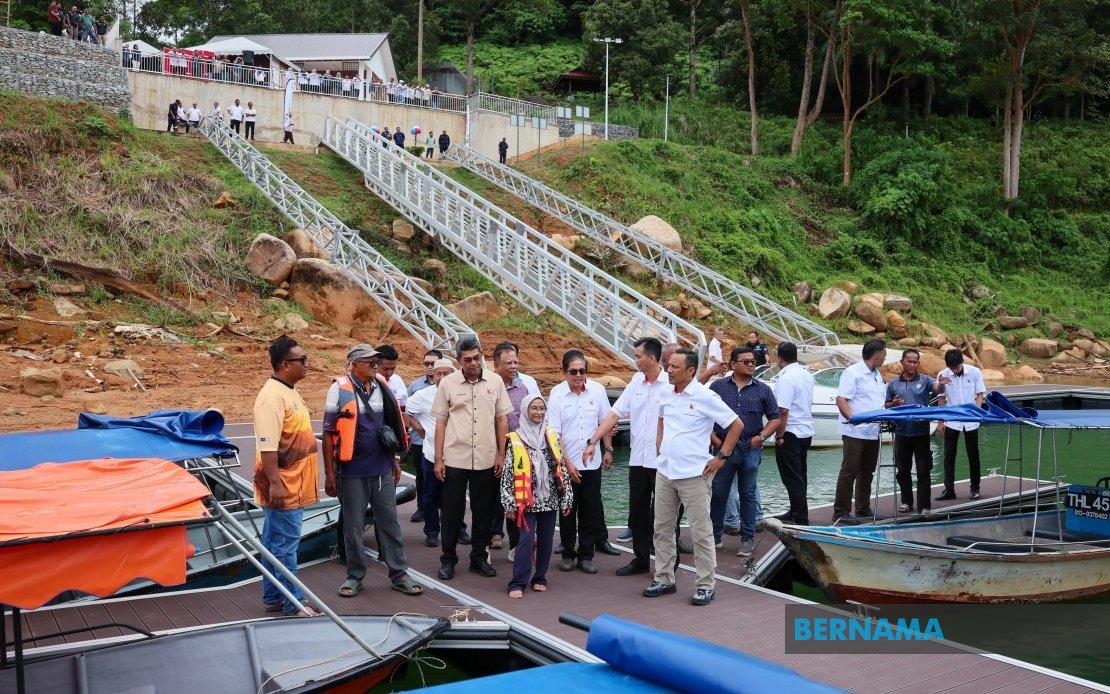
A newly completed RM8.7 million jetty facility at Tasik Kenyir marks a significant investment in streamlining one of Malaysia's most distinctive ecotourism destinations. The project, which commenced in 2023 and was handed over on July 6, represents a coordinated effort by the Terengganu Tengah Development Authority (KETENGAH) to establish professional infrastructure capable of accommodating more than 80 houseboats and speedboats in an organised manner.
The development reflects wider recognition among Malaysian tourism authorities that Tasik Kenyir possesses substantial potential as an international destination, yet has long struggled with operational challenges stemming from ad-hoc berthing practices. Located in the districts of Dungun, Hulu Terengganu and Kemaman, the man-made lake has attracted visitors for decades, but the absence of coordinated docking facilities created congestion and safety concerns around traditional berthing areas such as Pengkalan Gawi. This new infrastructure directly addresses those longstanding inefficiencies that have constrained visitor comfort and operator profitability alike.
Beyond the berthing capacity itself, the jetty incorporates comprehensive supporting facilities designed to elevate the visitor experience and operational standards. The complex includes a pedestrian walkway stretching approximately 600 metres, essential for comfortable movement between vessels and amenities. Eighty-six parking bays serve vehicle-dependent tourists, whilst public toilets, a staffed guard post, an electrical substation, a dedicated pump house and a waste disposal facility collectively establish the infrastructure backbone required for safe, hygienic operations. Critically, both electricity and water supply connections to houseboat berths address fundamental service gaps that had previously limited the comfort and duration of stays.
KETENGAH chairman Datuk Rozi Mamat emphasised that the project emerged from the Third Rolling Plan of the 11th Malaysia Plan (RMK-11), indicating alignment with national development priorities. His comments underscore official recognition that ecotourism infrastructure requires deliberate public investment to compete effectively in Southeast Asia's increasingly sophisticated tourism marketplace. Without such coordinated improvements, destinations risk losing market share to competitors offering superior facilities and safety standards.
The jetty project forms part of a broader investment strategy within the KETENGAH jurisdiction. The authority received RM48.36 million in development allocations this fiscal year, deployed across 28 programmes and projects spanning its three administrative districts. Six of these initiatives specifically target Tasik Kenyir itself, indicating concentrated effort to position the lake as a cohesive tourism product rather than a collection of dispersed attractions. Complementary works include restoration of the Sungai Petang Kelah Sanctuary Complex, remedial slope work at existing tourist sites, enhancement of facilities on Pulau Petang, development of a public mini park at Gawi Point, and redevelopment of the Herbal Park.
This multi-pronged approach reflects mature tourism planning principles now gaining acceptance across Malaysia's regional development authorities. Rather than constructing isolated facilities, KETENGAH is engineering an integrated visitor ecosystem where transport infrastructure, natural attractions, leisure spaces and support services reinforce one another. Such coordination typically yields superior outcomes for both business operators and leisure travellers compared to fragmented development patterns.
The resolution of Pengkalan Gawi's berthing disorder represents a particular achievement, as uncontrolled waterfront activity commonly generates friction between commercial operators, environmental advocates and local communities. By providing designated, serviced berths with clear management protocols, the jetty project establishes the physical and regulatory foundation for sustainable growth. The presence of guard posts and waste management infrastructure suggests attention to security and environmental stewardship, concerns that increasingly influence destination selection among discerning international tourists.
For Malaysian operators in the houseboat and speedboat sectors, the facility addresses a critical constraint on business expansion. Many proprietors have historically operated at sub-optimal scale due to congestion, safety liability exposure and inadequate services. Dedicated berths with utilities effectively reduce operational costs whilst permitting longer tourist stays and higher vessel utilisation rates. These economic gains should encourage investment in fleet modernisation and customer service improvements, ultimately raising sectoral competitiveness.
The timing of the jetty's completion aligns with post-pandemic tourism recovery across Southeast Asia. Regional visitor volumes to Malaysia have rebounded substantially, intensifying competition among destinations for high-value ecotourism segments. Tasik Kenyir's reputation as a premier freshwater lake destination has attracted international and domestic tourists for years, yet ageing infrastructure and operational disorganisation have constrained revenue realisation. Modern facilities positioned as environmental stewards may prove decisive in capturing growing demand for authentic, nature-based experiences that combine adventure, comfort and safety.
Looking forward, the jetty's success will depend on effective management and consistent service delivery. Infrastructure alone does not guarantee tourism growth; attentive operations, staff training and marketing communication must synchronise with physical assets. KETENGAH's broader portfolio of simultaneous improvements across Tasik Kenyir suggests organisational capacity exists for this challenge, yet destination authorities throughout Malaysia have experienced uneven results when newly completed facilities fall into maintenance disrepair or operational neglect.
The project also carries implications for regional competitiveness within Terengganu state and the broader East Coast Economic Region. Neighbouring states including Pahang and Kelantan pursue similar ecotourism strategies, positioning their own water-based attractions as alternatives to Tasik Kenyir. By systematically modernising infrastructure and services, KETENGAH signals commitment to defending market leadership and capturing incremental growth from expanding Southeast Asian leisure demand.
Ultimately, the RM8.7 million jetty embodies a strategic insight increasingly prevalent among Malaysian development policymakers: that tourism growth requires deliberate public investment in foundational infrastructure alongside private sector participation. The facility represents neither an end point nor a complete solution to Tasik Kenyir's development challenges, but rather a necessary inflection point that removes a critical operational constraint and establishes conditions for sustained sectoral advancement within one of Malaysia's most distinctive ecotourism settings.

