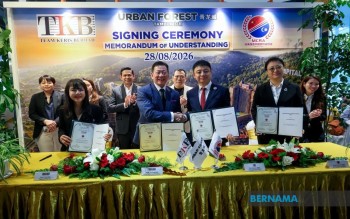
An ambitious RM1 billion urban forest development spanning 84 acres in Tambun, Ipoh, promises to reshape Perak's tourism landscape by creating a integrated ecosystem that blends international hospitality standards with Malaysia's distinctive culinary heritage. Team Keris Bhd is steering the three-year initiative alongside RJJ Hotels Sdn Bhd and the Malaysian Chinese Restaurant Association, marking a coordinated effort to transition the state from a domestic tourism focus to one capable of attracting visitors from major international markets including Australia, Britain, and the United States.
The strategic significance of this project lies in its comprehensive approach to destination development. Rather than creating isolated attractions, the partnership recognises that modern tourism demand requires seamless connectivity—from airport transfers and accommodation through dining experiences and leisure activities. Loh Sze Yee, chairman of Perak's Tourism, Industry, Investment and Corridor Development Committee, emphasised this integration, noting that the urban forest will complement existing attractions such as the Lost World of Tambun while elevating Ipoh's standing within global travel circuits. The development positions itself not as a standalone venue but as a catalyst that strengthens the broader commercial and hospitality ecosystem already established in the region.
Central to the project's appeal is its food and beverage strategy, which balances international competitiveness with authentic Malaysian identity. Datuk Lee Seng Hee, group executive chairman of TKB, outlined a composition where 40 per cent of F&B operators maintain Malaysian Chinese Restaurant Association affiliation, with the remaining 60 per cent comprising other Malaysian operators. This ratio intentionally preserves Malaysia's gastronomic authenticity while ensuring operational excellence and brand recognition that resonates with global consumers. The deliberate inclusion of Muslim-friendly offerings—accounting for at least 30 per cent of the total F&B portfolio—reflects both inclusivity and pragmatism, addressing the preferences of diverse visitor demographics while capitalising on Malaysia's recognised halal certification credentials.
The involvement of RJJ Hotels introduces substantial international reach that transcends conventional hotel operations. Through its affiliation with Jin Jiang Hotels, a network encompassing over 200 million members across more than 50 countries and operating more than 40 hotel brands, the development gains access to established travel distribution channels and global marketing platforms. Yap Lip Seng, RJJ Hotels' chief executive officer, articulated how this network transforms the visitor experience from fragmented touchpoints into curated, extended-stay packages. Rather than confronting travellers with logistical challenges such as airport transfers or multi-city navigation, the partnership structures offerings that encourage visitors to spend multiple nights exploring Ipoh's cultural and culinary attractions, fundamentally extending their economic impact within the destination.
This connectivity advantage proves particularly important for Perak's geographic positioning relative to major gateways. Kuala Lumpur and Penang airports typically serve as entry points for international visitors to northern Malaysia, yet neither location is particularly proximate to Ipoh. The urban forest's hospitality framework directly addresses this friction by packaging complete experiences—accommodation, dining, entertainment, and guided discovery—that eliminate decision paralysis and travel uncertainty. By positioning Ipoh as a destination requiring intentional allocation of multiple days rather than a convenient stopover, the project fundamentally reshapes travel behaviour and visitor spending patterns.
The employment and skills development dimension adds significant weight to the project's regional importance. Gao Houyun, president of the Malaysian Chinese Restaurant Association, highlighted commitments to training and upskilling local workers and operators, establishing pathways for the food and hospitality sector to meet international service standards. This human capital development extends beyond individual employment opportunities to encompassing systemic industry upgrading. Workers trained within the urban forest's operations acquire credentials and experience that create ripple effects throughout Perak's broader hospitality and culinary sectors, establishing benchmark standards that influence competitive dynamics across the state.
The supply chain development strategy reveals deeper economic ambitions. Gao Houyun identified particular potential in encouraging Chinese sauce, spice, and ingredient manufacturers to establish production facilities in Perak, effectively clustering complementary industrial activities. This approach recognises that food and beverage operations represent not isolated retail activities but nodes within complex value chains. By securing manufacturing of essential inputs locally, the urban forest reduces operational costs while creating upstream employment and establishing Perak as a hub for food ingredient production serving both domestic and export markets.
Malaysia's halal certification framework emerges as a strategic asset within this broader development narrative. Rather than viewing halal compliance as a constraint, project stakeholders recognise it as a competitive advantage enabling geographic expansion. Restaurant brands and food products developed within the Perak ecosystem can leverage Malaysia's internationally recognised halal certification to penetrate Southeast Asian markets where Muslim consumers represent significant demographic segments. This regulatory advantage translates into tangible commercial benefit, allowing Perak-based enterprises to pursue cross-border expansion with reduced certification barriers compared to international competitors.
The three-year development timeline reflects ambitious but plausible execution expectations, contingent on coordinated stakeholder collaboration and regulatory support. The project's success hinges not solely on infrastructure completion but on integrated operational readiness across hospitality, F&B, and service delivery dimensions. Any delays or inconsistencies in development sequencing could compromise the interdependent ecosystem logic that underpins the entire concept. Conversely, successful delivery creates demonstration effects that attract subsequent investment in supporting infrastructure, including improved transportation, telecommunications, and service sector businesses.
For Malaysian policymakers and business communities across Southeast Asia, the urban forest model represents a maturing approach to tourism development that extends beyond heritage preservation or natural attractions. It demonstrates how strategic partnerships between real estate developers, international hospitality operators, and local business associations can catalyse economic transformation by aligning supply-side capabilities with global demand patterns. Perak's positioning as a culinary destination accessible from major regional gateways positions the state to capture tourism spending that might otherwise concentrate in established destinations such as Bangkok, Singapore, or Bali.
The broader implications for Perak's economic trajectory are substantial. Tourism development generates employment across hospitality, F&B, retail, transportation, and entertainment sectors while attracting inbound foreign currency and stimulating local supplier demand. A successful urban forest creates visibility that attracts complementary private investment in accommodation, retail, and service businesses beyond the initial 84-acre footprint. International visitor flows generate data and insights regarding consumer preferences that inform product development across Malaysian food and hospitality sectors, potentially positioning Perak companies for export success in regional and global markets.
The initiative also addresses a strategic gap in Malaysia's tourism portfolio. While the country benefits from strong domestic tourism and established international destinations, intermediate cities such as Ipoh remain underdeveloped within global tourism consciousness. The urban forest project directly targets this market gap by creating reasons for international visitors to allocate time specifically to Perak rather than transiting through the state as a geographic necessity. Through coordinated development of world-class hospitality, distinctive culinary experiences, and strategic marketing channelled through Jin Jiang Hotels' global networks, Perak transitions from a peripheral destination into a deliberate choice within regional travel itineraries.

