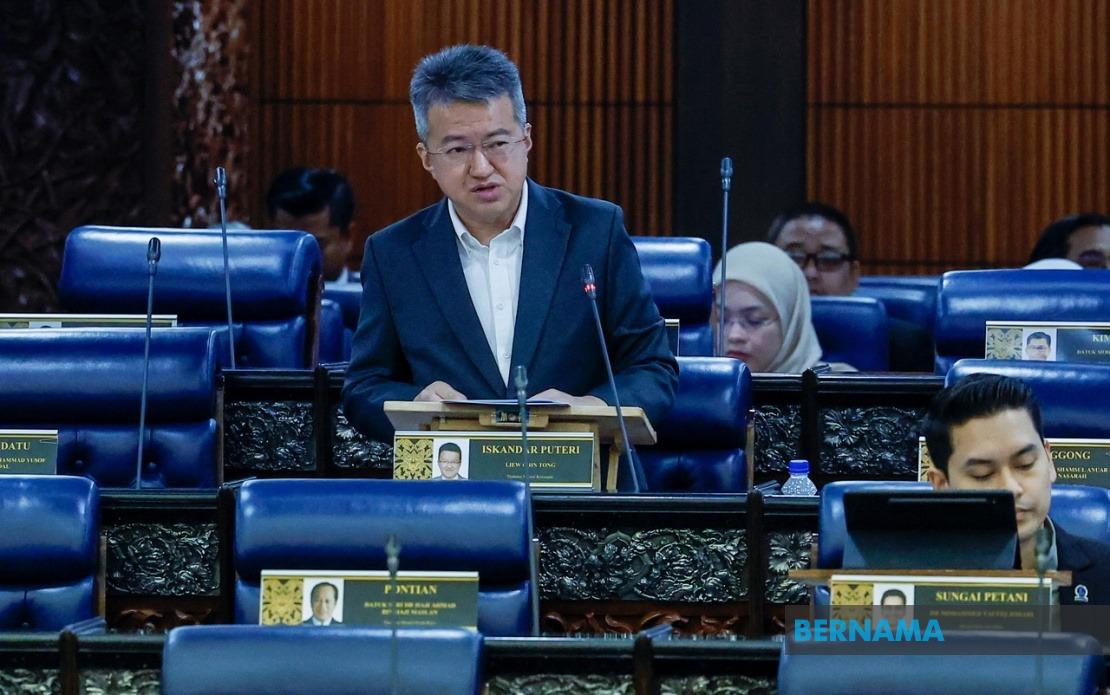
The federal government has moved to assure Sabah that its RM1.5 billion increase in interim special grant, announced by Prime Minister Datuk Seri Anwar Ibrahim in May, will leave the state's core development and operating budgets untouched. Deputy Finance Minister Liew Chin Tong made the clarification during a parliamentary session in response to concerns raised about how the additional funding would be managed alongside existing commitments.
The distinction between the special grant and regular development allocations is significant for Sabah's fiscal planning. Liew emphasised that the special grant — a constitutional entitlement under Article 112C of the Federal Constitution — operates as a separate funding stream and would not cannibalize allocations specifically designated for infrastructure and service delivery. This separation is crucial because Sabah, as a signatory to the Malaysia Agreement 1963, has specific constitutional protections regarding federal funding arrangements that differ from those of other states.
Under this year's federal budget, Sabah's development allocation has expanded from RM6.7 billion to RM6.9 billion, reflecting the government's commitment to the state's infrastructure priorities. The portfolio encompasses major infrastructure ventures including the Pan Borneo Highway — a transformative multi-billion ringgit project connecting Sabah's east and west coasts — alongside rural connectivity improvements such as road networks, electrification, and water supply systems. Additionally, significant resources are earmarked for health facility upgrades, including hospital and clinic construction and refurbishment, as well as the restoration of dilapidated educational institutions and police stations throughout the state.
The electricity subsidy commitment represents another layer of federal support that extends beyond the development budget proper. Although regulatory authority over electricity supply was transferred to the Sabah state government in 2024, the federal government continues to underwrite consumer costs through direct subsidies. For 2026, this subsidy allocation is projected to reach RM880 million, a substantial commitment that protects household and business electricity costs in a state where energy expenses can constrain economic activity and living standards. This ongoing support reflects the federal government's recognition that Sabah's energy infrastructure requires continued investment and price stabilisation to remain competitive.
Rural water supply infrastructure has received particular attention in recent budget allocations, signalling government priority on bridging the urban-rural development divide. Sabah's allocation for rural water supply has increased markedly from RM103.5 million in 2025 to RM143 million in the current financial year, a rise of approximately 38 percent that underscores commitment to expanding access to clean water in remote communities. This expansion is critical for Sabah, where large populations in interior regions have historically faced supply challenges that constrain health outcomes and economic productivity.
Beyond infrastructure spending, the government has extended direct assistance to Sabah's population through cost-of-living support schemes. The combined allocation for the Sumbangan Tunai Rahmah (STR) and Sumbangan Asas Rahmah (SARA) programmes in Sabah is estimated at RM1.2 billion, representing a direct injection of purchasing power into the state's economy and providing relief to households facing inflationary pressures. These cash transfer programmes have become a cornerstone of the government's social protection framework, particularly important in a state where income volatility and commodity-dependent livelihoods affect economic security.
The procedural framework governing the special grant requires strict adherence to constitutional provisions and established protocols. Liew clarified that both the federal and Sabah state governments must comply with processes outlined under Article 112D of the Federal Constitution when processing the new special grant, following the same mechanisms implemented in 2022, 2023, and 2025. This procedural consistency ensures transparency and prevents disputes about implementation while maintaining the constitutional integrity of arrangements between the federation and the state.
The federal government's position on the special grant reflects a more nuanced engagement with constitutional law surrounding Sabah's status. While affirming its respect for the special grant principle enshrined in Article 112C, the government has filed an appeal against certain elements of the Kota Kinabalu High Court's interpretation of the provision. This dual approach — respecting the principle while contesting specific judicial determinations — demonstrates the government's recognition of Sabah's constitutional standing while seeking clarity on implementation methodologies that satisfy both parties' interests.
Looking forward, the government has signalled its intention to establish a new mechanism for determining future special grant amounts in consultation with the Sabah state government. These negotiations, grounded in Articles 112C and 112D, aim to create a sustainable framework that respects constitutional obligations while providing predictability for state planning purposes. Such mechanism-building is essential for Sabah's long-term development strategy, as it would reduce fiscal uncertainty and enable multi-year project planning aligned with federal development priorities.
For Malaysia's federal system, the Sabah situation exemplifies the complexity of managing constitutional commitments to states with distinct historical and political arrangements. The RM1.5 billion increase, while substantial in absolute terms, must be understood within the context of broader federal-state fiscal relations and the specific historical compact that Malaysia Agreement 1963 represents. How these negotiations and funding mechanisms evolve will set precedents affecting not only Sabah but also the broader framework of federalism in Southeast Asia's largest federal democracy.
The government's careful articulation that the special grant does not reduce development allocations addresses legitimate concerns about fiscal crowding-out, where additional categorical transfers might reduce baseline support. For Malaysian policymakers and observers, this reassurance underscores the distinction between revenue-augmenting transfers and redistributive mechanisms — a crucial distinction often lost in public discussion of federal-state fiscal arrangements. Sabah's development priorities, from major infrastructure to basic service delivery, require both sustained baseline funding and additional targeted investments to achieve the balanced development the government has committed to delivering across the federation.

