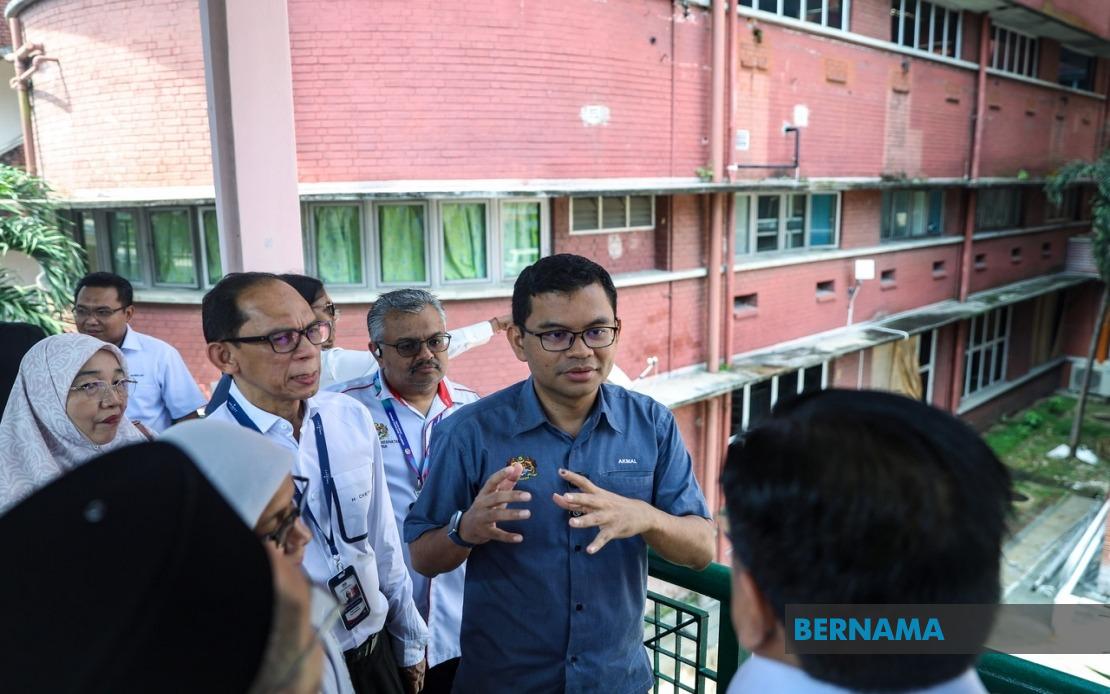
Johor Bahru's Sultanah Aminah Hospital is embarking on an ambitious RM1.139 billion healthcare infrastructure overhaul, with seven interconnected development projects designed to substantially expand its treatment capacity and modernise its operational systems. The ambitious initiative represents one of the largest healthcare investments in the state and reflects the federal government's commitment to strengthening medical facilities in Peninsular Malaysia's southern industrial heartland, where healthcare demand continues to mount alongside rapid urban and manufacturing growth.
Economy Minister Akmal Nasrullah Mohd Nasir revealed the scope of the transformation during a working visit to Johor, underscoring the strategic importance of the hospital's modernisation to the region's socioeconomic development. The minister disclosed that electrical infrastructure overhaul alone—a foundational component of the broader programme—carries a price tag of RM159 million and has already achieved 76.49 per cent completion. This particular initiative encompasses the replacement and upgrading of the main electricity distribution network alongside all associated mechanical and electrical systems, work that demands meticulous coordination to prevent disruptions to ongoing patient care and hospital operations.
The centrepiece of the investment programme is a dual-phase specialist clinic complex paired with a new day care centre and integrated multi-storey parking facility, collectively valued at RM877.54 million. This substantial component addresses a critical gap in the hospital's current infrastructure: the absence of dedicated specialist outpatient facilities and insufficient parking, both persistent complaints from patients and healthcare professionals. The specialist clinic complex, when operational, will consolidate scattered specialist services under a single modern facility, streamlining patient flow and reducing administrative inefficiencies. The associated day care centre will cater to patients requiring short-term observation or procedures that do not necessitate overnight admission, a growing segment of modern healthcare delivery.
The parking component deserves particular attention for Malaysian readers familiar with Johor Bahru's congestion challenges. The multi-storey facility will alleviate a longstanding bottleneck that has frustrated patients, visitors, and staff while also creating pedestrian-friendly connections between parking areas and hospital entrances—a consideration that reflects contemporary healthcare facility design principles centring on patient convenience and safety. Akmal Nasrullah indicated that formal contractor appointment through the Letter of Acceptance process is scheduled for February next year, suggesting that detailed planning and tender evaluation remain underway.
The expansion of the hospital's surgical capacity represents another significant dimension of the transformation programme. Three new operating rooms will be constructed, raising the hospital's total from twelve to fifteen—a twenty-five per cent increase that directly translates to enhanced throughput for routine and emergency surgical procedures. This expansion addresses supply-side constraints that have periodically caused surgical scheduling bottlenecks, particularly for non-emergency procedures. For Malaysian patients accustomed to lengthy waiting lists for elective surgeries, this augmentation represents a tangible improvement in service accessibility.
From a project management perspective, Akmal Nasrullah identified a central implementation challenge: executing this complex, multi-phased construction programme whilst maintaining uninterrupted hospital operations. Unlike greenfield developments where construction can proceed without operational constraints, healthcare facility expansion demands surgical precision in scheduling, phasing, and logistical coordination. The minister's acknowledgement of this tension underscores the complexity involved in transforming a functioning medical institution from within—a task that requires sophisticated planning to ensure patient safety and service continuity even as crews excavate, construct, and install new systems around operating theatres, intensive care units, and emergency departments.
The Sultanah Aminah Hospital investment sits within a substantially larger development portfolio spanning Johor state. Since 2000, Johor has absorbed RM56.12 billion across 613 development programmes and projects, encompassing 154 wholly new initiatives alongside 459 expansion and extension efforts. This multi-decade investment trajectory reflects sustained governmental commitment to infrastructure development in Malaysia's second-largest state, though the pace has modulated according to fiscal constraints and competing priorities across different administrations.
Current fiscal year disbursement patterns reveal the practical constraints facing implementation agencies. Through late July, RM2.5 billion—representing 50.51 per cent of the RM4.95 billion annual allocation—had been expended. This trajectory, whilst respectable, underscores the reality that large-scale construction projects frequently encounter procurement delays, weather-related stoppages, and unforeseen site conditions that compress actual spending into compressed timeframes, often towards financial year-end. For Malaysian businesses in the construction and engineering sectors, these spending patterns inform bidding strategies and cash flow projections.
The hospital modernisation programme carries implications extending beyond Johor's borders. Sultanah Aminah Hospital functions as a tertiary referral centre for southern Peninsular Malaysia, drawing patients from neighbouring Negeri Sembilan and northern Selangor. Enhanced surgical capacity and specialist clinic infrastructure will reduce pressure on other major teaching hospitals whilst improving service quality for a patient population spanning multiple states. Furthermore, the project demonstrates the government's willingness to channel major capital towards state-level healthcare infrastructure despite fiscal pressures, a signal to other healthcare institutions nationwide that transformative investments remain attainable through patient advocacy and political support.
The minister's emphasis on ensuring smooth implementation reflects heightened attention to project delivery outcomes following years of political scrutiny regarding cost overruns and timeline slippages affecting major development initiatives. By framing the implementation challenge explicitly and acknowledging the need for careful coordination, Akmal Nasrullah positioned the project within a narrative of disciplined project management and responsiveness to operational realities—messaging intended to reassure both healthcare professionals and the public that expansion will not compromise service quality during the transition period.
Looking forward, the Sultanah Aminah Hospital projects will influence healthcare planning discussions throughout Southeast Asia's rapidly developing regions. Malaysia's approach—combining surgical capacity expansion with specialist clinic consolidation and patient amenity improvements—represents a balanced strategy addressing both clinical functionality and patient experience. As regional healthcare systems grapple with rising demand stemming from ageing populations and increasing chronic disease prevalence, Johor's experience will inform similar transformation initiatives across Thailand, Indonesia, and the Philippines, where comparable infrastructure gaps exist.

