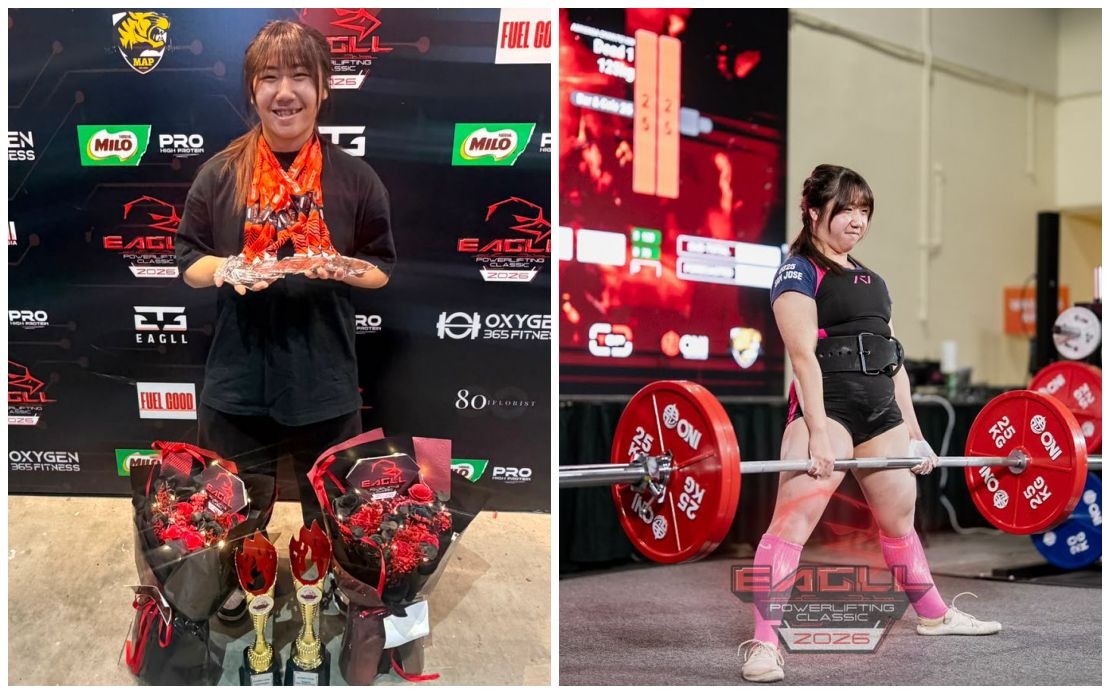
Malaysian powerlifting has found a rising star in Abrienda Chan, the 20-year-old Sarawakian who has transformed her competitive ambitions into tangible results by shattering five national records in the Under-57 kilogramme category at the Eagll Powerlifting Classic held in Kuala Lumpur this month. The breakthrough performance, which included seven gold medals and one silver across both junior and open divisions, represents a watershed moment for an athlete who stands just 151 centimetres tall yet continues to defy expectations in a sport traditionally dominated by heavier competitors.
Abrienda's record-breaking achievement demonstrates remarkable progress across multiple disciplines within the sport. Her newly established national marks encompassed the open squat record at 128 kilograms, junior and open bench press records both set at 70 kilograms, and junior and open total records of 343 kilograms. This multi-disciplinary dominance underscores not merely raw strength, but technical proficiency and consistency across the three fundamental powerlifting movements. The breadth of her accomplishments suggests systematic preparation and coaching excellence, particularly noteworthy for an athlete still in her early competitive career.
The EPC 2026 competition served as a critical stepping stone in Abrienda's preparation for two prestigious world championships scheduled for 2027. Her articulated strategy of systematically breaking national records indicates a methodical approach to athletic development, one that builds confidence whilst establishing benchmarks against which future progress can be measured. This approach contrasts sharply with athletes who pursue international competition without first dominating their domestic landscape, and it positions Malaysia's powerlifting federation as having identified genuine championship potential within its ranks.
Interestingly, Abrienda's own assessment of the competition revealed unexpected elements of her performance. She narrowly missed capturing the junior squat record due to technical difficulties during her final attempt, and deliberately adopted a conservative approach in the deadlift to secure overall titles rather than risk additional records. This tactical discipline—knowing when to pursue maximum records versus securing overall victories—demonstrates maturity beyond her years and suggests coaching staff attuned to long-term development rather than isolated achievements.
Perhaps more striking than the records themselves was Abrienda's second-place finish in the open overall standings, a result that surprised even the athlete herself given her status as one of the youngest competitors in that division. This crossover success, placing well in open-age categories whilst simultaneously dominating junior-age competition, indicates an athlete capable of competing effectively across different competitive levels. For Malaysian sports development, this versatility carries significance, as it suggests Abrienda may represent a generation of athletes trained to international standards from the outset.
Abrienda's competitive trajectory has been unusually rapid. Previously, she dominated the Under-52 kilogramme sub-junior category, where she continues to hold national records across all three lifts and the total score. The progression from sub-junior dominance through junior success and into credible open-division performance follows the ideal pathway for talent development. Her previous gold medal at the 2024 Asian Classic Powerlifting Championships established her as a continental competitor of note, yet she remains focused on achieving top-three placements in her category at the 2027 World Classic championships.
The structural support surrounding Abrienda's development reveals important considerations for Malaysian sports funding and development infrastructure. She acknowledges crucial backing from her family, coaching staff, and Turbo Fitness, which provided training facilities and contributed to competition travel expenses. This ecosystem of support—combining family commitment, professional coaching, commercial sponsorship, and training infrastructure—represents the foundation upon which elite athletes develop. For Malaysian sports administrators and potential sponsors, Abrienda's case demonstrates the returns on investment in targeted athlete support programmes.
Abrienda faces two distinct championship challenges in 2027. The World Classic and Equipped Bench Press Championships in Istanbul, Turkey presents one avenue, whilst the World Classic Sub-Junior and Junior Powerlifting Championships in Haining, China offers another. Her aspiration to crack the world's top three in the Under-57 junior category by 2027 represents an ambitious but achievable target, particularly given her demonstrated ability to establish national records consistently. The dual-championship strategy allows flexibility in achieving international recognition across different competition formats.
From a regional Southeast Asian perspective, Malaysia's emergence of strength athletes capable of competing at world championship level carries broader implications. Powerlifting remains a developing sport throughout much of Southeast Asia, with competition infrastructure and athlete development programmes still maturing across the region. Abrienda's achievements position Malaysia as a potential hub for powerlifting development, potentially attracting regional athletes and establishing the nation as a training destination within Asia. The sport's accessibility—requiring minimal equipment compared to many disciplines—suggests significant growth potential throughout the region.
Abrienda's reflections on her competitive preparation underscore the psychological dimensions of elite athletic development. She emphasised gaining deeper self-knowledge and body awareness through rigorous preparation, qualities essential for continued progression. Her gratitude towards her support network acknowledges that individual achievement in strength sports, whilst dependent on personal discipline and genetic predisposition, fundamentally requires institutional and personal backing. This perspective contrasts with popular narratives emphasising individual heroism, instead presenting athletic success as a collective endeavour requiring aligned efforts across multiple stakeholders.
Looking ahead, Abrienda's trajectory suggests Malaysia may be developing a new generation of strength athletes capable of genuine international success. Her willingness to compete across age categories, her technical proficiency evidenced by record-breaking performances, and her mature competitive approach indicate she possesses the foundation for sustained excellence. The 2027 world championships will provide the definitive test, but her current momentum and record-setting performances suggest Malaysian powerlifting's evolution from a niche activity to a sport producing competitors of international calibre. Her journey deserves close observation from sports administrators and aspiring athletes alike, as she represents both individual achievement and the emerging potential of Malaysian strength sports on the world stage.

