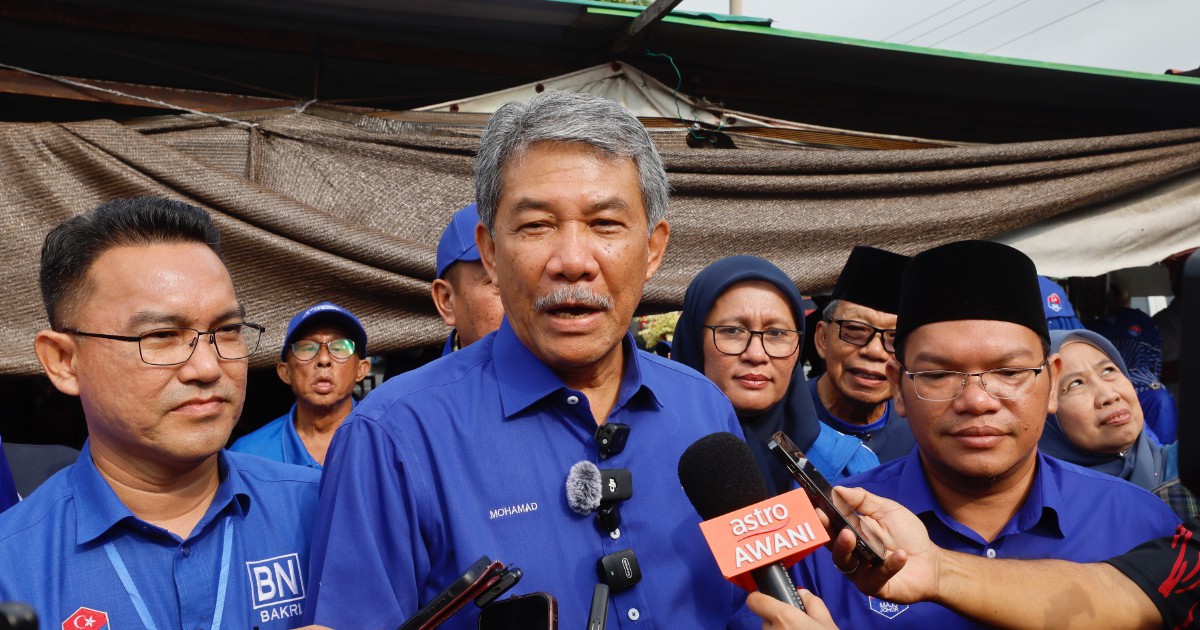
The political temperature in Malaysia's Johor heartland has risen sharply as Barisan Nasional deputy chairman Datuk Seri Mohamad Hasan issued a pointed ultimatum to DAP leader Nga Kor Ming, telling him to step down at once if he could no longer stomach his position. The rebuke came during remarks made in Muar, where Tok Mat, as he is widely known, appeared to react to earlier statements made by the Perak-based opposition politician concerning the Johor electoral contest.
The escalating war of words reflects deepening fractures within Malaysia's political coalition landscape, particularly as the country navigates an increasingly fragmented parliament. Tok Mat's demand carries particular weight given his position as one of BN's most senior figures and his influence within UMNO, the coalition's dominant member party. His blunt intervention suggests the ruling coalition views Nga's remarks not merely as rhetorical flourishes but as substantive challenges to its electoral legitimacy or governance approach in Johor.
Nga Kor Ming, who serves as a senior DAP figure and cabinet minister, has emerged as one of the opposition's more visible and vocal spokespersons on major national issues. His comments regarding the Johor election appear to have struck a nerve within the BN machinery, which continues to regard Johor as a crucial political stronghold. The state has historically been a BN bedrock, and any challenge to its electoral narrative or governance claims could be perceived as a direct threat to the coalition's broader political standing in the region.
The incident underscores the precarious nature of Malaysia's current political alignments. While BN and the DAP-led Pakatan Harapan coalition have cooperated at the federal level in recent years, particularly through the Madani administration, fundamental tensions persist at the state level and over key policy matters. Johor represents a particular flashpoint given its significance to both BN's identity and to broader Malaysian political calculations.
Tok Mat's reference to resignation appears designed to question Nga's commitment to his ministerial role and party positions, implying that if the DAP politician disagrees fundamentally with matters under BN's purview or disagreed with Johor's political direction, his continued service would be hypocritical. Such language is typical of Malaysian political confrontation, where questions of legitimacy and consistency frequently become weaponized during inter-party disputes.
For readers across Southeast Asia observing Malaysian politics, this exchange illustrates the volatile dynamics that continue to characterise the region's largest democracy. Unlike stable two-party systems, Malaysia's multi-ethnic, multi-party landscape requires complex coalition arrangements that frequently produce such public tensions despite operational cooperation. These friction points are rarely merely about the immediate issue—they often reflect deeper anxieties about representation, state-level power, and the distribution of political authority.
The DAP, as the largest Chinese-based political party in the region, remains acutely sensitive to questions about its influence and voice, particularly in states like Johor where ethnic Malay-Muslim majorities have historically supported BN. Nga's willingness to comment on Johor electoral matters likely stems from DAP's broader ambitions to establish relevance and credibility beyond its traditional strongholds in Penang, Selangor, and Kuala Lumpur. Conversely, BN's sharp response suggests it interprets such moves as encroachment on its traditional domains.
The timing of this confrontation may also reflect broader jockeying ahead of the next general election cycle. While Malaysia's electoral calendar is fluid, political parties across the spectrum are continuously repositioning themselves, testing messages, and attempting to shift electoral coalitions. Nga's remarks on Johor might represent DAP's attempt to stake claims in a state where it has historically struggled to gain traction, while Tok Mat's response signals BN's determination to maintain its territorial advantage.
Within the context of Malaysia's federal cabinet system, where both BN and DAP representation coexist despite party-level tensions, such public confrontations create awkward dynamics. Ministers who belong to opposing coalitions must nonetheless work together on national policy, creating an inherent contradiction between their electoral and governing roles. Tok Mat's challenge to Nga potentially reflects frustration with this arrangement, suggesting that continued ministerial participation should come with restraint on state-level political attacks.
The broader implications for Malaysian governance remain significant. Coalition arrangements built on convenience rather than shared ideological foundations tend to produce these kinds of flare-ups. Whether this particular exchange signals a temporary eruption or indicates deeper instability within the federal arrangement remains to be seen. For investors, business leaders, and observers across the region, such moments of political friction in Malaysia carry potential consequences for policy stability and administrative predictability.
Moving forward, much will depend on whether senior figures in both BN and DAP choose to escalate further or allow this particular dispute to subside. Tok Mat's ultimatum clearly represents a hardening of positions on one side, making the opposition's response crucial in determining whether this becomes a defining moment in coalition relations or simply another episode in Malaysia's perpetual political theatre.

