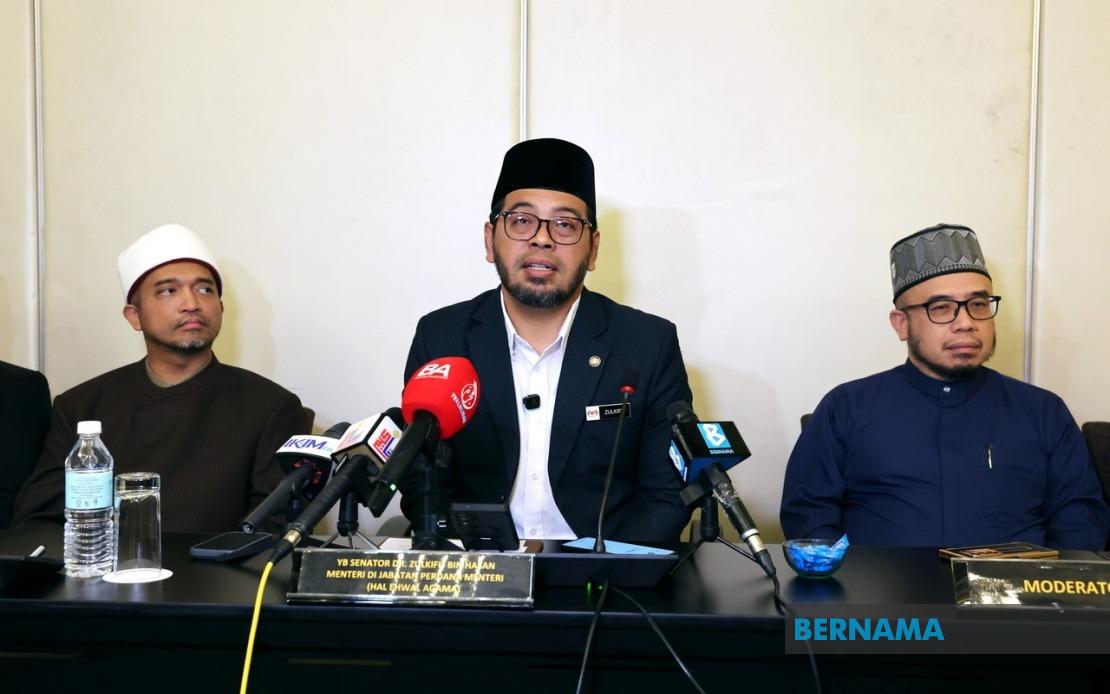
Minister in the Prime Minister's Department (Religious Affairs) Dr Zulkifli Hasan has firmly stated that the term "kafir harbi" has no place in Malaysian society, citing the binding nature of the Federal Constitution and the shared civic obligations that unite the nation's diverse population. Speaking in Putrajaya on August 10, Zulkifli underscored that Malaysia's constitutional framework supersedes any theological classifications that might divide citizens into categories of believers and non-believers or hostile outsiders.
The declaration came following a dedicated roundtable discussion convened specifically to examine the contentious term and its implications within the Malaysian context. The forum, titled "'Kafir Harbi' in Malaysia: A Discussion," brought together stakeholders to deliberate on whether such terminology could be meaningfully applied to Malaysian citizens without undermining the nation's foundational principles of unity and equal citizenship. The minister's position reflects a careful calibration between religious discourse and constitutional nationalism.
The historical and theological weight of "kafir harbi" cannot be understated. In Islamic jurisprudence, the term traditionally refers to non-Muslims in a state of war with the Muslim community, a classification rooted in centuries of Islamic legal scholarship. However, Zulkifli's intervention recognises that transplanting such categories into a modern, pluralistic nation-state creates fundamental contradictions. All Malaysian citizens, regardless of faith, inhabit the same legal and political space defined by the Federal Constitution, making the adversarial framing both theoretically incoherent and socially dangerous.
The minister articulated a vision of Malaysian citizenship that prioritises common bonds over religious divisions. He emphasised that citizens share not merely the same territory but also mutual responsibilities in defending and developing the nation. This formulation moves beyond mere tolerance or coexistence—it posits that the constitutional order itself creates a binding community of fate where religious differences, while acknowledged and protected, cannot override the primacy of shared citizenship. The approach reflects a broader Southeast Asian challenge of managing religious identity within secular constitutional frameworks.
Zulkifli's statement carries particular significance in Malaysia's contemporary political and social landscape. In recent years, the application of religious terminology to political opponents or religious minorities has occasionally surfaced in public discourse, raising concerns about the potential weaponisation of theological concepts for divisive purposes. By securing consensus from a roundtable discussion and articulating ministerial clarity, the government attempts to establish normative boundaries around religious language in public life. This preemptive stance aims to prevent further escalation of sectarian rhetoric before it becomes entrenched in mainstream political debate.
The Department of Islamic Development Malaysia (JAKIM) has been tasked with leading a collaborative initiative to disseminate clarification and awareness regarding the unsuitability of such terminology. This institutional approach suggests that addressing the issue requires sustained effort across multiple government agencies and levels, rather than relying on isolated statements. JAKIM's coordination reflects recognition that Islamic education and religious affairs cannot be siloed from broader national integration objectives, necessitating a whole-of-government response.
The collaborative framework outlined by Zulkifli extends beyond JAKIM to encompass other ministries and agencies, signalling that national unity cannot be achieved through religious measures alone. Such cross-sectoral cooperation underscores that maintaining social cohesion requires consistent messaging from educational institutions, civil service bodies, media regulators, and community organisations. The breadth of this approach acknowledges that religious terminology permeates various social domains—from academic institutions to community gatherings—and therefore cannot be addressed through any single institutional channel.
Zulkifli's appeal for mutual respect and intercultural understanding represents a diplomatic reinstatement of Malaysia's longstanding pluralistic ethos. His emphasis on Malaysians working together to strengthen unity, foster brotherhood, and respect diverse cultures and religions harkens back to the founding principles of the nation, while simultaneously addressing contemporary anxieties about religious polarisation. The statement functions both as a clarification for religious scholars and as reassurance for Malaysia's non-Muslim communities that constitutional protections remain intact.
The timing and framing of this ministerial intervention also carry implications for Malaysia's regional standing. Southeast Asia, with its diverse Islamic and non-Islamic societies, watches how Muslim-majority nations navigate religious pluralism. Malaysia's explicit rejection of divisive Islamic terminology—while affirming Islam's constitutional position—potentially sets a precedent for how modern Islamic governance can accommodate minority rights without sacrificing religious authority. This balance remains precarious and perpetually contested across the region.
Looking forward, the challenge lies in translating ministerial consensus into sustained behavioural change across Malaysian society. Public statements and government coordination represent necessary first steps, but embedding such norms requires engagement with religious teachers, community leaders, and digital platforms where such terminology might circulate unchecked. The success of this initiative will depend on whether JAKIM's collaborative efforts can create sufficient institutional momentum to shift everyday discourse, particularly in spaces where religious authority figures wield considerable influence over followers' worldviews and political attitudes.
The declaration also implicitly acknowledges that Malaysia's constitutional nationalism must be continuously defended and articulated against competing frameworks that prioritise religious boundaries over citizenship. By establishing clear ministerial guidance that "kafir harbi" classifications contradict Malaysia's constitutional order, the government creates authoritative reference points for religious scholars, community leaders, and ordinary citizens grappling with how religious identity relates to national belonging. Whether this intervention proves sufficient to prevent future invocation of such terminology remains an open question, but it signals governmental commitment to maintaining Malaysia's hard-won social peace through principled pluralism.

