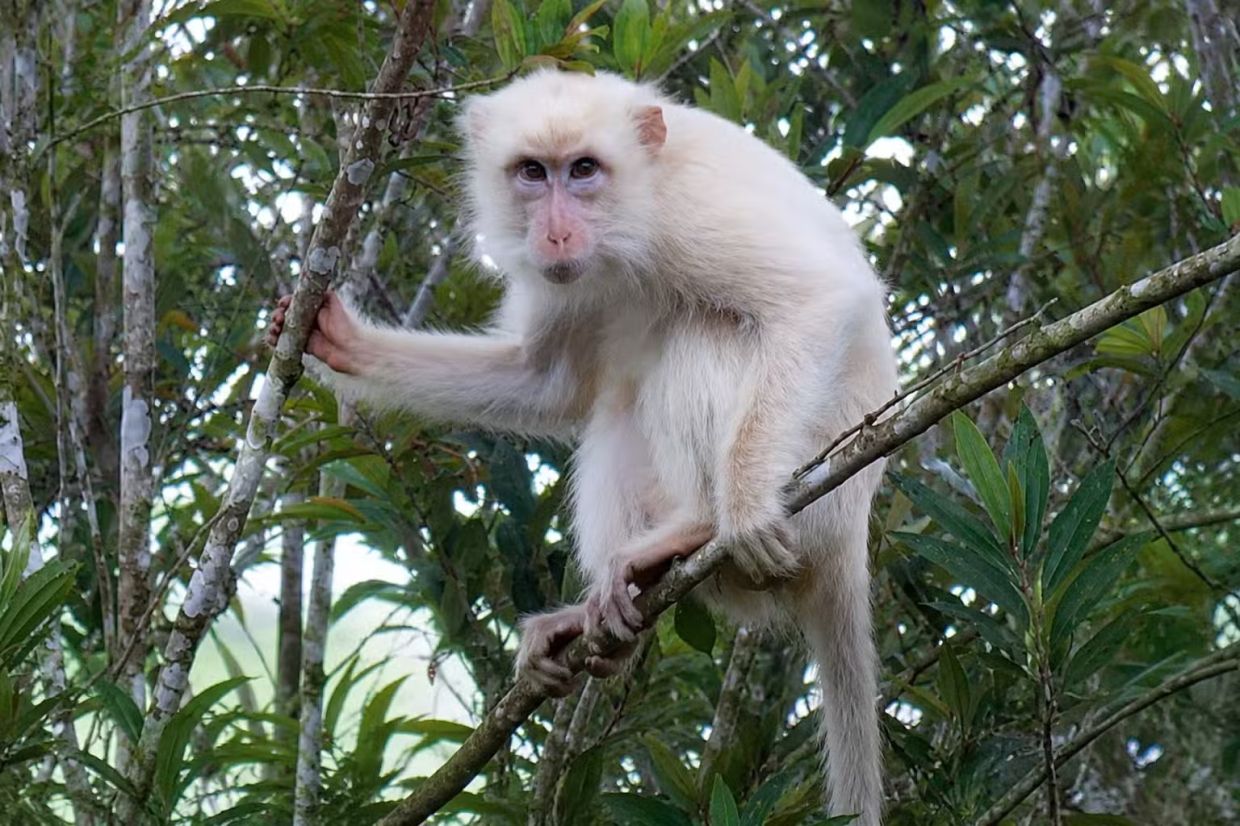
Conservation authorities in the Philippines have mobilised a rapid response to protect an extraordinarily pale macaque living in Sultan Kudarat province after the animal attracted widespread attention through social media. The primate, a Philippine long-tailed macaque displaying an unusual pigmentation anomaly, has inhabited the forested region since at least 2016, but only became a focal point for protection efforts once videos and photographs circulated online, drawing public curiosity and prompting concerns about its safety.
The Department of Environment and Natural Resources (DENR) Region XII and the local government of Senator Ninoy Aquino town have begun collaborative steps to shield the animal from disturbance and exploitation. Initial observations suggested the macaque might have albinism, a complete absence of pigment, yet a field validation conducted by a DENR composite monitoring team revealed brown to dark brown eyes, indicating the condition is more likely leucism or another form of pigmentation disorder. Scientific verification by wildlife specialists remains necessary before experts can definitively classify the anomaly, underscoring the complexity of understanding such rare biological variations in wild populations.
The discovery highlights a critical tension in the digital age: while social media amplifies awareness and can mobilise conservation action, it simultaneously exposes vulnerable wildlife to unprecedented risks. DENR officials expressed concern that the macaque's newfound prominence could make it a target for hunting, unlicensed capture, and removal from its natural habitat. The animal also faces heightened exposure to poaching and wildlife trafficking networks, which operate extensively across Southeast Asia and often exploit unusual or rare specimens for illegal trade, collections, or the exotic pet market.
During their field assessment, monitoring teams confirmed that the macaque's forest environment remains ecologically viable. Secondary growth vegetation and naturally occurring food sources continue to sustain the resident macaque population, meaning habitat degradation is not currently the primary threat. Instead, the immediate danger stems from human activity—both well-intentioned visitors seeking to observe the unusual animal and criminal elements seeking to profit from its rarity. This reality prompted swift intervention from local authorities.
The municipal government has temporarily restricted public access to the area where the white macaque is frequently observed, a precautionary measure designed to minimise disturbance and prevent illegal wildlife collection. The barangay of Bugso is now drafting a local ordinance to institutionalise long-term protection for the animal, its habitat, and the broader forest ecosystem. Pending formal enactment of this regulation, unauthorised entry to the immediate vicinity of reported sightings remains prohibited, establishing a legal framework that extends beyond temporary closures to create enduring safeguards.
Local officials recognise that sustainable conservation requires more than barriers and restrictions. Barangay Bugso has committed to tree-planting and habitat-restoration initiatives intended to strengthen the forest ecosystem's biological richness while advancing responsible ecotourism. This approach acknowledges a significant reality in modern conservation: communities living alongside wildlife must see tangible benefits from protection efforts, whether through sustainable income from controlled tourism or through ecosystem services like watershed protection and soil conservation. Without such incentives, local support for wildlife protection can erode over time.
The regulatory framework underpinning these efforts derives from Republic Act No. 9147, the Wildlife Resources Conservation and Protection Act, which comprehensively prohibits hunting, capturing, collecting, possessing, transporting, trading, or disturbing any protected wildlife without proper permits. All Philippine wildlife falls under this umbrella of legal protection, yet enforcement remains inconsistent, particularly in remote areas where monitoring capacity is limited and economic pressures drive illegal wildlife exploitation. The presence of a rare, visually striking animal increases compliance challenges substantially.
Recognising the role that digital communication plays in endangering wildlife, DENR has issued public appeals to vloggers, photographers, journalists, social media users, and residents to refrain from disclosing precise locations of rare species sightings or posting geotagged content that could facilitate poaching. This guidance reflects a growing understanding among conservation professionals that detailed location information, even when shared with benign intent, can rapidly be weaponised by exploitation networks. The message represents a significant cultural shift, given that wildlife documentation and nature content dominate contemporary social media platforms across the region.
Looking ahead, DENR Region XII will submit comprehensive documentation on the white macaque to the Biodiversity Management Bureau for technical evaluation and classification. The agency plans to continue regular monitoring of the habitat, strengthen coordination mechanisms with local government units, community leaders, and stakeholder organisations, and intensify public education campaigns on wildlife protection principles and legal requirements. These components reflect best practices in conservation management, combining scientific investigation with community engagement and regulatory enforcement.
The case carries broader implications for Southeast Asia, a region harbouring extraordinary biodiversity alongside intense pressures from habitat loss, illegal wildlife trade, and human encroachment. The white macaque of Sultan Kudarat exemplifies how rare biological phenomena can simultaneously draw protective attention and attract threatening interest. Success in this instance will depend on sustained commitment from authorities, genuine community participation, and the public's willingness to prioritise species survival over curiosity and documentation. For now, the unusual primate remains in its forest home, no longer an anonymous inhabitant but a symbol of the complex balancing act that modern conservation demands.
The situation also underscores the critical importance of capacity-building within conservation agencies. DENR and local governments in the Philippines often operate with stretched budgets and limited personnel, making systematic monitoring and enforcement difficult. International cooperation, technical assistance from regional conservation organisations, and increased domestic resource allocation will be necessary to protect not only this singular macaque but the thousands of endemic and threatened species across the Philippine archipelago that receive far less public attention.

