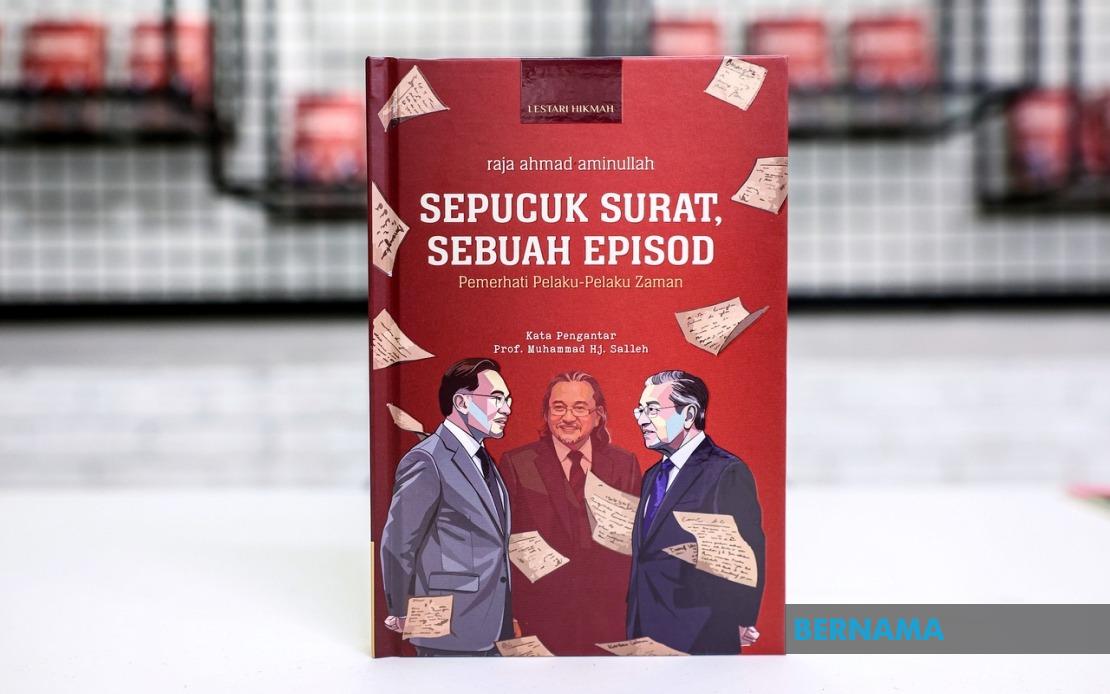
A new publication launched in Kuala Lumpur this week provides an intimate look at Malaysia's political and cultural landscape through the personal correspondence of celebrated cultural commentator Raja Ahmad Aminullah. The book, titled "Sepucuk Surat Sebuah Episod: Rakaman Pelaku-Pelaku Zaman", compiles letters and exchanges with some of the country's most significant figures, offering readers a rare documentary perspective on the people who have influenced Malaysia's trajectory over recent decades.
Raja Ahmad, affectionately known as Pak Engku, deliberately frames the publication as a socio-cultural and historical document rather than a political commentary. Speaking at the official book launch, he emphasized that his primary interest lies in observing and recording the societies and communities surrounding him, rather than engaging with political narratives or partisan positioning. This distinction is crucial for understanding the work's intent: it is positioned as a chronicle of lived experience and social observation rather than as advocacy or analysis of political movements.
The author stressed that the collection does not elevate any particular national figure above others or attempt to reshape their public perception. Instead, Raja Ahmad describes the volume as a time capsule of interactions and moments captured roughly 25 years ago, preserved to allow contemporary and future readers to extract meaning and lessons from the documented exchanges. By framing the work this way, he sidesteps the inevitable speculation that might otherwise surround a book featuring correspondence with figures of the calibre of Tun Dr Mahathir Mohamad and Datuk Seri Anwar Ibrahim, two dominant forces in Malaysian politics across multiple decades.
The book's launch was hosted by the National Book Council of Malaysia, with Mohd Khair Ngadiron, the council's director, presiding over the event. The gathering drew an audience of artists, writers, academics, and long-standing associates of Raja Ahmad, reflecting the cultural and intellectual circles in which the author moves. This composition of attendees underscores the work's positioning within Malaysia's cultural and literary establishments rather than purely within political spheres.
For Malaysian readers and those studying the nation's recent history, the publication offers potential value as a primary source document. Personal correspondence between influential figures provides texture and context that official historical records often lack. Letters reveal how leaders thought privately, what concerned them beyond public pronouncements, and how they engaged with trusted interlocutors. In the Southeast Asian context, where Malaysia has experienced significant political transformation and institutional challenges in recent years, such intimate records of conversations from an earlier era may illuminate continuities and shifts in thinking among the country's elites.
Raja Ahmad's approach to documentation reflects a broader trend among Malaysian intellectuals and cultural figures seeking to preserve and interpret the nation's recent past. As Malaysia navigates complex questions about governance, national identity, and social cohesion, historical materials that offer non-partisan observation become increasingly valuable. The author's explicit disavowal of interest in "the politics of confrontation" suggests a deliberate effort to position the work above the partisan divisions that have intensified in Malaysian public discourse.
The practical accessibility of the publication also matters for its potential readership. Published by Lestari Hikmah, the 169-page volume is available in both softcover and hardcover editions, priced at RM30 and RM80 respectively, making it reasonably accessible to interested readers. Distribution through conventional bookstores and online channels ensures it can reach academic institutions, libraries, and individual collectors of Malaysian historical materials across the region.
For students of Malaysian history and social development, the work is expected to serve as a reference point for understanding the personal dimensions of national leadership during a formative period. The author explicitly positions the book as a resource for those engaged with literature, history, and social sciences—disciplines that often benefit from primary source materials that illuminate the human contexts in which major events and decisions occur.
Raja Ahmad's characterization of himself as "inconsequential" in the narrative is notably self-deprecating but also strategic. By minimizing his own role as author and commentator, he directs reader attention toward the figures whose letters populate the volume and the era they represent. This rhetorical move invites readers to form their own interpretations rather than accepting a predetermined narrative framework, positioning the work as documentary rather than memoir or advocacy.
The timing of the publication, occurring in mid-2024, places it within a moment when Malaysia is actively reassessing its recent political history. The country has experienced significant shifts in government, institutional reforms, and ongoing public debate about the future direction of various national institutions. In this context, a documented record of how prominent figures thought and communicated a quarter-century ago provides comparative material for understanding how Malaysian leadership has evolved—or failed to evolve—in response to changing national circumstances.

