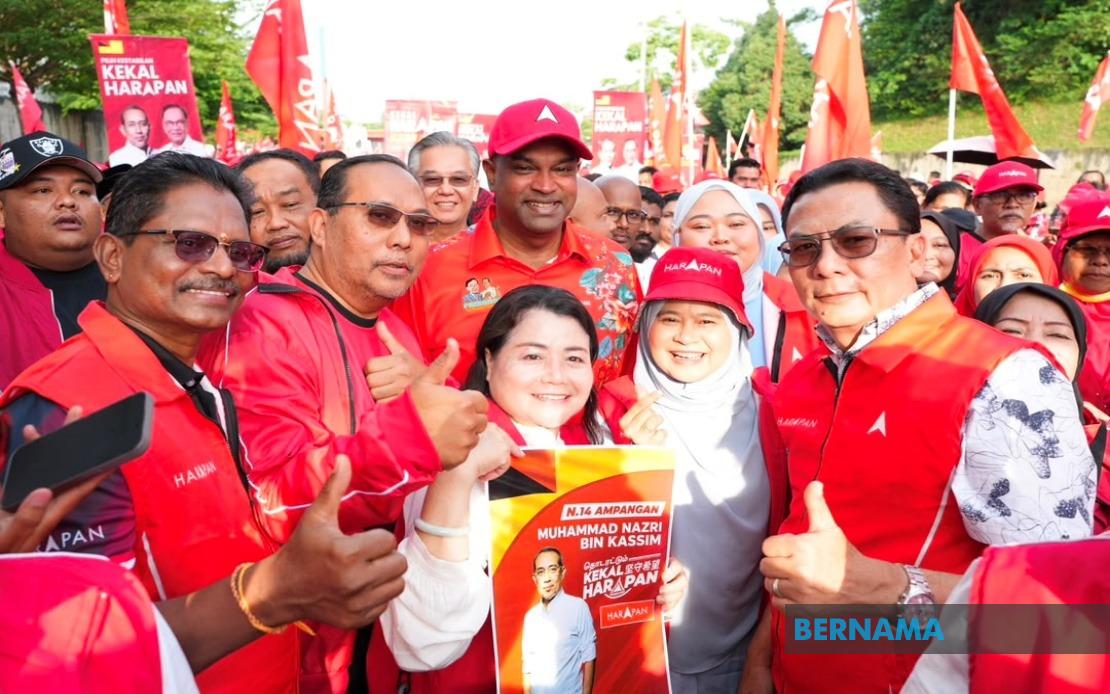
Senior Pakatan Harapan leaders converged on Seremban's nomination centre this week to demonstrate their unified backing for a slate of six candidates competing in the 16th Negeri Sembilan state election. The show of force, led by PKR vice-president Datuk Seri R. Ramanan and DAP deputy secretary-general Steven Sim, underscored the coalition's determination to maintain its political foothold in the state as it enters the crucial campaign stretch.
Ramanan, who represents the parliamentary seat of Sungai Buloh, appeared at the Seremban City Council Building (Wisma MBS) alongside fellow party stalwarts to endorse the candidacies of Nor Azman Mohamad in Sikamat, Datuk Muhammad Nazri Kassim in Ampangan, Zarinna Abu Zarin in Lenggeng, Chew Seh Yong in Lobak, J. Arul Kumar in Nilai, and Ho Weng Wah in Temiang. This cross-party coordination reflects the coalition's strategy of presenting a united front in a state where the outcome remains consequential for both Putrajaya and the opposition.
The gathering at Wisma MBS carried symbolic weight beyond the ceremonial endorsement. According to Ramanan's comments, the visible turnout of party supporters and organisational personnel at the nomination centre suggested robust grassroots enthusiasm and institutional readiness for the electoral battle ahead. Such visible demonstrations of party machinery are carefully staged affairs in Malaysian politics, serving to signal donor confidence, volunteer engagement, and organisational capacity to both supporters and observers.
In his statement, Ramanan articulated the coalition's broader messaging around the election. He framed the campaign not merely as a partisan exercise but as an undertaking essential to "stability and the continuity of development in Negeri Sembilan." This rhetorical positioning—linking electoral success to substantive governance outcomes—forms part of the narrative Pakatan Harapan has pursued since reclaiming federal power in 2018. The emphasis on "engaging with the people" throughout the campaign period suggests the coalition recognises the need for sustained, direct voter contact rather than relying solely on institutional advantages.
Negeri Sembilan carries particular significance within the Malaysian political ecosystem. As a state assembly with 36 seats, it operates as a mid-tier arena where coalition dynamics are tested without the complexity of larger federal contests. The state has historically served as a bellwether for broader political sentiment, making its electoral performance noteworthy for tracking shifts in public opinion across the peninsula. A strong showing here could provide Pakatan Harapan with momentum heading into potential federal contests, while underperformance might signal erosion of support in key demographics or regions.
The timeline for the election underscores the intensity of the upcoming campaign phase. With the formal nomination process now complete, parties enter a compressed engagement window spanning from the nomination date through July 31, giving candidates and party machinery barely two weeks of concentrated campaigning before early voting on July 28 and the main polling day on August 1. This compressed schedule requires disciplined resource allocation and strategic targeting of voter segments rather than broad-based, diffuse messaging.
The dissolution of the state assembly on June 5 triggered this electoral cycle, resetting the political clock and forcing all contenders to rebuild their respective organisational positions from scratch. For Pakatan Harapan, the presence of senior figures like Ramanan and Sim at nomination centres serves multiple functions: it legitimises local candidates by association with established federal figures, it generates media coverage that reinforces coalition visibility, and it provides an opportunity to assess local party structures and identify potential vulnerabilities or recruitment gaps ahead of the intensive campaign phase.
The decision to field this particular slate of candidates reflects broader coalition calculations about winnable seats and demographic representation. The diversity of candidates' backgrounds and the geographic spread across six different constituencies suggest a strategy aimed at broad appeal rather than concentration in particular strongholds. This dispersal approach requires confident assessment of organisational capacity across multiple districts simultaneously.
For Malaysian voters in Negeri Sembilan, the election presents a choice about the trajectory of state governance. The presence of high-level federal figures staking political capital in these local contests indicates that Pakatan Harapan views the outcome as material to national political positioning. The coalition's messaging around development continuity implies that local governance quality and service delivery remain central to their electoral appeals, even as deeper ideological divides between federal coalitions continue to shape Malaysian politics.
The weeks ahead will test whether the visible enthusiasm at nomination centres translates into sustained voter mobilisation and ultimately into electoral success. Negeri Sembilan's voters will render their verdict on August 1, providing a snapshot of coalition performance that national observers will scrutinise closely for broader implications.

