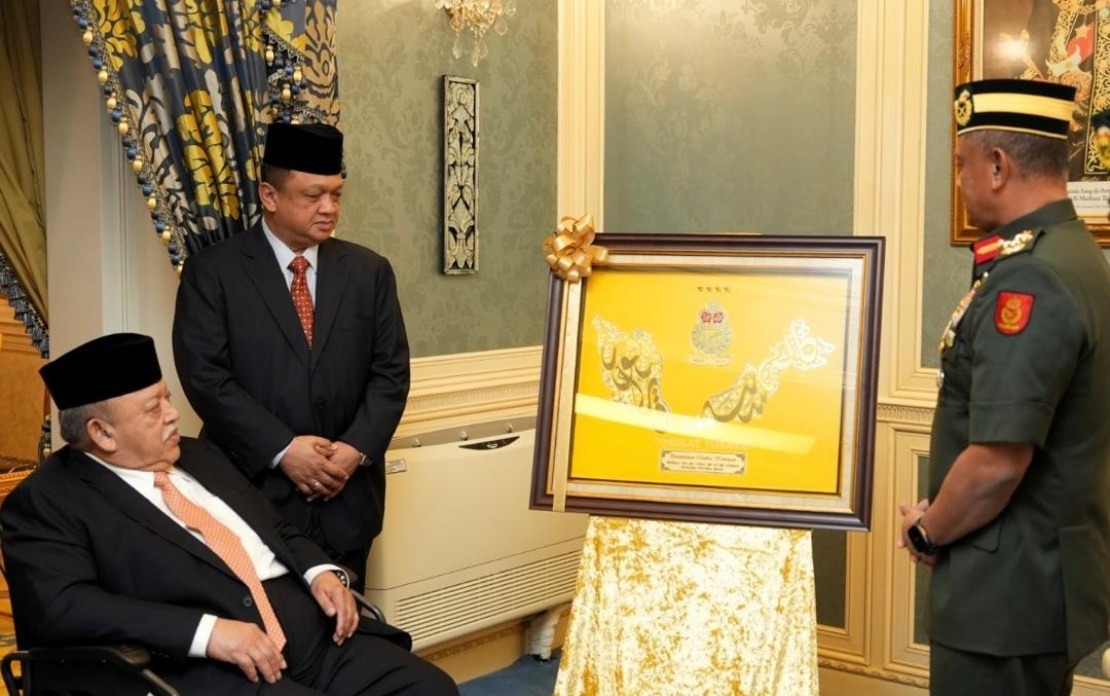
Tuanku Syed Sirajuddin Jamalullail, the Raja of Perlis, held a ceremonial audience with General Tan Sri Azhan Md Othman, the Chief of Defence Force, on July 29 at the Balai Menghadap Biru within Istana Arau. The gathering represented a deliberate step to reinforce the institutional relationship between Perlis's royal leadership and Malaysia's military command structure, underscoring the importance both institutions place on coordinated governance and security matters at the state and national levels.
The Raja Muda of Perlis, Brigadier General Tuanku Syed Faizuddin Putra Jamalullail, accompanied His Royal Highness during the encounter. Notably, the Raja Muda holds an active military position as Commander of the 504th Territorial Army Regiment, which operates from Kem Bukit Keteri near Padang Besar in the northern border district. This dual role—bridging royal and military hierarchies—reflects a broader Malaysian practice of integrating palace institutions with defence structures, a tradition particularly pronounced in states with significant strategic importance like Perlis.
The palace issued a formal statement characterising the audience as an opportunity to strengthen longstanding bonds between the Perlis Royal Institution and the armed forces. Beyond ceremonial protocol, officials emphasised that the meeting provided occasion to recognise the military's fundamental role in protecting national sovereignty and maintaining public security—responsibilities that remain constant regardless of political shifts or administrative changes. This framing reflects how Southeast Asian monarchies typically position themselves as custodians of stability and national cohesion.
Tuanku Syed Sirajuddin Jamalullail holds several ceremonial defence appointments that give him formal standing in military matters. He serves as Colonel-in-Chief of both the Royal Ranger Regiment (RRD) and the Royal Military Police Corps (KPTD), positions that carry symbolic weight and underscore the crown's connection to armed institutions. These titles, while largely ceremonial, carry historical significance dating back to the formation of Malaysia's defence establishment and represent continuity with pre-independence military traditions.
According to palace officials, the meeting functioned as a strategic platform for advancing cooperation between army leadership and Perlis's state administration. The discussion encompassed multiple domains: security matters affecting the state, the welfare of Perlis residents, and broader initiatives in national development. This multifaceted agenda suggests conversations ranged beyond routine courtesy to encompass substantive policy coordination, particularly given Perlis's location along Malaysia's northern frontier with Thailand.
The emphasis on preserving national peace, stability and prosperity through close coordination between defence and royal institutions reveals an underlying concern in Malaysia's governance model. The palace statement suggested that institutional alignment between the military hierarchy and the sultanate remains essential for managing the complex security environment that characterises Malaysia, particularly in northern states contending with cross-border considerations and transnational challenges. Such coordination helps ensure that civilian, military, and royal perspectives align on matters affecting public order.
Perlis occupies a distinctive position within Malaysia's federal structure. As one of Malaysia's smaller states yet serving as a critical buffer along the Thailand-Malaysia border, it faces unique strategic considerations. Military and security matters carry particular weight in state-level governance, and close ties between royal patrons and defence leadership help maintain the communication channels necessary for addressing issues ranging from border management to internal security operations. The audience thus served purposes extending beyond ceremonial formality.
The timing of such audiences often reflects broader political calendars or operational cycles within the defence establishment. While the palace did not elaborate on specific motivations for scheduling this particular meeting in late July, such engagements typically mark important junctures—perhaps acknowledging leadership transitions, reviewing strategic priorities, or reaffirming institutional commitments during specific periods of heightened operational focus.
For Malaysian readers and regional observers, such royal-military interactions carry significance beyond their surface appearance. They demonstrate mechanisms through which Malaysia's constitutional monarchy maintains influence over defence matters and ensures that senior military commanders maintain respectful engagement with royal institutions. This practice distinguishes Malaysia from purely republican governance models and reflects the federation's complex constitutional architecture.
The audience underscores how Malaysia's institutional framework distributes authority across multiple centres of power—the military establishment, the federal government, and the royal institution. Rather than viewing these as competing entities, Malaysian governance tends to emphasise their complementary roles in ensuring national security and stability. The formal recognition of the army's contributions to sovereignty protection, coupled with the palace's role in overseeing ceremonial defence appointments, illustrates this balanced distribution of institutional responsibility.
For observers watching Malaysian politics and defence policy, such meetings provide valuable indicators of the health of civil-military relations and the crown's continued relevance in security governance. The substantive agenda discussed—encompassing security, welfare, and development—suggests that these encounters remain genuine platforms for coordination rather than empty ritual. The involvement of the Raja Muda, himself an active military officer, further demonstrates Malaysia's effort to maintain organic connections between its monarchy and defence establishment, preventing any institutional drift or misalignment that could undermine national cohesion.

