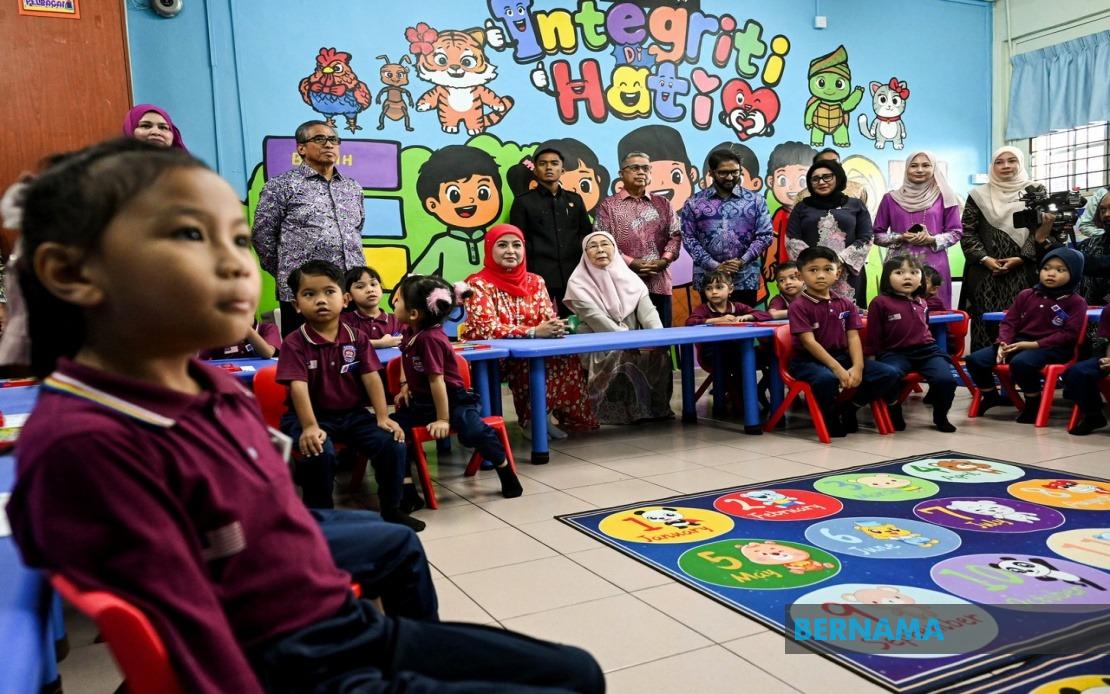
Queen Raja Zarith Sofiah officially inaugurated the Children's Integrity Module (MIKa) on August 27 at Tabika Perpaduan Taman Bukit Cheras in Kuala Lumpur, marking a significant milestone in Malaysia's commitment to cultivating moral character from the earliest stages of development. The ceremonial launch, attended by key government officials including National Unity Minister Datuk Aaron Ago Dagang and Chief Secretary to the Government Tan Sri Shamsul Azri Abu Bakar, underscores the government's conviction that foundational values must be woven into early childhood education rather than addressed retroactively through regulatory frameworks alone.
The Children's Integrity Module represents an ambitious pedagogical intervention developed collaboratively by the Malaysian Institute of Integrity (IIM) and a consortium of 35 early childhood education specialists. Conceived and refined since 2024, the curriculum framework seeks to operationalise abstract concepts of honesty, trustworthiness and responsibility into age-appropriate learning experiences for preschool-aged children. The programme has garnered institutional support spanning multiple ministries, government agencies, and higher education bodies, reflecting broad consensus that integrity formation constitutes a shared social responsibility extending beyond individual families.
During the launch ceremony, the Queen witnessed a live classroom simulation demonstrating how MIKa learning activities function in practice, subsequently engaging directly with pupils to observe their engagement with the module's pedagogical methods. This hands-on participation by the Queen symbolically affirmed the national significance attached to early childhood moral development and elevated public consciousness around the initiative's aspirations. The visible endorsement from the highest level of Malaysia's constitutional monarchy signals that integrity education commands priority status within the nation's developmental agenda.
Tan Sri Shamsul Azri articulated an expansive implementation roadmap projecting that by 2030, MIKa curriculum will permeate Malaysia's entire early childhood education ecosystem. This vision encompasses more than 31,000 registered childcare centres, kindergartens and preschools operating nationwide, potentially reaching hundreds of thousands of children during their most formative developmental window. Such comprehensive coverage would constitute one of Southeast Asia's most extensive standardised values-based curricula at the foundational education level, positioning Malaysia as a regional leader in institutionalised moral education.
The strategic rationale underpinning MIKa rests on a developmental psychology premise that ethical dispositions crystallise through repeated practice and environmental reinforcement during early childhood, rather than through exhortation or punitive mechanisms in later years. Tan Sri Shamsul Azri emphasised that integrity cannot be effectively imposed through legislative mandates or institutional rules alone; rather, it must be cultivated as habitual behaviour and internalised value orientation from infancy onwards. This represents a philosophical departure from enforcement-centric approaches toward preventive socialisation that aims to cultivate intrinsic commitment to ethical conduct.
The module's focus on the two-to-six age bracket reflects contemporary neuroscience findings regarding critical periods in moral cognitive development and the formation of prosocial behavioural templates. Early childhood educators and developmental specialists increasingly recognise that values integration during this window creates durable psychological foundations influencing ethical decision-making throughout subsequent life stages. By targeting this precise developmental window, MIKa attempts to intervene at the juncture where moral reasoning capacity first emerges and fundamental attitudes toward honesty and fairness take root.
For Malaysian policymakers, the MIKa initiative addresses longstanding institutional concerns regarding corruption and ethical deficits perceived within the civil service and broader society. Rather than pursuing reactive remediation of adult misconduct through investigation and prosecution, this programme embodies a preventive strategy predicated on the assumption that early values transmission reduces the incidence of integrity violations across subsequent generations. The approach reflects growing international recognition that sustainable anti-corruption efforts necessitate cultural transformation beginning in childhood rather than administrative enforcement mechanisms alone.
The involvement of parents as essential partners in the integrity formation process constitutes a critical dimension of MIKa's theory of change. Tan Sri Shamsul Azri highlighted that institutional curriculum must be reinforced through parental modelling and household-level practice, as young children acquire moral frameworks primarily through observing trusted adults' behaviour and receiving consistent messaging across contexts. This systemic approach recognising the interdependence between early childhood institutions and family environments distinguishes MIKa from narrowly school-based moral education interventions.
For Southeast Asian observers, Malaysia's systematic investment in childhood integrity education reflects emerging regional trends toward values-based curriculum development as a counterweight to purely academic or skills-focused pedagogies. Countries across the region increasingly acknowledge that economic competitiveness and institutional effectiveness depend upon populations internalising shared ethical norms rather than relying exclusively on external monitoring and enforcement. MIKa exemplifies this shift toward viewing moral development as integral to human capital formation and national capacity-building.
The projected nationwide rollout across more than 31,000 early childhood institutions presents substantial implementation challenges spanning teacher training, curriculum standardisation, resource allocation and sustained institutional commitment across multiple government cycles. Success requires not merely policy articulation but sustained investment in educator professional development, instructional materials and system-level coordination mechanisms. The involvement of diverse stakeholders—government agencies, academic institutions and civil society organisations—suggests recognition that such comprehensive implementation demands broad institutional commitment rather than siloed governmental effort.
Rajah Zarith Sofiah's prominent participation signals that the government intends to maintain high-level political visibility and symbolic commitment to the MIKa programme throughout its implementation trajectory. Royal patronage traditionally carries substantial weight within Malaysian institutional contexts, potentially facilitating resource mobilisation, interagency coordination and public receptiveness to the initiative. This ceremonial and symbolic dimension complements the programme's substantive pedagogical objectives.

