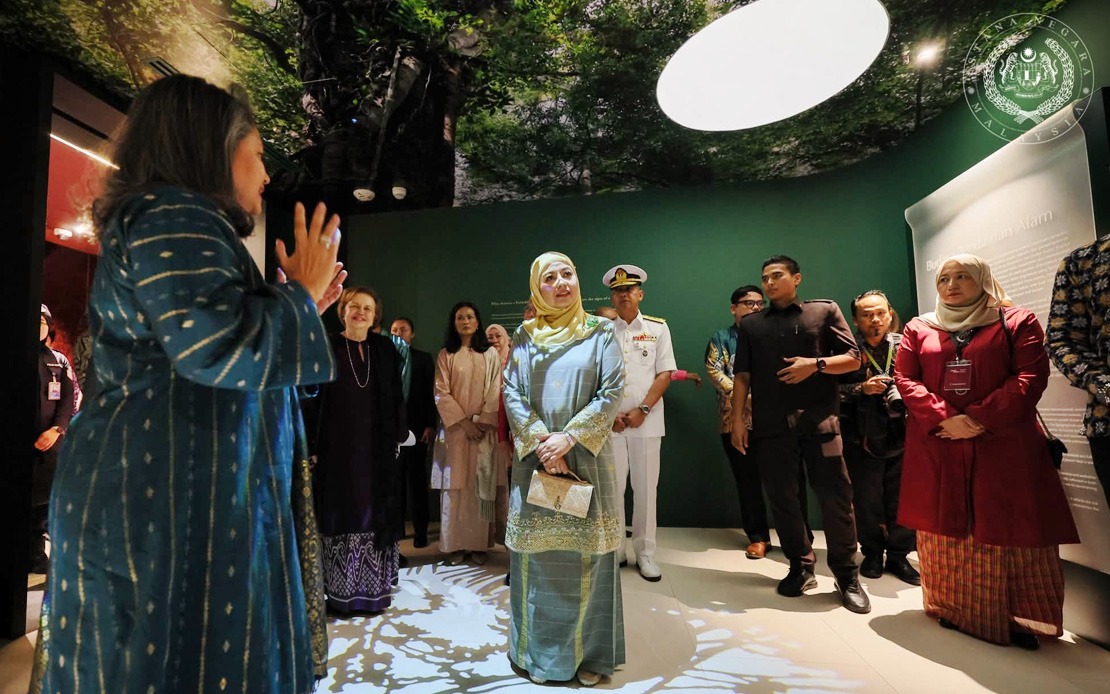
Her Majesty Raja Zarith Sofiah, Queen of Malaysia, inaugurated the Merdeka Textile Museum on August 21 at the Menara Merdeka Maybank complex in Kuala Lumpur, marking a significant milestone in the nation's efforts to safeguard its cultural legacy. The institution, established by PNB Merdeka Ventures Sdn Bhd—a subsidiary of Permodalan Nasional Berhad—represents a strategic investment in preserving and celebrating the rich textile traditions that have shaped Malay identity and society across generations.
The museum's foundation rests upon an exceptional personal collection assembled by the late Sharifah Azah Syed Mohammed Alsagoff, widely known as Azah Aziz. The widow of the late Prof Diraja Ungku Abdul Aziz Abdul Hamid and mother of the former Bank Negara Malaysia governor Tan Sri Dr Ungku Zeti Akhtar Aziz, Azah Aziz dedicated considerable attention to documenting and preserving textile artifacts of historical and cultural significance. Her family generously donated the entire collection to establish this museum, ensuring that decades of meticulous curation would serve the broader Malaysian public rather than remain confined to private holdings.
At the heart of the institution lies a carefully curated assembly comprising 240 distinct textile pieces and 69 items of traditional jewelry spanning multiple regional and temporal contexts. The collection encompasses songket sarongs, Limar Baju Kurung garments, and exquisitely embroidered Tekat Emas pieces—each representing specific techniques, materials, and cultural expressions particular to different communities within the Malay world. These artifacts serve as tangible records of craftsmanship, aesthetic values, and the social meanings embedded within traditional dress across the archipelago.
The Queen emphasized during the launch ceremony that heritage preservation constitutes a national responsibility transcending purely academic or museum-focused concerns. Raja Zarith Sofiah articulated the conviction that every society possesses cultural foundations requiring active recognition, protection, and transmission to succeeding generations. She underscored that cultural traditions function as lived expressions of collective identity and values, distinguishing communities and providing continuity amid broader social transformations. Her remarks, shared via Sultan Ibrahim Sultan Iskandar's official social media channels, framed textile heritage specifically as integral to understanding Malaysian society's character and historical development.
The Queen's statement identified the museum as more than a repository for historical objects, instead positioning it as a vital educational institution and source of inspirational engagement. She expressed hope that the facility would cultivate deeper appreciation among younger Malaysians for the country's cultural inheritance, addressing anxieties about heritage erosion in contemporary society. This concern reflects broader anxieties across Southeast Asia regarding the gradual displacement of traditional practices by globalized consumer culture and digital lifestyles, particularly among youth populations with limited exposure to pre-modern cultural contexts.
The Queen further directed attention toward the museum's particular significance for Malaysian women, both present and future. This emphasis acknowledges that textile production, design, and wearing constitute domains historically central to women's creative expression, economic participation, and social positioning within traditional societies. By elevating textile heritage to institutional prominence, the museum implicitly recognizes women's roles as custodians, creators, and transmitters of cultural knowledge—a dimension often marginalized in mainstream historical narratives dominated by political and military subject matter.
Structurally, the Merdeka Textile Museum spans eight distinct gallery spaces, each presumably organized thematically or geographically to facilitate visitor understanding of textile diversity and evolution. Beyond exhibition galleries, the institution incorporates specialized research and conservation infrastructure, including a dedicated study centre, conservation laboratory, fabric library, and textile knowledge centre. This comprehensive approach positions the museum as a living institution supporting scholarly inquiry and professional conservation work, rather than serving merely as a passive display space. Researchers, conservators, and students gain access to materials and expertise essential for ongoing investigation into textile traditions and their contemporary relevance.
The initiative carries particular resonance for Malaysia's ongoing cultural nation-building efforts, arriving amid heightened focus on safeguarding intangible heritage and traditional knowledge systems. The project demonstrates public institutional commitment to documenting and celebrating pre-colonial and early modern material cultures, territories often underrepresented in mainstream Malaysian museums historically oriented toward colonial, nationalist, or modernization narratives. By establishing dedicated space for textile heritage, the government signals recognition that understanding national identity requires engagement with aesthetic, technical, and social dimensions of traditional practice.
The event attracted senior government figures including Hannah Yeoh, Minister in the Prime Minister's Department responsible for Federal Territories, alongside Tan Sri Shamsul Azri Abu Bakar, Chief Secretary to the Government, and Raja Tan Sri Arshad Raja Tun Uda, PNB group chairman. The assembly of such high-ranking officials underscores governmental priority accorded the museum's establishment and broader cultural preservation agenda. Their participation signals that heritage conservation enjoys bipartisan support and institutional backing extending across ministerial portfolios and sovereign wealth management structures.
For regional audiences across Southeast Asia, the Merdeka Textile Museum exemplifies how postcolonial societies reclaim and institutionalize cultural narratives previously marginalized during colonial and early postcolonial periods. Similar initiatives across the region—from textile museums in Indonesia to weaving centers in Cambodia—reflect shared commitments to recentering indigenous aesthetic and technical knowledge systems within national consciousness. The museum's inauguration demonstrates that such efforts require sustained financial investment, curatorial expertise, and institutional infrastructure beyond individual enthusiasm or academic interest.
The museum's opening furthermore addresses practical conservation challenges confronting aging textile collections across the region. Proper storage conditions, expert handling, and public engagement mechanisms presented by institutional settings substantially improve survival prospects for fragile artifacts vulnerable to environmental degradation, pest damage, and inadvertent deterioration. By relocating the Azah Aziz collection into professionally managed facilities, the museum ensures that these irreplaceable cultural materials receive treatment appropriate to their historical and aesthetic significance.
Looking forward, the Merdeka Textile Museum positions itself to influence broader conversations about heritage, identity, and cultural value in contemporary Malaysia. Through educational programming, scholarly partnerships, and public engagement initiatives, the institution possesses potential to reshape how Malaysians understand relationships between textiles and identity, tradition and modernity, women's creativity and national history. The facility stands as testament to the conviction that safeguarding cultural heritage constitutes an investment in national cohesion and social understanding as meaningful as more conventional economic or infrastructure undertakings.

