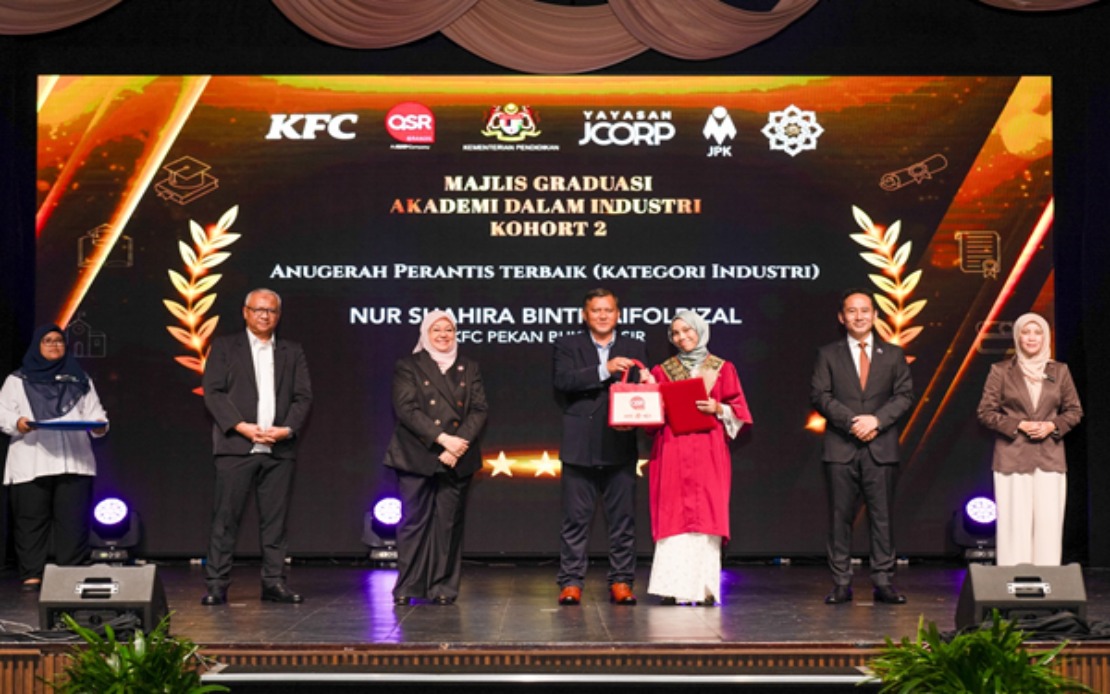
A partnership between QSR Brands, operating KFC Malaysia, and Yayasan JCorp has produced its second cohort of vocational graduates, with 37 young Malaysians completing the Apprenticeship-to-Diploma Intake (ADI) programme in Johor Bahru. This latest milestone underscores the growing momentum of industry-education collaboration in the country's quick-service restaurant sector, a field that employs tens of thousands nationwide yet has historically struggled to attract talent through formal vocational pathways.
The ADI programme represents a deliberate fusion of classroom instruction with operational workplace training, allowing participants to earn recognised qualifications while developing genuine competencies in food preparation, restaurant management, and customer service. All 37 graduates in this second cohort completed their training at KFC outlets in Johor Bahru, working within live commercial environments rather than simulated settings. This approach transforms vocational education from theoretical study into practical mastery, a distinction that resonates with educators and employers seeking to bridge the persistent skills gap affecting Malaysia's service sector.
Results from the graduating cohort demonstrate the effectiveness of the model's design. Students achieved a flawless 100 per cent pass rate in Vocational Stream Subjects (MPAK) examinations and in both the Malaysian Skills Certificate (SKM) Level 2 and Level 3 assessments, establishing a strong foundation for immediate employment. Additionally, 95 per cent of participants successfully completed the Sijil Pelajaran Malaysia (SPM) examination, indicating they maintained academic rigour alongside their vocational training. Each graduate received five distinct qualifications upon completion, including the Vocational Sijil Pelajaran Malaysia (SPMV), both SKM certifications, a programme completion certificate, and recognition from QSR Brands itself.
Zulkernai Fauzi, director of the Ministry of Education's Technical and Vocational Education and Training division, characterised the ADI programme as an exemplar for industry-education integration that merits expansion across Malaysia's vocational landscape. His endorsement carries weight given the government's ongoing push to increase TVET enrolment and improve outcomes. The official perspective emphasises that acquiring recognised certifications while simultaneously building real-world experience represents the trajectory Malaysia's technical education system should pursue. This validation from the education ministry suggests potential for replication in other sectors beyond quick-service restaurants.
The programme's growth trajectory indicates emerging confidence from both corporate sponsors and educational institutions. The inaugural intake, comprising 23 students, completed their training in March 2025, establishing proof of concept. The current cohort of 37 represents a 61 per cent expansion in participant numbers, bringing the cumulative total of ADI graduates trained by KFC Malaysia to 60 individuals. For a programme launched only in June 2023, this scaling demonstrates that the model has achieved sufficient credibility and operational stability to attract sustained corporate investment and government support.
Rozaini Mohd Sani, chairman of Yayasan JCorp, framed the initiative within the broader context of social mobility and opportunity creation for Malaysian youth. His statement highlighted that participation opens pathways for individuals regardless of socioeconomic background to build self-assurance and acquire practical competencies. This emphasis on inclusivity addresses a persistent concern within Malaysia's education landscape: ensuring that vocational pathways function as gateways to meaningful livelihoods rather than second-tier alternatives. By positioning the programme as a confidence-building exercise alongside skills development, the foundation's leadership signals commitment to treating vocational training as dignity-affirming rather than remedial.
Dr Sharifah Musainah Syed Alwi, chief human resources officer at QSR Brands, stressed that the programme's significance transcends ceremonial certificate presentation. Her framing emphasises that graduates emerge from the initiative having operated within actual restaurant environments, managed real operational challenges, and mastered industry-recognised competencies. This distinction matters substantially in labour markets where employers often perceive vocational graduates as possessing theoretical knowledge disconnected from workplace demands. By highlighting that participants have managed genuine operations, QSR Brands positions its graduates as immediately productive assets rather than requiring additional on-the-job orientation.
The curriculum structure reflects deliberate alignment with sector requirements. Participants underwent training according to the vocational syllabus for Fast Food Preparation and Service, ensuring that theoretical content mapped directly to industry needs. Beyond technical skills in food preparation, the programme exposed trainees to restaurant operations, customer service protocols, and workplace compliance standards. This comprehensive exposure to the ecosystem within which they will work addresses a critical shortcoming in some traditional vocational programmes that concentrate narrowly on technical skills while neglecting the organisational and interpersonal dimensions of employment.
The ADI programme originated as a strategic collaboration involving three key stakeholders: KFC Malaysia as the corporate training partner, the Department of Skills Development operating under the Ministry of Human Resources, and the Ministry of Education. This three-way alignment represents a rare achievement in Malaysia's vocational ecosystem, where coordination between education authorities, skills development bodies, and industry partners historically has been fragmented. The programme's positioning as the first initiative of its kind in the quick-service restaurant sector positions Malaysia as an early adopter of integrated apprenticeship models within the food service industry.
For Malaysian policymakers and sector observers, the ADI programme offers a template for addressing workforce development challenges across hospitality and related service industries. The model demonstrates that combining academic qualifications with practical workplace experience, delivered through partnerships between established corporations and educational institutions, can produce graduates meeting actual labour market demand. As Malaysia seeks to enhance its TVET system's relevance and appeal, programmes like ADI provide evidence that collaborative, outcomes-focused approaches can succeed where traditional institutional silos have struggled. The recognition of outstanding achievements through awards for best apprentices further reinforces professional standards and motivates excellence within participant cohorts.
Looking forward, the expansion of such programmes across additional corporate partners and sectors could substantially influence Malaysia's approach to preparing young people for employment. The demonstrated success with KFC Malaysia suggests that other major service-sector employers might adopt similar models, creating multiple pathways through which students can earn credentials while developing competence. For Yayasan JCorp and QSR Brands, the continued success of the ADI programme reinforces their positioning as employers genuinely invested in workforce development rather than merely seeking short-term labour solutions. This commitment carries implications for brand reputation and talent retention, as employees trained through rigorous partnerships with educational institutions often demonstrate higher engagement and loyalty than those recruited through conventional labour markets.

