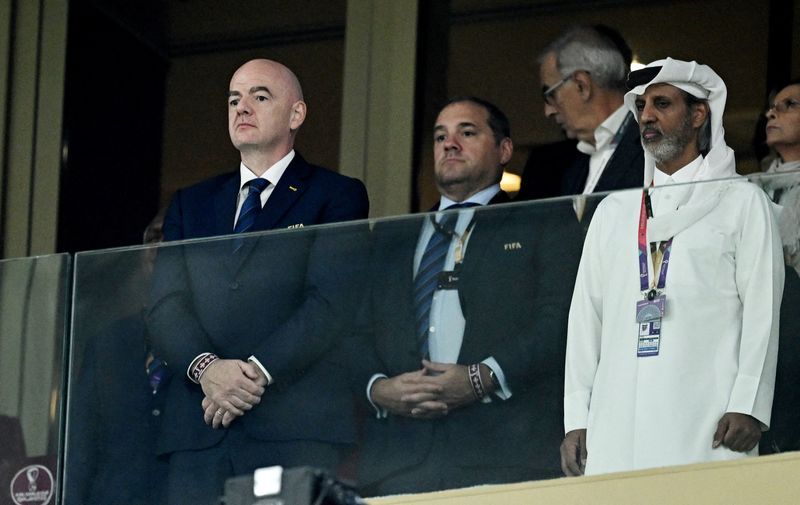
The Qatar Football Association has escalated a rare public dispute with the Asian Football Confederation over the body's decision to sign a joint statement criticising FIFA President Gianni Infantino, arguing that the AFC lacked authority to act without explicit member approval. In an unusually blunt third letter to AFC President Sheikh Salman bin Ebrahim Al-Khalifa, QFA President Hamad bin Khalifa Al-Thani contested the confederation's justification for the move, asserting that questions about procedural propriety remained fundamentally unaddressed despite the AFC's detailed rebuttal.
The row centres on whether AFC leadership possessed the mandate to attach the confederation's name to correspondence jointly issued with UEFA and CONCACAF that questioned Infantino's handling of a failed initiative to introduce private investment into the FIFA World Cup structure. The criticism struck at the heart of Infantino's governance as he prepares for reelection next year, with the signatories characterising his conduct as unilateral and insufficiently consultative with football's constituent bodies.
Al-Thani's written response, dated Wednesday and reviewed by Reuters, dismissed the AFC's explanatory letter as fundamentally evasive. He contended that by acknowledging no prior consultation occurred—whether with the AFC executive committee, individual member associations, or otherwise—Sheikh Salman had essentially admitted a procedural failure rather than refuted it. The distinction Al-Thani drew centred on substance versus legitimacy: even if the AFC's criticisms of the FIFA Forward Enterprise proposal proved accurate, this did not establish that the president possessed unilateral authority to commit all 47 members to a public position without their knowledge.
This procedural objection carries particular weight within Asian football governance, where formal authority structures matter significantly in managing relationships between a confederation and its diverse member states. The AFC's constitution appears to vest significant executive power in the president, yet Al-Thani's argument suggests these powers may be constrained when acting on matters of major policy consequence. By invoking his position as both a FIFA Council member and AFC executive committee member, Al-Thani stressed that he understood the governance frameworks at stake and rejected any suggestion his complaint was merely technical posturing.
The genesis of this dispute traces to Infantino's FIFA Forward Enterprise proposal, which was designed to attract private capital to World Cup operations but developed without formal consultation involving the six continental confederations. When the initiative faltered following widespread confederation criticism, Infantino faced unprecedented public opposition from football's regional power structures. Qatar, along with five other AFC members, had initially supported Infantino during this crisis, underscoring Doha's alignment with the FIFA president.
Sheikh Salman's response to Al-Thani, delivered Tuesday, took a notably assertive tone for a regional administrator addressing a member association. The AFC president insisted he possessed both the legal authority and institutional responsibility to defend Asian football's interests decisively, effectively telling Qatar to look beyond procedural minutiae to the substantive governance issues at stake. He noted that the AFC had previously issued public statements on matters of continental significance, including AFC backing for Qatar as host of the 2022 World Cup during a period of intense global scrutiny.
However, Al-Thani distinguished between those prior statements and the Infantino letter. He argued that previous AFC statements in support of the 2022 World Cup reflected the confederation's own institutional interest in the successful staging of a tournament in Asia, thereby serving a collective purpose. By contrast, the recent letter criticising Infantino appeared to advance a position on internal FIFA governance that transcended regional football interests and required explicit member authorisation before being issued collectively. This framing suggests Al-Thani views the two situations as fundamentally different in their scope and implications.
The public nature of this exchange itself represents a significant departure from how the AFC typically conducts sensitive business. The confederation has long preferred private negotiations and closed-door deliberations among member associations and executive committees, making this epistolary dispute unusual in its transparency and adversarial tone. The willingness of both parties to allow their correspondence to circulate within the football community signals that this disagreement involves questions both view as sufficiently important to risk exposing the AFC's internal tensions.
For observers of Asian football governance, the dispute illuminates broader questions about how regional confederations operate amid competing pressures from member associations and FIFA itself. The AFC's 47 members represent wildly different political systems, economic circumstances, and football development levels, yet they must somehow develop coherent institutional positions on major FIFA matters. Al-Thani's insistence on proper consultation reflects awareness that when confederation leaders make unilateral commitments on controversial issues, they risk alienating members who might have preferred a different stance.
The particular sensitivity around the Infantino letter stems from its role as a document of governance criticism rather than purely football administration. Member associations might reasonably desire input on questions that affect FIFA's internal power structures and financial arrangements, particularly given that the World Cup generates enormous revenue distributed throughout the football world. An AFC member that supported Infantino, such as Qatar, would naturally resent having its confederation join his critics without being consulted or given opportunity to dissent.
Sheikh Salman's assertion that he acted within his presidential remit carries weight under typical confederation governance models, yet Al-Thani's response suggests that extraordinary circumstances—such as issuing joint public criticism of the FIFA president himself—might demand a higher threshold of member consultation than routine administrative matters. This reflects a principle found in many institutional frameworks: while executive officers enjoy broad discretion for ordinary business, decisions with major strategic implications may require explicit authority from the broader membership.
With no immediate AFC response forthcoming to Al-Thani's latest letter, the immediate trajectory of this dispute remains unclear. However, the exchange has already succeeded in exposing cracks within Asian football's formal structures at a moment when the AFC's unity might matter for larger conversations about FIFA reform and governance. As regional confederations continue navigating their relationship with FIFA during a period of institutional turbulence, how they manage internal decision-making procedures will influence their credibility and cohesion.

