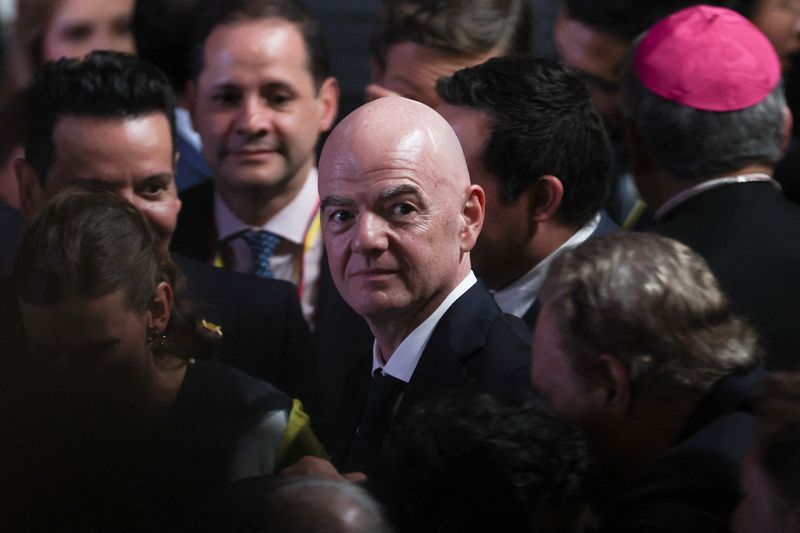
A significant fracture has opened within Asian football governance as Qatar publicly contested the Asian Football Confederation's participation in a multilateral assault on FIFA President Gianni Infantino, exposing deep disagreements over how the continental body should conduct its affairs. The dispute centres on whether the AFC possessed the mandate to attach its name to a collective denunciation alongside UEFA and CONCACAF, whose leadership accused Infantino of misconduct and demanded his resignation ahead of next year's FIFA election.
Qatar Football Association President Hamad bin Khalifa Al-Thani formally objected in a letter addressed to AFC President Sheikh Salman bin Ibrahim Al Khalifa, lodged immediately after the three continental confederations released their coordinated statement on Monday. In his correspondence, Al-Thani—himself an AFC Executive Committee member and FIFA Council representative—articulated a procedural grievance that strikes at the heart of institutional legitimacy within Asian football. He asserted that neither he personally nor the QFA received advance notification, preview drafts, or any opportunity to shape the content before the AFC issued the declaration purporting to represent all 47 member associations across the continent.
The timing of this challenge underscores the stakes involved in FIFA's ongoing leadership crisis. Infantino has weathered mounting pressure following his ultimately abandoned proposal to restructure World Cup financial arrangements by privatising certain commercial rights and selling a 20 percent stake to private investors, a manoeuvre designed to generate approximately $4.2 billion but which triggered extraordinary backlash from football's governing bodies. The AFC's decision to join UEFA and CONCACAF in calling for his departure represented an unusually coordinated show of force by football's continental powers, making Qatar's subsequent objection particularly noteworthy for its implications regarding consensus-building across Asian football.
Al-Thani's central argument pivots on the distinction between democratic procedure and unilateral action. He contended that establishing a collective position among the AFC's membership cannot be presumed or announced through declaration alone; rather, such consensus must be demonstrated through genuine consultation. His letter demanded clarification regarding what consultative processes—if any—had actually occurred and on what grounds the AFC considered itself authorised to speak with binding authority on behalf of its member associations. The AFC declined to respond when approached for comment, effectively leaving Al-Thani's challenge unanswered and heightening questions about the confederation's internal governance procedures.
This intervention exposes real institutional tensions within Asian soccer at precisely the moment when football's global leadership confronts its most serious internal challenge in years. The AFC, which encompasses the world's most populous nations and represents some of football's fastest-growing markets, finds itself internally divided over fundamental questions of authority and representation. Such divisions carry consequences not merely for FIFA's directorship but for how continental football bodies exercise power and legitimacy across their membership.
Notably, six heads of Arab national football associations—including Qatar and Morocco, set to co-host the 2030 World Cup—had publicly backed Infantino just days before the AFC's open letter, signalling that substantial portions of Asian football leadership do not necessarily align with the confederations' aggressive stance against the FIFA president. This Arab statement, released on Thursday, explicitly praised Infantino's efforts to develop football globally and expand opportunities across regions, drawing a stark contrast with UEFA's and CONCACAF's simultaneous denunciations. The signatories included several individuals wielding significant influence within FIFA's governance structures: beyond Al-Thani himself, the group encompassed Egypt's Hany Abo Rida, Morocco's Fouzi Lekjaa, and Mauritania's Ahmed Yahya—four of whom hold seats on the FIFA Council, the body responsible for electing FIFA's president.
This constellation of competing statements illustrates the fragmentation emerging within football's power structure as various constituencies position themselves ahead of Infantino's reelection campaign. The existence of simultaneous, contradictory public positions from within the same confederation demonstrates that no monolithic Asian consensus exists regarding the FIFA president's fitness for office. For Malaysian readers and Southeast Asian observers, the significance lies partly in understanding that regional football governance reflects deeper patterns of geopolitical alignment and economic interest that extend well beyond the sport itself. Qatar's assertiveness as a financial and football powerhouse in Asia frequently intersects with regional diplomacy, and its willingness to challenge the AFC's authority may resonate with other states questioning whether continental bodies adequately represent their particular interests.
The unfolding dispute raises questions about institutional design within continental football confederations. If the AFC's executive leadership can issue sweeping statements without prior consultation among its 47 members, does this constitute a deficit of democratic process? Conversely, if such statements require consensus from every member association, does this effectively paralyse the confederation's capacity to act? Al-Thani's intervention, while phrased in technical procedural language, implicitly challenges whether larger confederations can unilaterally determine collective positions without robust consultation mechanisms. For Southeast Asian football associations—most of whom hold considerably less leverage than Qatar or the Gulf states—this procedural question carries practical implications about their voice within continental governance.
The Infantino affair thus becomes a proxy for examining how Asian football conducts its internal affairs. The AFC's apparent decision to join a coordinated three-confederation assault without securing prior buy-in from its membership raises fundamental questions about whether such bodies serve as authentic representative forums or function instead as hierarchical structures where leadership circles exercise power relatively insulated from grassroots consultation. As Asian football's economic and sporting importance grows, with multiple nations now competing seriously at the highest international levels, these governance questions assume greater urgency. Qatar's challenge to the AFC may prove consequential not simply for determining FIFA's next president but for establishing precedents regarding how Asian football's governance should operate in an era when member associations increasingly possess independent leverage and distinct strategic interests.
The immediate outcome remains uncertain, with the AFC having offered no substantive response to Al-Thani's objections. However, the very existence of this formal challenge signals that Asia's football community cannot be treated as a monolithic bloc and that procedural legitimacy matters to influential stakeholders within the confederation. As the FIFA presidential election approaches, this internal Asian debate will likely intensify, with multiple member associations staking out positions that reflect their own institutional interests and their relationships with FIFA's leadership. For Southeast Asian football, still emerging from the AFC's shadow but gradually increasing its presence in continental and global competitions, these power struggles within Asia's football hierarchy will shape the institutional environment in which their own sporting ambitions develop.

