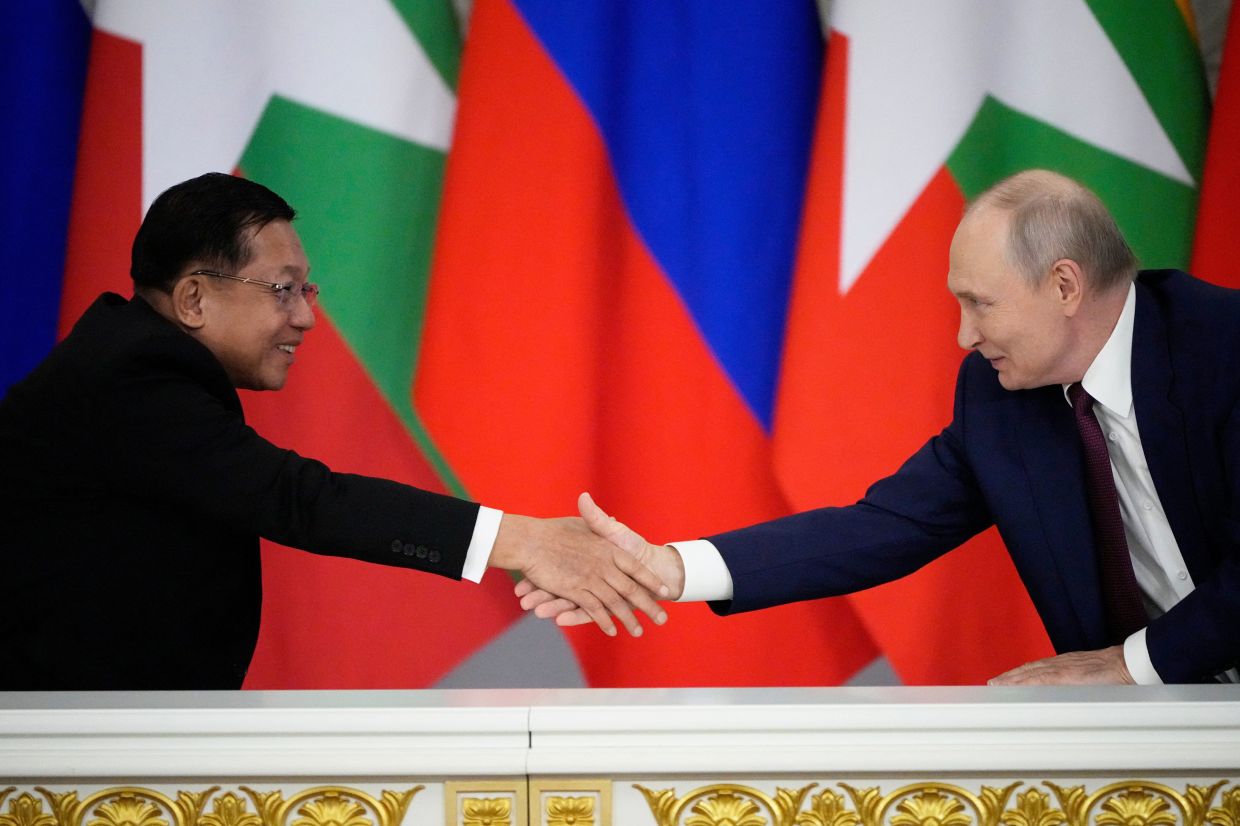
Russia is reinforcing its strategic partnership with Myanmar through expanded military coordination and ambitious energy projects, as Myanmar's military leadership seeks international validation following a disputed election that drew widespread criticism from Western democracies. The visit by Myanmar leader Min Aung Hlaing to the Kremlin on Tuesday marked his first trip to Moscow since formally assuming the presidency in his country's contested electoral process, and represented the pair's fourth meeting since Russia's 2022 invasion of Ukraine transformed the geopolitical landscape.
During their talks, Russian President Vladimir Putin characterised bilateral relations as having become "especially trusting" in recent years, a striking statement coming from Moscow as it faces sweeping Western sanctions and diplomatic isolation over its military aggression in Ukraine. The Russian leader's carefully chosen words underscore how closely the two authoritarian governments have aligned themselves, particularly as conventional international partnerships have fractured along ideological lines. For Myanmar's military junta, this embrace from Moscow provides crucial diplomatic cover at a moment when much of the developed world has turned its back on the regime.
The economic dimensions of the relationship appear particularly significant. Russia is pursuing major infrastructure investments in Myanmar's southern regions, with Putin indicating that Moscow seeks to construct both a power plant and an oil refinery whilst simultaneously developing hydrocarbon extraction capabilities. Beyond these headline projects, Russia has expressed keen interest in expanding liquefied natural gas exports to Myanmar, potentially creating long-term energy dependencies that would bind the two nations together. The scope of these initiatives reflects Russia's strategy to deepen economic ties with Asian partners willing to maintain relations despite Western pressure.
Nuclear technology cooperation represents another critical pillar of the Russia-Myanmar relationship. Myanmar is advancing plans with Russia's Rosatom State Corporation to develop a small nuclear power plant, marking the initial phase of incorporating nuclear capabilities into the country's broader development agenda across healthcare, agricultural production and industrial sectors. This dimension of cooperation carries particular strategic weight, as it provides Myanmar with access to advanced technology typically reserved for established international partners whilst giving Russia influence over Myanmar's long-term energy infrastructure planning.
The military dimension of the relationship has intensified substantially since Myanmar's 2021 coup d'état. Russia has functioned as a primary weapons supplier to Myanmar's military forces, with documented deliveries exceeding US$400 million since the coup according to a May 2023 United Nations report. Beyond hardware provision, the two nations have established what Putin described as "close military and military-technical cooperation," suggesting ongoing training exchanges, doctrine development and operational coordination that extends beyond simple procurement relationships. This military alignment becomes particularly noteworthy given Russia's own military vulnerabilities and resource constraints resulting from its Ukraine campaign.
Min Aung Hlaing's Moscow delegation was notably comprehensive, encompassing multiple ministerial officials and the head of Myanmar's Space Agency, an indication that the government views this visit as opportunity to broaden engagement across multiple sectors simultaneously. During his three-day stay, the Myanmar leader met with Prime Minister Mikhail Mishustin and Vyacheslav Volodin, speaker of Russia's lower house parliament, before participating in a Myanmar-Russia Business Forum designed to facilitate commercial connections between the two economies. This multi-layered approach to engagement demonstrates Myanmar's desire to institutionalise relationships across governmental and commercial spheres.
The Moscow meeting constitutes part of Min Aung Hlaing's broader diplomatic campaign to rehabilitate his government's international standing following the February election that international observers, including the United Nations and Western democracies, characterised as fundamentally flawed and lacking legitimacy. Since his parliamentary selection as president, he has undertaken an ambitious regional tour encompassing China, India, Laos and Thailand, whilst simultaneously attempting to improve relations with the United States and the Association of Southeast Asian Nations despite remaining intransigent on demands to release ousted civilian leader Aung San Suu Kyi.
Russia's positioning as a committed partner to Myanmar stands in sharp contrast to the strategic retreat most Western nations have undertaken. Whereas Washington, European capitals and many traditional partners have imposed sanctions and diplomatic restrictions targeting Myanmar's military leadership, Moscow has remained consistently supportive. Kremlin Security Council Secretary Sergei Shoigu's visit to Myanmar in February, merely weeks after the disputed election, signalled immediately that Russia would not permit international controversy to affect its relationship with Naypyidaw. This February visit carried particular symbolic weight as the first high-level foreign delegation to visit Myanmar following the election.
For Malaysia and the broader Southeast Asian region, the Russia-Myanmar alignment carries important implications for regional stability and balance. Myanmar's geographic location along Southeast Asian maritime routes and its border with multiple regional powers makes its strategic orientation consequential for the entire region. The deepening Russia-Myanmar nexus, combined with Myanmar's existing close ties to China, creates a configuration whereby Myanmar's international orientation has swung decisively away from Western-aligned frameworks and toward an authoritarian Eurasian axis. This shift potentially complicates ASEAN's efforts to maintain Myanmar as a functional member whilst simultaneously pressuring it toward democratic reforms and humanitarian accountability.
The emphasis that both Putin and Min Aung Hlaing are placing on economic cooperation suggests that beneath the traditional military and political dimensions, serious commercial calculations are driving the relationship forward. Myanmar possesses significant hydrocarbon reserves and sits strategically astride energy transit routes, making it potentially valuable to Russia's long-term diversification away from European markets. Conversely, Myanmar gains access to Russian technology, weaponry and markets at a moment when Western restrictions have significantly constrained its international options. This mutually beneficial commercial logic may ultimately prove more durable than any temporary diplomatic alignment.
Regional observers must carefully monitor whether this Moscow visit foreshadows expanded Russian military presence in Myanmar, potentially including port facilities or other strategic infrastructure that would extend Moscow's operational reach into Southeast Asia. The establishment of Russian-style military cooperation frameworks in Myanmar could eventually translate into broader geopolitical complications for regional nations attempting to maintain balanced relationships between competing great powers. The convergence of Russian and Myanmar interests represents an example of how isolated regimes facing international pressure increasingly gravitate toward alternative partnership models, reshaping regional alignments in ways that may challenge established Southeast Asian approaches to neutrality and non-alignment.

